

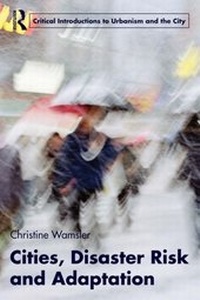
Cities, Disaster Risk and Adaptation
1st Edition
Published on 23. January 2014
352 pages
978-1-134-61495-0 (ISBN)
Description

Worldwide, disasters and climate change pose a serious risk to sustainable urban development, resulting in escalating human and economic costs. Consequently, city authorities and other urban actors face the challenge of integrating risk reduction and adaptation strategies into their work. However, related knowledge and expertise are still scarce and fragmented.
Cities, Disaster Risk and Adaptation explores ways in which resilient cities can be 'built' and sustainable urban transformations achieved. The book provides a comprehensive understanding of urban risk reduction and adaptation planning, exploring key theoretical concepts and analysing the complex interrelations between cities, disasters and climate change. Furthermore, it provides an overview of current risk reduction and adaptation approaches taken by both city authorities and city dwellers from diverse contexts in low, middle and high income nations. Finally, the book offers a planning framework for reducing and adapting to risk in urban areas by expanding on pre-existing positive actions and addressing current shortfalls in theory and practice. The importance of a distributed urban governance system, in which institutions' and citizens' adaptive capacities can support and complement each other, is highlighted.
This book takes a holistic approach; it integrates perspectives and practice from risk reduction and climate change adaptation based on a specific urban viewpoint. The text is richly supplemented with boxed case studies written by renowned academics and practitioners in the field and 'test yourself' scenarios that integrate theory into practice. Each chapter contains learning objectives, end of chapter questions, suggested further reading and web resources, as well as a wealth of tables and figures. This book is essential reading for undergraduate and postgraduate students of geography, urban studies and planning, architecture, environmental studies, international development, sociology and sustainability studies.
Cities, Disaster Risk and Adaptation explores ways in which resilient cities can be 'built' and sustainable urban transformations achieved. The book provides a comprehensive understanding of urban risk reduction and adaptation planning, exploring key theoretical concepts and analysing the complex interrelations between cities, disasters and climate change. Furthermore, it provides an overview of current risk reduction and adaptation approaches taken by both city authorities and city dwellers from diverse contexts in low, middle and high income nations. Finally, the book offers a planning framework for reducing and adapting to risk in urban areas by expanding on pre-existing positive actions and addressing current shortfalls in theory and practice. The importance of a distributed urban governance system, in which institutions' and citizens' adaptive capacities can support and complement each other, is highlighted.
This book takes a holistic approach; it integrates perspectives and practice from risk reduction and climate change adaptation based on a specific urban viewpoint. The text is richly supplemented with boxed case studies written by renowned academics and practitioners in the field and 'test yourself' scenarios that integrate theory into practice. Each chapter contains learning objectives, end of chapter questions, suggested further reading and web resources, as well as a wealth of tables and figures. This book is essential reading for undergraduate and postgraduate students of geography, urban studies and planning, architecture, environmental studies, international development, sociology and sustainability studies.
Reviews / Votes
"Christine Wamsler has produced what can only be described as an all-encompassing book on urban sustainability, risk and disaster management, and urban resilience." - Urban Studies, Mario Pole`se, University of Quebec, Canada"A very timely and valuable contribution to the literature for urban planners, city governments and all those who wish to understand the interactions between urbanization, disaster risk and climate change, and explore innovative ways and means of action." - David Satterthwaite, Senior Fellow at the International Institute of Environment and Development, coordinating lead author on the IPCC Fifth Assessment Report
"I congratulate the author on this important book which bridges the gap between theory, rhetoric and the daily efforts to manage disasters and reduce risk in urban areas worldwide. It develops new thinking, offers practical ideas, and lessens the time-consuming task of searching for advice on what does or does not work. Its usefulness extends far beyond its directly intended readership." - Margareta Wahlstroem, United Nations Special Representative of the Secretary-General for Disaster Risk Reduction
More details
Series
Language
English
Place of publication
London
United Kingdom
Publishing group
Taylor & Francis Ltd
Target group
College/higher education
Illustrations
28 s/w Abbildungen, 30 s/w Tabellen, 13 s/w Photographien bzw. Rasterbilder, 15 s/w Zeichnungen
30 Tables, black and white; 15 Line drawings, black and white; 13 Halftones, black and white; 28 Illustrations, black and white
File size
4,91 MB
ISBN-13
978-1-134-61495-0 (9781134614950)
Copyright in bibliographic data and cover images is held by Nielsen Book Services Limited or by the publishers or by their respective licensors: all rights reserved.
Schweitzer Classification
Other editions
Additional editions
Christine Wamsler
Cities, Disaster Risk and Adaptation
Book
11/2013
1st Edition
Routledge
€232.40
Shipment within 15-20 days
Christine Wamsler
Cities, Disaster Risk and Adaptation
Book
11/2013
1st Edition
Routledge
€83.20
Shipment within 15-20 days
Person
Christine Wamsler is Associate Professor at Lund University Centre for Sustainability Studies (LUCSUS), Associate of Lund University Centre for Risk Assessment and Management (LUCRAM), Sweden, and Honorary Fellow at the Global Urban Research Centre (GURC) and the Institute for Development Policy and Management (IDPM) of the University of Manchester, UK. She is also part of the personnel pool of risk reduction experts of the Swedish Civil Contingencies Agency (MSB). In addition, Christine has been working as a consultant for diff erent organizations, such as the International Institute for Applied Systems Analysis (IIASA), the German Society for International Cooperation (GIZ), the German, Austrian and Belgium Red Cross, the Swedish International Development Cooperation Agency (Sida), the Swedish Organization for Individual Relief (SOIR/IM) and various local NGOs. Places where she has worked and conducted research include Brazil, Chile, Colombia, El Salvador, Germany, Guatemala, India, Kosovo, Mexico, Peru, the Philippines, Sweden, Tanzania, Togo and the UK. Christine's?research interests are in sustainable city development and focus on disaster risk reduction, climate change adaptation and urban resilience.
Content
Introduction 1. Setting the Scene Part I: Theoretical Framework 2. Sorting out the Conceptual 'Jungle' Associated with Urban Risk Reduction and Adaptation 3. The City-disasters Nexus: A Two-way Relationship Part II: Current Practice 4. City Authorities' Approaches to Urban Risk Reduction and Adaptation 5. Citizens' Own Ways to Reduce and Adapt to Urban Risk Part III: Moving Forward 6. Advancing Sustainable Urban Risk Governance and Transformation 7. Concluding Remarks
