

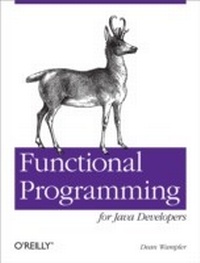
Functional Programming for Java Developers
Tools for Better Concurrency, Abstraction, and Agility
1st Edition
Published on 22. July 2011
90 pages
978-1-4493-1544-3 (ISBN)
Description

Software development today is embracing functional programming (FP), whether it's for writing concurrent programs or for managing Big Data. Where does that leave Java developers? This concise book offers a pragmatic, approachable introduction to FP for Java developers or anyone who uses an object-oriented language.Dean Wampler, Java expert and author of Programming Scala (O'Reilly), shows you how to apply FP principles such as immutability, avoidance of side-effects, and higher-order functions to your Java code. Each chapter provides exercises to help you practice what you've learned. Once you grasp the benefits of functional programming, youll discover that it improves all of the code you write.Learn basic FP principles and apply them to object-oriented programmingDiscover how FP is more concise and modular than OOPGet useful FP lessons for your Java type designsuch as avoiding nullsDesign data structures and algorithms using functional programming principlesWrite concurrent programs using the Actor model and software transactional memoryUse functional libraries and frameworks for Javaand learn where to go next to deepen your functional programming skills
More details
Other editions
Additional editions
Dean Wampler
Functional Programming for Java Developers
Tools for Better Concurrency, Abstraction, and Agility
Book
08/2011
O'Reilly
€22.00
Article not available at the moment
Content
- Intro
- Table of Contents
- Preface
- Welcome to Functional Programming for Java Developers
- Conventions Used in This Book
- Using the Code Examples
- Getting the Code Examples
- Safari® Books Online
- How to Contact Us
- Acknowledgments
- Chapter 1. Why Functional Programming?
- I Have to Be Good at Writing Concurrent Programs
- Most Programs Are Just Data Management Problems
- Functional Programming Is More Modular
- I Have to Work Faster and Faster
- Functional Programming Is a Return to Simplicity
- Chapter 2. What Is Functional Programming?
- The Basic Principles of Functional Programming
- Avoiding Mutable State
- Functions as First-Class Values
- Lambdas and Closures
- Higher-Order Functions
- Side-Effect-Free Functions
- Recursion
- Lazy vs. Eager Evaluation
- Declarative vs. Imperative Programming
- Designing Types
- What About Nulls?
- Algebraic Data Types and Abstract Data Types
- Exercises
- Chapter 3. Data Structures and Algorithms
- Lists
- Maps
- Combinator Functions: The Collection Power Tools
- Persistent Data Structures
- Some Final Thoughts on Data Structures and Algorithms
- Exercises
- Chapter 4. Functional Concurrency
- The Actor Model
- Software Transactional Memory
- Exercises
- Chapter 5. Better Object-Oriented Programming
- Imperative, Mutable Code
- The Liskov Substitution Principle
- More on Design Patterns
- Pattern Matching
- What Makes a Good Type?
- Rethinking Object-Oriented Middleware
- Exercises
- Chapter 6. Where to Go From Here
- Functional Tools for Java
- A Recap
- Exercises
- Appendix. References
- Glossary
