

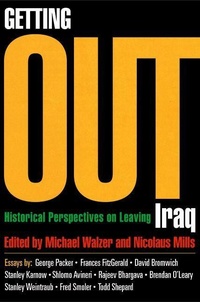
Getting Out
Historical Perspectives on Leaving Iraq
1st Edition
Published on 6. July 2011
168 pages
978-0-8122-0590-9 (ISBN)
Description

Eventually every conqueror, every imperial power, every occupying army gets out. Why do they decide to leave? And how do political and military leaders manage withdrawal? Do they take with them those who might be at risk if left behind? What are the immediate consequences of departure? For Michael Walzer and Nicolaus Mills, now is the time to ask those questions about exiting-and to worry specifically about the difficulties certain to arise as we leave-Iraq.
Getting Out approaches these issues in two sections. The first, entitled "Lessons Learned," examines seven historical cases of how and how not to withdraw: Britain's departure from the American colonies and from India, the French withdrawal from Algeria, Israel's unilateral withdrawal from Gaza, and the U.S. decision to leave (or not leave) the Philippines, Korea, and Vietnam. These cases offer a comparative perspective and an opportunity to learn from the history of political and military retreats.
The second section, "Exiting Iraq," begins with an introduction to just how the United States got into Iraq and continues with an examination of how the U.S. might leave from a diversity of voices, ranging from those who believe that the Iraq war has produced no real good to those who hope for a decent ending. In addition to essays by volume editors Walzer and Mills, Getting Out features contributions by Shlomo Avineri, Rajeev Bhargava, David Bromwich, Frances FitzGerald, Stanley Karnow, Brendan O'Leary, George Packer, Todd Shepard, Fred Smoler, and Stanley Weintraub.
Getting Out approaches these issues in two sections. The first, entitled "Lessons Learned," examines seven historical cases of how and how not to withdraw: Britain's departure from the American colonies and from India, the French withdrawal from Algeria, Israel's unilateral withdrawal from Gaza, and the U.S. decision to leave (or not leave) the Philippines, Korea, and Vietnam. These cases offer a comparative perspective and an opportunity to learn from the history of political and military retreats.
The second section, "Exiting Iraq," begins with an introduction to just how the United States got into Iraq and continues with an examination of how the U.S. might leave from a diversity of voices, ranging from those who believe that the Iraq war has produced no real good to those who hope for a decent ending. In addition to essays by volume editors Walzer and Mills, Getting Out features contributions by Shlomo Avineri, Rajeev Bhargava, David Bromwich, Frances FitzGerald, Stanley Karnow, Brendan O'Leary, George Packer, Todd Shepard, Fred Smoler, and Stanley Weintraub.
Reviews / Votes
"An arresting, morally serious book, of the sort that readers have come to expect from the precincts of Dissent." (Sean Wilentz, author of The Rise of American Democracy: Jackson to Lincoln) "From Stanley Weintraub's crisp essay on Great Britain's withdrawal from the Colonies after its defeat in the American Revolutionary War to studies of much more recent disengagements, the contributions offer a variety of useful and stimulating perspectives on the complex problems involved in orderly withdrawals." (Walter Russell Mead, Foreign Affairs) "This admirable book makes it plain that one reason why military occupations are, in general, a bad idea, is that exit ramps get blocked and horrors ensue. It is morally evident that, for the occupying power, there is no end to responsibilities, which begin even in nightmares. This is not a book that offers simple recipes for Iraq or Afghanistan. But people of all persuasions should read it to deepen their awareness of the moral imperatives." (Todd Gitlin, Columbia University) "This collection will appeal to a broad audience. Excellent at dealing with a complicated topic both historically and in terms of the current situation in Iraq, it will appeal to anyone interested in the fate of our world today." (Library Journal)More details
Language
English
Place of publication
Pennsylvania
United States
Target group
College/higher education
File size
0,97 MB
ISBN-13
978-0-8122-0590-9 (9780812205909)
Copyright in bibliographic data and cover images is held by Nielsen Book Services Limited or by the publishers or by their respective licensors: all rights reserved.
Schweitzer Classification
Other editions
Additional editions
Book
09/2009
University of Pennsylvania Press
€37.50
Shipment within 10-20 days
Persons
Michael Walzer is Professor Emeritus in the School of Social Science at the Institute for Advanced Study in Princeton and editor of Dissent. He is the author of many books, including Just and Unjust Wars and, most recently, Thinking Politically: Essays in Political Theory. Nicolaus Mills is Professor of Literature and American Studies at Sarah Lawrence College. A long-time contributor to Dissent magazine, his most recent book is Winning the Peace: The Marshall Plan and America's Coming of Age as a Superpower.
Content
Introduction
-Michael Walzer
LESSONS FROM THE PAST
1. No Exit but Victory: Britain and the American Colonies
-Stanley Weintraub
2. America and the Philippines: The Graceful Withdrawal
-Stanley Karnow
3. India and Britain: The Consequences of Leaving Too Soon
-Rajeev Bhargava
4. The Surprising Success: The United States and Korea
-Fred Smoler
5. France and Algeria: Claim Victory and Au Revoir
-Todd Shepard
6. Vietnam and the United States: The Price of Intransigence
-Frances FitzGerald
7. The Gates of Gaza and the Limits of Power: Israel and Gaza
-Shlomo Avineri
GETTING IN/GETTING OUT
8. 9/11 and the Road to Iraq
-Nicolaus Mills
9. The Persistence of Empire
-David Bromwich
10. Departing Responsibly
-Brendan O'Leary
11. It Isn't Over
-George Packer
List of Contributors
Index
Acknowledgments
-Michael Walzer
LESSONS FROM THE PAST
1. No Exit but Victory: Britain and the American Colonies
-Stanley Weintraub
2. America and the Philippines: The Graceful Withdrawal
-Stanley Karnow
3. India and Britain: The Consequences of Leaving Too Soon
-Rajeev Bhargava
4. The Surprising Success: The United States and Korea
-Fred Smoler
5. France and Algeria: Claim Victory and Au Revoir
-Todd Shepard
6. Vietnam and the United States: The Price of Intransigence
-Frances FitzGerald
7. The Gates of Gaza and the Limits of Power: Israel and Gaza
-Shlomo Avineri
GETTING IN/GETTING OUT
8. 9/11 and the Road to Iraq
-Nicolaus Mills
9. The Persistence of Empire
-David Bromwich
10. Departing Responsibly
-Brendan O'Leary
11. It Isn't Over
-George Packer
List of Contributors
Index
Acknowledgments
