

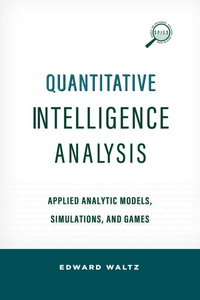
Quantitative Intelligence Analysis
Applied Analytic Models, Simulations, and Games
1st Edition
Published on 16. October 2014
314 pages
978-1-4422-3587-8 (ISBN)
Description

Quantitative Intelligence Analysis describes the model-based method of intelligence analysis that represents the analyst's mental models of a subject, as well as the analyst's reasoning process exposing what the analyst believes about the subject, and how they arrived at those beliefs and converged on analytic judgments. It includes:
Specific methods of explicitly representing the analyst's mental models as computational models;dynamic simulations and interactive analytic games;the structure of an analyst's mental model and the theoretical basis for capturing and representing the tacit knowledge of these models explicitly as computational models detailed description of the use of these models in rigorous, structured analysis of difficult targets;model illustrations and simulation descriptions;the role of models in support of collection and operations;case studies that illustrate a wide range of intelligence problems;And a recommended curriculum for technical analysts.
Specific methods of explicitly representing the analyst's mental models as computational models;dynamic simulations and interactive analytic games;the structure of an analyst's mental model and the theoretical basis for capturing and representing the tacit knowledge of these models explicitly as computational models detailed description of the use of these models in rigorous, structured analysis of difficult targets;model illustrations and simulation descriptions;the role of models in support of collection and operations;case studies that illustrate a wide range of intelligence problems;And a recommended curriculum for technical analysts.
More details
Series
Edition
1. Auflage
Language
English
Place of publication
New York
United States
Publishing group
Bloomsbury Publishing Plc
Illustrations
66 b/w illustrations;33 tables
ISBN-13
978-1-4422-3587-8 (9781442235878)
Copyright in bibliographic data and cover images is held by Nielsen Book Services Limited or by the publishers or by their respective licensors: all rights reserved.
Schweitzer Classification
Other editions
Additional editions

Book
07/2017
Rowman & Littlefield Publishers
€46.30
Shipment within 10-20 days
Book
10/2014
Rowman & Littlefield Publishers
€136.67
Shipment within 10-20 days
Person
Edward (Ed) Waltz is Distinguished Member of the Technical Staff at Virginia Tech.
Content
- Quantitative Intelligence Analysis
- Table of Contents
- List of Figures
- List of Tables
- Foreword
- Preface
- Chapter 1 The Intelligence Analyst and Synthesis
- Models in Intelligence and Policy
- The Tools of Synthesis
- The Organization of this Book
- Chapter 2 Modeling in Intelligence
- Using Models to Understand Systems
- Using Models to Enable Analytic Collaboration
- Using Models to Explain Analytic Judgment
- Challenges to the Use of Models
- Determinism, Causality, and Prediction
- Case Study: Understanding Terrorist Organization
- Summary
- Chapter 3 Mental Models in Intelligence Analysis
- Models of Thinking
- Mental Models as Artifacts of Thinking
- Intelligence Analysts and Their Mental Models
- Chapter 4 Translating Mental Models to Explicit Sharable Models
- Framing and Representing an Intelligence Problem
- Tacit-Explicit Capture and Interaction
- The Tacit-Explicit Translation Process
- Understanding Mental Models and Cognitive Processes to Enhance Analytic Rigor
- Chapter 5 Explicit Models in Structured and Quantitative Analysis
- Structured and Quantitative Analysis
- First, a Caution
- Explicit Models in the Analytic Process
- The Explicit Modeling Process
- Case Study: An Example of the Explicit Modeling Process
- Summary
- Chapter 6 Explicit Models of Analytic Thinking
- Expressing Analytic Thought in Explicit Models
- Modeling the Concepts that Precede Analysis
- Modeling in Counterfactual Reasoning
- Modeling in Convergent Reasoning from Evidence to Inference
- Modeling Comparative Reasoning about Alternative Hypotheses
- Integrating Target and Analysis Models
- Chapter 7 Explicit Models of the Targets of Analysis
- Models of Data and Models of Theory
- Models and Model Prediction in Intelligence
- Abstracting Real Target Systems
- The Validity of Models
- Descriptive Models in Analysis
- Exploratory and Predictive Simulations in Analysis
- Case Study: Simulating a Physical System
- Simulating Human Systems
- Case Study: Civilian Population Responses to Sanctions
- Hybrid Modeling Socio-Technical Systems
- Case Study: Model-based support to Planning: Joint Intelligence Preparation of the Operational Environment (JIPOE)
- Methodology and Technology Challenges
- Chapter 8 Analytic Wargaming in Intelligence
- Principles of Gaming and Categories of Games
- Analytic Games in Intelligence
- The Game Process
- Incorporating Computational Models and Simulations in Analytic Games
- Case Study: Conducting Analytic Games to Support Intelligence
- CRYSTALLINE
- VERTIGO
- Analytic Games to Enhance Work-Group Effectiveness
- Chapter 9 Model-Based Support to Collection and Operations
- Model-Based Approaches to ISR Collection Support for Physical Target Systems
- Model-Based Approaches to Support Activity-Based Intelligence (ABI) for Human Target Systems
- Case Study: Model-Based Collection Support
- Hypothesis Testing Analytic Method
- The Future Role of Models and Simulations in Joint Intelligence Operations
- Chapter 10 Implementing the Discipline of Explicit Quantitative Modeling and Analytic Gaming
- Implementing Modeling Capabilities
- Teaching Modeling, Gaming, and Simulation
- Partnering with the DoD Modeling, Gaming, and Simulation Community
- Appendix A-Glossary
- Appendix B-A Course in Modeling, Simulation, and Analytic Gaming for Intelligence
- Index
- About the Author
