

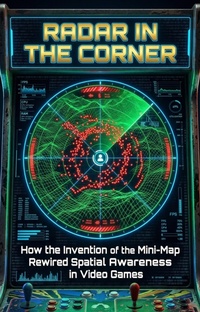
Radar in the Corner
How the Invention of the Mini-Map Rewired Spatial Awareness in Video Games
1st Edition
Published on 11. March 2026
188 pages
978-3-565-31417-1 (ISBN)
Description

In the early days of video games, spatial awareness was limited to exactly what was on the screen. If an enemy was off-screen, it didn't exist until it killed you. Then, arcade classics like 'Defender' introduced a revolutionary concept: a crude, glowing radar at the top of the screen. This tiny UI element, which evolved into the modern mini-map, fundamentally changed how human beings process virtual space and navigate digital worlds.
This deep dive into game design architecture explores the psychological impact of the mini-map. It details how real-time strategy games perfected the concept, allowing players to manage massive armies across continents. However, the book also dissects the dark side of this invention: how modern open-world games became so reliant on the mini-map that players stopped looking at the beautifully crafted 3D environments, instead playing the entire game by staring at a small circle of icons in the corner.
Discover the friction between convenient navigation and true immersion. Understanding the evolution of the mini-map reveals the delicate psychological balance game developers must strike when guiding players through artificial worlds.
More details
Person
Author
