

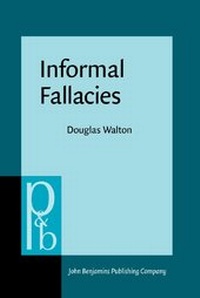
Informal Fallacies
Towards a Theory of Argument of Criticisms
1st Edition
Published on 1. January 1987
X, 338 pages
978-90-272-7890-6 (ISBN)
Description

The basic question of this monograph is: how should we go about judging arguments to be reasonable or unreasonable? Our concern will be with argument in a broad sense, with realistic arguments in natural language. The basic object will be to engage in a normative study of determining what factors, standards, or procedures should be adopted or appealed to in evaluating an argument as "good," "not-so-good," "open to criticism," "fallacious," and so forth. Hence our primary concern will be with the problems of how to criticize an argument, and when a criticism is reasonably justified.
More details
Other editions
Additional editions
Douglas N. Walton
Informal Fallacies
Book
01/1987
John Benjamins Publishing Co
€121.90
Shipment within 10-15 days
Content
- INFORMAL FALLACIES Towards a Theory of Argument Criticisms
- Editorial page
- Title page
- Copyright page
- Acknowledgements
- Table of contents
- CHAPTER 1: A NEW MODEL OF ARGUMENT
- 1. Introduction to the Fallacies
- 2. Some More Fallacies
- 3. Fallacies Combined in Realistic Dialogues
- 4. What is an Argument?
- 5. Criticism as Challenge and Response
- 6. Basic Categories of Argument Study
- NOTES
- CHAPTER TWO: HOT RHETORIC AND ARGUMENT
- 1. Appeals to Popular Sentiment
- 2. Appeals to Force
- 3. Appeals to Pity
- 4. Overly Personal Argumentation
- 5. The Rhetorical Debate
- 6. Case Study: Parliamentary Debate
- 1. THE ECONOMY MEASURES TO MAINTAIN EMPLOYMENT
- 2. BANKS AND BANKING
- 7. Conclusion
- NOTES
- CHAPTER 3: THE LOGIC OF PROPOSITIONS
- 1. Deductive Validity
- 2. Formal Logic
- 3. Classical Propositional Calculus
- 4. Applying Deductive Logic to Arguments
- 5. Invalidity and Fallaciousness
- 6. Relevance and Validit
- 7. Subject-Matter Relatedness
- 8. Relatedness Logic
- 9. Semantics and Pragmatics
- 10. What is a Fallacy?
- NOTES
- CHAPTER 4: LOGICAL DIALOGUE-GAMES
- 1. Different Approaches to Formal Dialogues
- 2. The Ad Ignorantiam Fallacy
- 3. Fallacies of Question-Asking
- 4. The Fallacy of Many Questions
- 5. Demanding Direct Answers to Questions
- 6. Misconception of Refutation
- 7. Case Studies of Political Debates
- 8. A Game with Dark-Side Commitments
- NOTES
- CHAPTER 5: ENTHYMEMES
- 1. The Tradition of Enthymemes
- 2. The Objectives of Dialogue
- 3. Veiled Commitment-Sets
- 4. Strategy and Plausibility
- 5. The Problem Resolved
- 6. Order of the Premisses
- 7. Multiple Premisses in Complex Arguments
- NOTE
- CHAPTER 6: LONGER SEQUENCES OF ARGUMENTATION
- 1. Sequences of Argumentation
- 2. Graphs of Arguments
- 3. Case Study: Argument on Sex Education
- 4. Case Study: Circular Argumentation
- 5. Plausibility Conditions on Arguments
- 6. The Missing Links
- 7. Conclusions on Circular Arguments
- NOTES
- CHAPTER 7: FALLACIOUS ARGUMENTS FROM AUTHORITY
- 1. How Appeals to Authority Can Go Wrong
- 2. Plausible Argument
- 3. Where Experts Disagree
- 4. Expertise and Legal Dialogue
- 5. Dialogue and Expertise
- 6. Conclusions
- NOTE
- CHAPTER 8: VARIOUS FALLACIES
- 1. Inductive Fallacies
- 2. Deductive and Inductive Arguments
- 3. Post Hoc Arguments
- 4. Slippery Slope
- 5. Equivocation
- 6. Amphiboly
- 7. Composition and Division
- CHAPTER 9: ARGUMENTS AGAINST THE PERSON
- 1. Poisoning the Well
- 2. The Sportsman's Rejoinder
- 3. Evaluating Ad Hominem Disputations
- 4. Four Types of Circumstantial Ad Hominem
- 5. Rhetorical Context of Ad Hominem Attacks
- 6. Positional Defensibility
- 7. Conclusion
- NOTES
- CHAPTER 10: EQUIVOCATION
- 1. What is Equivocation?
- 2. Vagueness and Criticisms of Equivocality
- 3. The Problem of Subtle Equivocations
- 4. Deep Deception and Equivocal Dialogue
- 5. Many-Valued Logic for Equivocators
- 6. Priest's System LP
- 7. Applying LP to the Fallacy of Equivocation
- 8. R-Mingle as a Logic for Equivocators
- 9. RM and Equivocation
- 10. Conclusions
- NOTES
- CHAPTER 11: INFORMAL LOGIC AS A DISCIPLINE
- 1. The Role of Formal Logic
- 2. Dialectic as a Theory of Argument
- 3. Function of Why-Questions
- 4. Subject-Specific Nature of Arguments
- 5. Case Studies on Circular Reasoning
- 6. Conversational Pragmatics
- 7. Pedagogical Directions for Informal Logic
- NOTES
- BIBLIOGRAPHY
- INDEX OF NAMES
- GENERAL INDEX
