

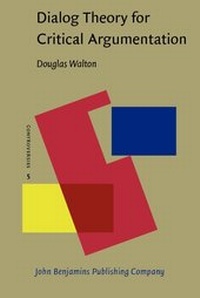
Dialog Theory for Critical Argumentation
1st Edition
Published on 19. September 2007
XVIII, 308 pages
978-90-272-9200-1 (ISBN)
Description

Because of the need to devise systems for electronic communication on the internet, multi-agent computing is moving to a model of communication as a structured conversation between rational agents. For example, in multi-agent systems, an electronic agent searches around the internet, and collects certain kinds of information by asking questions to other agents. Such agents also reason with each other when they engage in negotiation and persuasion. It is shown in this book that critical argumentation is best represented in this framework by the model of reasoned argument called a dialog, in which two or more parties engage in a polite and orderly exchange with each other according to rules governed by conversation policies. In such dialog argumentation, the two parties reason together by taking turns asking questions, offering replies, and offering reasons to support a claim. They try to settle their disagreements by an orderly conversational exchange that is partly adversarial and partly collaborative.
More details
Other editions
Additional editions
Douglas N. Walton
Dialog Theory for Critical Argumentation
Book
09/2007
John Benjamins Publishing Co
€116.60
Shipment within 10-15 days
Person
Content
- Dialog Theory for Critical Argumentation
- Editorial page
- Title page
- LCC data
- Dedication
- Table of Contents
- Acknowledgements
- Acronyms
- Introduction: Dialog theory for Critical Argumentation
- 1. The place of dialog theory
- 1 The rebirth of dialog theory
- 2 Dialog theory in computing
- 3 Agent communication
- 4 Fundamental concepts of dialog theory
- 5 The Critical discussion as a type of dialog
- 6 Plan recognition and deliberation
- 7 The BDI model and the commitment model
- 8 The problem of retraction
- 9 Communication and information
- 10 The future and past of dialog theory
- 2. The history of dialectic
- 1 Origins of dialectic in ancient philosophy
- 2 The dialectic of Socrates and Plato
- 3 Aristotelian dialectic
- 4 Aristotle's classification of types of dialog
- 5 Medieval dialectic
- 6 Dialectic in modern philosophy
- 7 The re-appearance of dialectic
- 8 Eight characteristics of dialectic
- 9 Hamblin's dialog rules
- 10 Functions of questioning and asserting
- 11 The Future of dialectic as a subject
- 3. Persuasion dialog
- 1 Persuasion in rhetoric and dialectic
- 2 Characteristics of persuasion dialog
- 3 Defeasibility and acceptance
- 4 Evidence, testing, and burden of proof
- 5 Dialogs, truth and relativism
- 6 The charge of pernicious relativism
- 7 Judging the maieutic depth of a persuasion dialog
- 8 Aiming at the truth
- 9 Truth, evidence and acceptance
- 10 Conclusions
- 4. Mutlti-agent dialog systems
- 1 Agent communication systems
- 2 Speech acts
- 3 Interrogative messages in ACL's
- 4 Conversation policies
- 5 Sincerity conditions
- 6 Understanding of messages
- 7 Rational effects of a message
- 8 Future multi-agent systems and dialog theory
- 5. Agents in critical argumentation
- 1 The case of the critical discussion on euthanasia
- 2 Fallacy and deception
- 3 Current systems of formal dialectic
- 4 Implicit commitment and Gricean implicature
- 5 Adding speech acts and agents to formal dialectic
- 6 What characteristics of an agent are needed?
- 7 Expectations and plausible inference
- 8 Plans, strategies and chaining forward
- 9 Strategies in formal dialectic
- 10 Qualities of character for agents in formal dialectic
- 6. Dialectical shifts and embeddings
- 1 Dialectical shifts and fallacies
- 2 The problem of shifts and embeddings
- 3 Cases of shifts based on embeddings
- 4 Cases of shifts not based on embeddings
- 5 Argumentation schemes
- 6 Analysis of the cases based on embeddings
- 7 Analysis of the cases not based on embeddings
- 8 Fitting dialogs together at global and local levels
- 9 Metadialogs
- 10 Solving the embedding problem
- 7. Criticizing a natural language argument
- 1 Explanation, clarification and interpretation
- 2 The three stages of critical assessment
- 3 Plan recognition and incomplete arguments
- 4 New tools for argument diagramming
- 5 The problem of enthymemes
- 6 Three bases for the enthymeme
- 7 Textual interpretation as an abductive process
- 8 Textual interpretation as simulative
- 9 Anticipating an arguer's future moves
- 10 The problem of diffuse dialog
- Bibliography
- Index
- The series Controversies
