

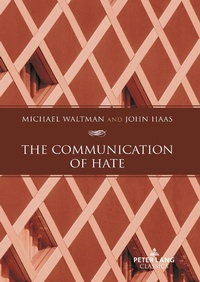
The Communication of Hate
Description

The book was awarded the 2011 NCA Franklyn S. Haiman Award for Distinguished Scholarship in Freedom of Expression.
This book sets out to explore how hate comes alive in language and actions by examining the nature and persuasive functions of hate in American society. Hate speech may be used for many purposes and have different intended consequences. It may be directed to intimidate an out-group, or to influence the behavior of in-group members. But how does this language function? What does it accomplish? The answers to these questions are addressed by an examination of the communicative messages produced by those with hateful minds. Beginning with an examination of the organized hate movement, the book provides a critique of racist discourse used to recruit and socialize new members, construct enemies, promote valued identities, and encourage ethnoviolence. The book also examines the strategic manipulation of hatred in our everyday lives by politicians, political operatives, and media personalities. Providing a comprehensive overview of hate speech, the book ends by describing the desirable features of an anti-hate discourse that promotes respect for social differences.
More details
Other editions
Additional editions
Persons
Michael Waltman is Associate Professor of Communication Studies at the University of North Carolina. His research examines the social and political uses of various forms of hate speech, including the role of hate speech in the production of ethnoviolence and hate crime. Dr. Waltman and his students conduct workshops with children in North Carolina communities that focus on the value and importance of respecting social differences.
John Haas is Associate Professor and Chair of the Department of Speech Communication at the University of Tennessee. He teaches graduate and undergraduate courses in organizational communication, interpersonal communication, and research methods. His work has appeared in American Behavioral Scientist, Management Communication Quarterly, The Journal of Business Communication, The International Journal of Personal Construct Psychology, Southern States Communication Journal, and Journalism Quarterly.
Content
Acknowledgments - Language in Action: Overview of Discursive Constructs Useful for Understanding Hate Speech - Discursive Nature of Organized Hate Groups - Conceptual Properties of Hate-Motivated Speech - Hate Speech and the Internet - Nativism and Nativist Discourse - Nativism and the 2008 Presidential Election - Anti-Hate Narratives - Conclusion - Appendix A - Appendix B - References - Author Index - Subject Index.
