

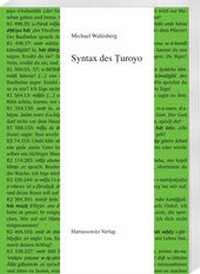
Syntax des ?uroyo
1st Edition
Published on 1. February 2017
401 pages
978-3-447-19577-5 (ISBN)
Description

Die neuaramäische Sprache Turoyo war ursprünglich im Gebiet der Tur 'Abdin in der Südosttürkei (Zentrum Midyat) beheimatet und wird noch heute von syrisch-orthodoxen Christen im nahöstlichen und europäischen Exil gesprochen. Trotz der Verbreitung und guten Dokumentation dieser Sprache blieb eine ausführliche Darstellung der Syntax lange ein Desideratum der Forschung. Mit dem vorliegenden Band schließt Michael Waltisberg diese Lücke. Als Quellen der Untersuchung fungieren neben Daten von zwei muttersprachlichen Informanten die meisten bisher veröffentlichten Turoyo-Texte in Dorfdialekten, die mehrheitlich von Helmut Ritter und Otto Jastrow ediert worden sind. Der syntaktische Stoff wird in den drei großen Kapiteln Nominalphrase, einfacher Satz und komplexer Satz dargestellt und mit einer Fülle von Beispielen belegt. Der methodische Ansatz ist dabei induktiv angelegt und funktional orientiert, indem der sprachliche Befund der Formulierung der Regeln vorangeht und Sprache als abstraktes System betrachtet wird, das mit semantischen und pragmatischen Faktoren interagiert. Eine allgemeine Charakteristik der Turoyo-Syntax schließt das Buch ab.
All prices
More details
Other editions
Additional editions
Michael Waltisberg
Syntax des ?uroyo
Book
12/2016
1st Edition
Harrassowitz Verlag
€98.00
Shipment within 5-7 days
Content
- Cover
- Title Page
- Copyright
- Table of Contents
- Body
- Vorwort
- 1 Thema
- 1.1 Aufgabe
- 1.2 Forschungsstand
- 1.3 Quellentexte und Informanten
- 1.4 Technik
- 2 Nominalphrase
- 2.1 Grundstruktur
- 2.1.1 Kopf
- 2.1.2 Koordination
- 2.1.2.1 Distributive Repetition
- 2.1.2.2 Verknüpfung mehrerer Nomina
- 2.2 Definitheit und Indefinitheit
- 2.2.1 Definitheit
- 2.2.1.1 Definiter Artikel
- 2.2.1.2 Definitheit nach xud
- 2.2.2 Indefinitheit
- 2.2.2.1 Indefiniter Artikel
- 2.2.2.2 Substantivierung von ?a
- 2.2.2.3 Indefinite Nomina
- 2.2.2.4 Paronomastische Wiederholung des Substantivs mit me
- 2.3 Attribut
- 2.3.1 Allgemeines
- 2.3.1.1 Stellung und Struktur
- 2.3.1.2 Pronomina und adverbiale Ausdrücke als Attribut
- 2.3.1.3 Distanz zwischen Kopf und Attribut
- 2.3.2 Attributives Adjektiv
- 2.3.2.1 Adjektiv nach weiteren Elementen
- 2.3.2.2 Adjektiv und Demonstrativ
- 2.3.2.3 Definitheit
- 2.3.2.4 Attributiver Komparativ
- 2.3.3 Mit Relator d- markiertes Attribut
- 2.3.3.1 Adnominale Possession
- 2.3.3.2 Analytische Markierung des präpositionalen Attributs
- 2.3.3.3 Analytische Markierung des adverbiellen Attributs
- 2.3.3.4 Analytische Markierung des attributiven Komparativs
- 2.3.4 Apposition
- 2.3.4.1 Form und Funktion
- 2.3.4.2 Distanz zwischen Bezugswort und Apposition
- 2.4 Quantoren und Numeralia
- 2.4.1 Quantoren
- 2.4.1.1 Quantor qa ~ qa?
- 2.4.1.2 Quantor ?umum
- 2.4.1.3 Quantor kmo
- 2.4.1.4 Quantor tmam
- 2.4.1.5 Quantor kul
- 2.4.2 Numeralia
- 2.4.2.1 Stellung
- 2.4.2.2 Definitheit und Indefinitheit
- 2.4.2.3 Substantivierung von Numeralia
- 2.4.2.4 Kardinalia als Ordinalia
- 2.5 Relativsatz
- 2.5.1 Syndetischer Relativsatz
- 2.5.1.2 Syndetischer Relativsatz nach indefinitem Kopf
- 2.5.1.3 Korrelativ
- 2.5.1.4 Paronomastischer Relativsatz
- 2.5.1.5 Kopfloser Relativsatz
- 2.5.1.6 Konditionaler Relativsatz
- 2.5.2 Asyndetischer Relativsatz
- 2.6 Pronomina
- 2.6.1 Koreferentielle Pronomina
- 2.6.2 Possessivsuffixe
- 2.6.3 Possessivum di?e
- 2.6.3.1 Stellung
- 2.6.3.2 Anwendung
- 2.6.4 Demonstrative
- 2.6.4.1 Anwendung
- 2.6.4.2 Substantivierung der d-Phrase
- 2.6.5 Indefinitpronomina ('jemand')
- 2.7 Vokativ
- 2.7.1 Unmarkierter Vokativ
- 2.7.2 Markierter Vokativ
- 3 Einfacher Satz
- 3.1 Nucleus
- 3.1.1 Existenzausdruck und Kopula
- 3.1.1.1 Kit(o)/kitwa
- 3.1.1.2 Flektiertes kityo
- 3.1.1.3 Enklitisch -yo/-wa
- 3.1.1.4 Résumé
- 3.1.2 Verboide
- 3.1.2.1 Kibe
- 3.1.2.2 Kitle
- 3.1.3 Verb
- 3.1.3.1 Pluralkongruenz
- 3.1.3.2 Unpersönliches Verb
- 3.1.3.3 Unpersönliches Subjekt
- 3.1.3.4 Komplexe Nuclei und verwandte Phänomene
- 3.2 Tempus und Aspekt
- 3.2.1 Inventar
- 3.2.2 Funktionen der Tempus/Aspekt-Formen
- 3.2.2.1 Aktuelles Präsens
- 3.2.2.2 Generelles Präsens
- 3.2.2.3 Perfektische und inferentiell-mirative Funktion
- 3.2.2.4 Futur
- 3.2.2.5 Generelle Vergangenheit
- 3.2.2.6 Vorvergangenheit
- 3.2.3 Präteritum
- 3.2.4 Erzählung
- 3.2.5 Das Tempus/Aspekt-System des ?uroyo
- 3.3 Modus
- 3.3.1 Subjunktiv
- 3.3.1.1 Balki 'vielleicht'
- 3.3.1.2 Kohortativ
- 3.3.1.3 Jussiv
- 3.3.2 Imperativ
- 3.3.2.1 Einfacher Imperativ
- 3.3.2.2 Erweiterter Imperativ
- 3.3.2.3 Präfigierter Imperativ
- 3.4 Fragesatz
- 3.4.1 Direkte Frage
- 3.4.1.1 Unmarkierte Frage
- 3.4.1.2 Interrogativmarker
- 3.4.1.3 Interrogativpronomina und -adverbien
- 3.4.2 Indirekte Frage
- 3.4.2.1 Unmarkierte Frage
- 3.4.2.2 Interrogativmarker
- 3.4.2.3 Interrogativpronomina und -adverbien
- 3.4.2.4 Stellung
- 3.5 Relationales Verhalten
- 3.5.1 Präpositionale Markierung von A und S
- 3.5.2 Markierung von O
- 3.5.2.1 Inkorporiertes O
- 3.5.2.2 Unabhängiges Pronomen als O
- 3.5.2.3 Unmarkiertes substantivisches O
- 3.5.2.4 O-Prädikativ
- 3.5.2.5 Einschub: Subjektsprädikativ
- 3.5.2.6 Objekt komplexer Verben
- 3.5.2.7 Präpositionale Markierung von substantivischem O
- 3.5.2.8 Bipersonale Markierung von O
- 3.5.2.9 Anaphorischer O-Marker nach L-Suffix
- 3.5.2.10 Ausblendung von O
- 3.5.3 Markierung von IO
- 3.5.3.1 Präpositionale Markierung von IO
- 3.5.3.2 Bipersonale Markierung von IO
- 3.5.3.3 Supplementäres L-Suffix
- 3.6 Diathese
- 3.6.1 Reflexivität
- 3.6.1.1 Unmarkierte Reflexivität
- 3.6.1.2 Reflexivmarker ru?-
- 3.6.1.3 Reflexivmarker nafs-
- 3.6.1.4 Reziprokmarker ??o?e
- 3.6.2 Passiv und Medium
- 3.6.2.1 Grundlagen
- 3.6.2.2 Medium
- 3.6.2.3 Analytische Markierung von zugrundeliegendem A
- 3.7 Negation
- 3.7.1 Verneinung von Existenzausdruck und Kopula
- 3.7.1.1 Layt(o)
- 3.7.1.2 Latyo
- 3.7.2 Negierte Verboide
- 3.7.2.1 Laybe
- 3.7.2.2 Latle
- 3.7.3 Negator lo
- 3.7.3.1 Allgemeines
- 3.7.3.2 Kombinierte negative Ausdrücke
- 3.7.3.3 Negation fokaler Elemente
- 3.7.4 Negator haw
- 3.7.5 Mit Negatoren verbundene Intensitätspartikeln
- 3.7.5.1 Hic
- 3.7.5.2 Ti-
- 3.7.5.3 Abadan
- 3.7.5.4 B-naqqa
- 3.7.5.5 Kul-
- 3.7.6 Expletive Negation
- 3.8 Adverbiale
- 3.8.1 Unmarkiertes Adverb
- 3.8.1.1 Nomen als Adverb
- 3.8.1.2 Quantor kule als Adverb
- 3.8.1.3 Zeitangaben
- 3.8.1.4 Lokalangaben
- 3.8.2 Markiertes Adverb
- 3.8.2.1 Allgemeines
- 3.8.2.2 Zeitangaben
- 3.8.2.3 Weitere adverbiale Angaben
- 3.9 Präsentativ
- 3.9.1 Kale
- 3.9.1.1 Kale nach Wahrnehmungsverben
- 3.9.1.2 Einführung einer neuen Situation
- 3.9.1.3 Kale in Kopulafunktion
- 3.9.1.4 Kale mit Präsens
- 3.9.1.5 Kale in abhängigen Klausen
- 3.9.2 Kal und ko
- 3.9.2.1 Kal
- 3.9.2.2 Ko
- 3.9.3 Ga ~ gava
- 3.9.3.1 Ga ~ gava nach Wahrnehmungsverben
- 3.9.3.2 Doppelte Setzung von ga
- 3.9.4 Demonstrative
- 3.9.5 Ha
- 3.10 Inkongruenzphänomene
- 3.10.1 Numerus
- 3.10.1.1 Zeitraum
- 3.10.1.2 Indefinites Subjekt
- 3.10.1.3 Nachwuchs
- 3.10.1.4 Synesis
- 3.10.2 Genus
- 3.10.2.1 Zeitausdrücke
- 3.10.2.2 Nachwuchs
- 3.10.2.3 Nucleus ote l-
- 3.10.2.4 Weitere Fälle
- 3.11 Ausblendungsphänomene
- 3.11.1 Ausblendung der Kopula
- 3.11.1.1 Sichvorstellen
- 3.11.1.2 Matrixsatz vor d-Klause
- 3.11.1.3 Komparativ
- 3.11.1.4 Weitere Fälle
- 3.11.2 Ausblendung des Verbs
- 3.11.3 Ausblendung des Tempusmarkers
- 3.11.3.1 Koordinierte Verben
- 3.11.3.2 Subjunktiv in direkter Rede
- 3.11.4 Ellipse des Matrixsatzes
- 3.12 Diskursgrammatik
- 3.12.1 Dislokation
- 3.12.1.1 Linksversetzung
- 3.12.1.2 Rechtsversetzung
- 3.12.2 Einschub: Isolierung
- 3.12.3 Partikel -ze ~ -ste
- 3.12.3.1 Grundbedeutung 'auch'
- 3.12.3.2 Diskursmarker -ze ~ -ste
- 3.12.4 Unabhängiges Pronomen
- 3.12.4.1 Allgemeines
- 3.12.4.2 Direkte Rede
- 3.12.4.3 Diskontinuität
- 3.12.4.4 Kontrast
- 3.12.4.5 Imperativ
- 3.12.5 Verbalwurzel q-y-m
- 3.12.5.1 Subjekt-Prädikat-Kongruenz
- 3.12.5.2 Subjekt-Prädikat-Inkongruenz
- 3.12.6 Verbalwurzel ?-y-r
- 3.12.7 Demonstrative
- 3.12.8 Synopse der diskursgrammatischen Mittel
- 3.13 Wortfolge
- 3.13.1 Sample
- 3.13.2 Die Position nominaler Konstituenten (A, S, O, IO)
- 3.13.2.1 Frontierung
- 3.13.2.2 Zur Linearisierung transitiver Sätze
- 3.14 Anakoluth
- 4 Komplexer Satz
- 4.1 Koordination
- 4.1.1 Parataxe statt Hypotaxe
- 4.1.2 Asyndetische Koordination
- 4.1.2.1 Sequentielle Sachverhalte
- 4.1.2.2 Perzeptionsverben und Asyndese
- 4.1.2.3 Imperativ mit asyndetischem Subjunktiv
- 4.1.2.4 Asyndetischer Komplementsatz
- 4.1.3 Asyndetische Erläuterung
- 4.1.4 Einschub
- 4.1.5 Syndetische Koordination
- 4.1.6 Inzidenzschema
- 4.1.6.1 Verblose Inzidenzbasis
- 4.1.6.2 Präsentische Inzidenzbasis
- 4.1.6.3 Präteritale Inzidenzbasis
- 4.2 Spaltsatz
- 4.3 Umstandssatz
- 4.3.1 Asyndetischer Umstandssatz
- 4.3.2 Syndetischer Umstandssatz
- 4.3.3 Semantisch verwandte Sätze
- 4.4 Subordination
- 4.4.1 Komplementsatz
- 4.4.1.1 Nominaler Komplementsatz
- 4.4.1.2 Asyndetischer verbaler Komplementsatz
- 4.4.1.3 Syndetischer verbaler Komplementsatz
- 4.4.2 Raising
- 4.4.2.1 Existenz
- 4.4.2.2 Raising mit Subjunktiv
- 4.4.2.3 Raising mit Präsens
- 4.4.2.4 Raising mit Präteritum und passivem Partizip
- 4.4.3 Konjunktionalsatz
- 4.4.3.1 Inventar
- 4.4.3.2 Temporalsatz
- 4.4.3.3 Kausalsatz
- 4.4.3.4 Finalsatz
- 4.4.3.5 Konjunktionalsätze mit Subjunktiv
- 4.4.3.6 Komparativsatz
- 4.4.4 Proleptische Kodierung im Matrixsatz
- 4.5 Konditionalsatz
- 4.5.1 Forschungsstand
- 4.5.2 Synopse
- 4.5.2.1 Realer Konditionalsatz
- 4.5.2.2 Irrealer Konditionalsatz
- 4.5.2.3 Résumé
- 4.5.3 Realer Konditionalsatz
- 4.5.3.1 Kopula, Verboid und Existenzausdrücke als Nucleus
- 4.5.3.2 Subjunktiv als Nucleus
- 4.5.3.3 Präsens als Nucleus
- 4.5.3.4 Präteritum als Nucleus
- 4.5.3.5 Futur (bzw. generelles Präsens) als Nucleus
- 4.5.4 Irrealer Konditionalsatz
- 4.5.4.1 Imperfekt als Nucleus
- 4.5.4.2 Imperfekt als Irrealis
- 4.5.4.3 Plusquampräteritum als Irrealis
- 5 Charakter der ?uroyo-Syntax
- 6 Abkürzungs- und Literaturverzeichnis
- 6.1 Abkürzungen der Quellen
- 6.2 Literatur
