

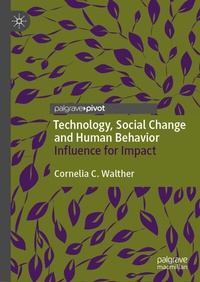
Technology, Social Change and Human Behavior
Description

This book looks at the changing continuum that links individuals, communities and society. An outline of Aspirational Algorithms (AA) and Valuable Wearables is presented as tools to shift from an AI culture to the cultivation of Augmented Humanity (AH). The human mindset that is behind the design and use of technology determines the outcomes of technology. If the intended outcome is the common good, then the preceding human aspiration must be geared toward that goal. Only technology that is conceived with the aspiration of a society that lifts individuals to fulfill their potential can be a game-changer for good. Seeing the constant interplay between the four levels of human existence - soul, heart, mind, body, expressed as aspirations, emotions, thoughts and sensations, how technology may serve to systematically sway individuals from inspiration to desire, from informing to the ignition of tangible transformation. This transition is explained in the book along the scale of influence. Two convergent and mutually influencing dynamics are analyzed: first, the influence of values and aspirations on the impact of technology, and second, the influence of technology on the attitude and action of users. Both assess how hardware and software can serve a maximum of people to live a meaningful happy life.
Reviews / Votes
"This book presents evidence that is possible to reach a state of AH if we use our potential for others to achieve our own, and if all the sectors of society come together under a common goal of inclusion, growth, social progress and sustainable development. And the role of technology in this issue will depend on the way we synchronize our aspirations with our technological creations." (Claudia Andrea Petrone, Applied Research in Quality of Life, Vol. 17 (5), 2022)More details
Other editions
Additional editions
Person
Cornelia C. Walther 's experience combines practice and research. As a humanitarian practitioner she worked for UNICEF and the World Food Program (WFP) for almost 20 years, operating as the head of communication in large-scale emergencies in Africa, Asia and the Caribbean. She collaborates as a coach and a researcher with the Center for Humanitarian Leadership, Deakin University, Australia, and as a lecturer with both the Fachhochschule Muenster, Germany, and the University of Law, Aix-Marseille, France. She is part of the network of humanitarian assistance, and holds a Ph.D. in Law. Books published in 2020 include Development, Humanitarian Action and Social Welfare ; Humanitarian Work, Social Change and Human Behavior ; and Development and Connection in Times of Covid .
