

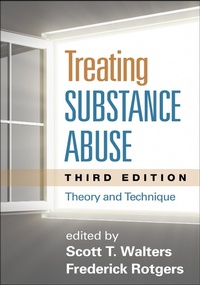
Treating Substance Abuse
Description

Practitioners and graduate students in clinical psychology, clinical social work, psychiatric nursing, counseling, and psychiatry. Serves as a text in Substance Abuse Treatment, Addiction Counseling, and related courses.
More details
Other editions
Additional editions
Persons
Scott T. Walters, PhD, is Regents Professor in the School of Public Health at the University of North Texas Health Science Center. His research focuses on the use of motivational interviewing and other brief interventions to help people make changes in substance abuse and other problem behaviors. Widely published, Dr. Walters has acted as a consultant for several agencies; is a frequent speaker to university, community, and medical groups; and has received national and international awards for his work integrating research and practice.
Frederick Rotgers, PsyD, ABPP, is Director of the Program for Motivation and Change at the Graduate School of Applied and Professional Psychology, Rutgers, The State University of New Jersey, and a psychologist in independent practice. He is a Fellow of the American Psychological Association (APA), is a past president of the Society of Addiction Psychology (APA Division 50), and is certified in clinical and cognitive and behavioral psychology by the American Board of Professional Psychology. The author or editor of numerous books on the assessment and treatment of substance use disorders, Dr. Rotgers is American Editor-in-Chief of the journal Addiction Research and Theory.
Content
1. Theories of Motivation and Addictive Behavior, Gary S. Rose and Scott T. Walters
2. Motivational Interviewing in Practice, Erin M. Tooley and Theresa B. Moyers
3. The Behavioral Economics of Substance Abuse, James G. Murphy, James MacKillop, Rudy E. Vuchinich, and Jalie A. Tucker
4. Contingency Management in Substance Abuse Treatment, Jesse Dallery, Steven E. Meredith, and Alan J. Budney
5. Cognitive-Behavioral Theories of Substance Abuse, Frederick Rotgers
6. Behavioral Treatment Techniques for Psychoactive Substance Use Disorders, James S. Marinchak and Thomas J. Morgan
7. Theory of 12-Step-Oriented Treatment, John Wallace
8. Facilitating 12-Step Recovery from Substance Abuse, Joseph Nowinski
9. Theoretical Bases of Family Approaches to Substance Abuse Treatment, Barbara S. McCrady, Benjamin O. Ladd, and Kevin A. Hallgren
10. Family Therapy Techniques for Substance Abuse Treatment, Wendy K. K. Lam, Timothy J. O'Farrell, and Gary R. Birchler
11. Neurobiological Bases of Addiction Treatment, Phillip H. Chung, Julie D. Ross, Sidarth Wakhlu, and Bryon Adinoff
12. Integrating Psychotherapy and Pharmacotherapy in Substance Abuse Treatment, Kathleen M. Carroll and Brian D. Kiluk
13. Addressing Substance Abuse in Primary Care Settings: Screening and Brief Intervention, Kristen L. Barry and Frederic C. Blow
14. Integrating Theory, Research, and Practice: A Clinician's Perspective, Edward Rubin
15. Case Management in Substance Abuse Treatment, Allen Zweben
