

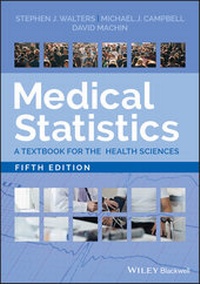
Medical Statistics
Description

Helpful multi-choice exercises are included at the end of each chapter, with answers provided at the end of the book. Each analysis technique is carefully explained and the mathematics kept to minimum. Written in a style suitable for statisticians and clinicians alike, this edition features many real and original examples, taken from the authors' combined many years' experience of designing and analysing clinical trials and teaching statistics.
Students of the health sciences, such as medicine, nursing, dentistry, physiotherapy, occupational therapy, and radiography should find the book useful, with examples relevant to their disciplines. The aim of training courses in medical statistics pertinent to these areas is not to turn the students into medical statisticians but rather to help them interpret the published scientific literature and appreciate how to design studies and analyse data arising from their own projects. However, the reader who is about to design their own study and collect, analyse and report on their own data will benefit from a clearly written book on the subject which provides practical guidance to such issues.
The practical guidance provided by this book will be of use to professionals working in and/or managing clinical trials, in academic, public health, government and industry settings, particularly medical statisticians, clinicians, trial co-ordinators. Its practical approach will appeal to applied statisticians and biomedical researchers, in particular those in the biopharmaceutical industry, medical and public health organisations.
More details
Other editions
Additional editions
Persons
STEPHEN J. WALTERS is Professor of Medical Statistics and Clinical Trials in the School of Health and Related Research (ScHARR) at the University of Sheffield, UK. Stephen is a prolific researcher and writer, including the popular textbooks How to Display Data and How to Design, Analyse and Report Cluster Randomised Trials in Medicine and Health Related Research. He is a National Institute for Health Research (NIHR) Senior Investigator, and has developed several courses on teaching medical statistics to medical and health science students, clinicians and allied health professionals.
MICHAEL J. CAMPBELL is Emeritus Professor of Medical Statistics in the School of Health and Related Research (ScHARR) at the University of Sheffield, UK. Mike is a leading researcher in medical statistics and clinical trials with a national and international reputation. A prolific writer, Mike has written many best-selling textbooks on medical statistics and clinical trials including: Statistics at Square One, Statistics at Square Two, Sample Size Tables for Clinical Studies, and How to Design, Analyse and Report Cluster Randomised Trials in Medicine and Health Related Research.
DAVID MACHIN is Emeritus Professor of Medical Statistics in the School of Health and Related Research (ScHARR) at the University of Sheffield, UK. He was Foundation Director of the National Medical Research Council, Clinical Trials and Epidemiology Research Unit, Singapore, and Head of the MRC Cancer Trials Office, Cambridge, UK. He has published more than 250 peer reviewed articles, and several books on a wide variety of topics in statistics and medicine. His earlier experience included posts at the Universities of Wales, Leeds, Stirling, Southampton and Sheffield, a period with the European Organisation for Research and Treatment of Cancer in Brussels, Belgium, and at the World Health Organization in Geneva, Switzerland.
Content
Preface xi
1 Uses and Abuses of Medical Statistics 1
1.1 Introduction 2
1.2 Why Use Statistics? 2
1.3 Statistics is About Common Sense and Good Design 3
1.4 How a Statistician Can Help 5
2 Displaying and Summarising Data 9
2.1 Types of Data 10
2.2 Summarising Categorical Data 13
2.3 Displaying Categorical Data 15
2.4 Summarising Continuous Data 17
2.5 Displaying Continuous Data 24
2.6 Within-Subject Variability 28
2.7 Presentation 30
2.8 Points When Reading the Literature 31
2.9 Technical Details 32
2.10 Exercises 33
3 Summary Measures for Binary Data 37
3.1 Summarising Binary and Categorical Data 38
3.2 Points When Reading the Literature 46
3.3 Exercises 46
4 Probability and Distributions 49
4.1 Types of Probability 50
4.2 The Binomial Distribution 54
4.3 The Poisson Distribution 55
4.4 Probability for Continuous Outcomes 57
4.5 The Normal Distribution 58
4.6 Reference Ranges 63
4.7 Other Distributions 64
4.8 Points When Reading the Literature 66
4.9 Technical Section 66
4.10 Exercises 67
5 Populations, Samples, Standard Errors and Confidence Intervals 71
5.1 Populations 72
5.2 Samples 73
5.3 The Standard Error 74
5.4 The Central Limit Theorem 75
5.5 Standard Errors for Proportions and Rates 77
5.6 Standard Error of Differences 79
5.7 Confidence Intervals for an Estimate 80
5.8 Confidence Intervals for Differences 83
5.9 Points When Reading the Literature 84
5.10 Technical Details 85
5.11 Exercises 86
6 Hypothesis Testing, P-values and Statistical Inference 91
6.1 Introduction 92
6.2 The Null Hypothesis 92
6.3 The Main Steps in Hypothesis Testing 94
6.4 Using Your P-value to Make a Decision About Whether to Reject, or Not Reject, Your Null Hypothesis 96
6.5 Statistical Power 99
6.6 One-sided and Two-sided Tests 101
6.7 Confidence Intervals (CIs) 101
6.8 Large Sample Tests for Two Independent Means or Proportions 104
6.9 Issues with P-values 107
6.10 Points When Reading the Literature 108
6.11 Exercises 108
7 Comparing Two or More Groups with Continuous Data 111
7.1 Introduction 112
7.2 Comparison of Two Groups of Paired Observations - Continuous Outcomes 113
7.3 Comparison of Two Independent Groups - Continuous Outcomes 119
7.4 Comparing More than Two Groups 127
7.5 Non-Normal Distributions 130
7.6 Degrees of Freedom 131
7.7 Points When Reading the Literature 132
7.8 Technical Details 132
7.9 Exercises 140
8 Comparing Groups of Binary and Categorical Data 145
8.1 Introduction 146
8.2 Comparison of Two Independent Groups - Binary Outcomes 146
8.3 Comparing Risks 151
8.4 Comparison of Two Groups of Paired Observations - Categorical Outcomes 152
8.5 Degrees of Freedom 153
8.6 Points When Reading the Literature 154
8.7 Technical Details 154
8.8 Exercises 160
9 Correlation and Linear Regression 163
9.1 Introduction 164
9.2 Correlation 165
9.3 Linear Regression 171
9.4 Comparison of Assumptions Between Correlation and Regression 178
9.5 Multiple Regression 179
9.6 Correlation is not Causation 181
9.7 Points When Reading the Literature 182
9.8 Technical Details 182
9.9 Exercises 190
10 Logistic Regression 193
10.1 Introduction 194
10.2 Binary Outcome Variable 194
10.3 The Multiple Logistic Regression Equation 196
10.4 Conditional Logistic Regression 200
10.5 Reporting the Results of a Logistic Regression 201
10.6 Additional Points When Reading the Literature When Logistic Regression Has Been Used 202
10.7 Technical Details 202
10.8 The Wald Test 204
10.9 Evaluating the Model and its Fit: The Hosmer-Lemeshow Test 204
10.10 Assessing Predictive Efficiency (1): 2 × 2 Classification Table 205
10.11 Assessing Predictive Efficiency (2): The ROC Curve 206
10.12 Investigating Linearity 206
10.13 Exercises 207
11 Survival Analysis 211
11.1 Time to Event Data 212
11.2 Kaplan-Meier Survival Curve 214
11.3 The Logrank Test 217
11.4 The Hazard Ratio 221
11.5 Modelling Time to Event Data 223
11.6 Points When Reading Literature 226
11.7 Exercises 229
12 Reliability and Method Comparison Studies 233
12.1 Introduction 234
12.2 Repeatability 234
12.3 Agreement 237
12.4 Validity 239
12.5 Method Comparison Studies 240
12.6 Points When Reading the Literature 243
12.7 Technical Details 243
12.8 Exercises 245
13 Evaluation of Diagnostic Tests 249
13.1 Introduction 250
13.2 Diagnostic Tests 250
13.3 Prevalence, Overall Accuracy, Sensitivity, and Specificity 251
13.4 Positive and Negative Predictive Values 252
13.5 The Effect of Prevalence 253
13.6 Confidence Intervals 254
13.7 Functions of a Screening and Diagnostic Test 255
13.8 Likelihood Ratio, Pre-test Odds and Post-test Odds 256
13.9 Receiver Operating Characteristic (ROC) Curve 257
13.10 Points When Reading the Literature About a Diagnostic Test 261
13.11 Exercises 262
14 Observational Studies 265
14.1 Introduction 266
14.2 Risk and Rates 266
14.3 Taking a Random Sample 272
14.4 Questionnaire and Form Design 273
14.5 Cross-sectional Surveys 274
14.6 Non-randomised Studies 275
14.7 Cohort Studies 278
14.8 Case-Control Studies 282
14.9 Association and Causality 287
14.10 Modern Causality Methods and Big Data 287
14.11 Points When Reading the Literature 288
14.12 Technical Details 288
14.13 Exercises 290
15 The Randomised Controlled Trial 293
15.1 Introduction 294
15.2 The Protocol 294
15.3 Why Randomise? 295
15.4 Methods of Randomisation 296
15.5 Design Features 298
15.6 Design Options 303
15.7 Meta-analysis 309
15.8 Checklists for Design, Analysis and Reporting 309
15.9 Consort 311
15.10 Points When Reading the Literature About a Trial 311
15.11 Exercises 311
16 Sample Size Issues 313
16.1 Introduction 314
16.2 Study Size 315
16.3 Continuous Data 318
16.4 Binary Data 319
16.5 Prevalence 321
16.6 Subject Withdrawals 322
16.7 Other Aspects of Sample Size Calculations 323
16.8 Points When Reading the Literature 325
16.9 Technical Details 325
16.10 Exercises 327
17 Other Statistical Methods 331
17.1 Analysing Serial or Longitudinal Data 332
17.2 Poisson Regression 341
17.3 Missing Data 343
17.4 Bootstrap Methods 350
17.5 Points When Reading the Literature 353
17.6 Exercises 353
18 Meta-analysis 355
18.1 Introduction 356
18.2 What is a Meta-analysis? 356
18.3 Meta-analysis Methods 358
18.4 Example: Mobile Phone Based Intervention for Smoking Cessation 359
18.5 Discussion 363
18.6 Technical Details 363
18.7 Exercises 365
19 Common Mistakes and Pitfalls 369
19.1 Introduction 370
19.2 Misleading Graphs and Tables 370
19.3 Plotting Change Against Initial Value 376
19.4 Within Group Versus Between Group Analyses 380
19.5 Analysing Paired Data Ignoring the Matching 381
19.6 Unit of Analysis 382
19.7 Testing for Baseline Imbalances in an RCT 382
19.8 Repeated Measures 383
19.9 Clinical and Statistical Significance 387
19.10 Post Hoc Power Calculations 387
19.11 Predicting or Extrapolating Beyond the Observed Range of Data 388
19.12 Exploratory Data Analysis 390
19.13 Misuse of P-values 391
19.14 Points When Reading the Literature 391
Appendix: Statistical Tables 393
Solutions to Multiple-Choice Exercises 403
References 413
Index 423
1
Uses and Abuses of Medical Statistics
- 1.1 Introduction
- 1.2 Why Use Statistics?
- 1.3 Statistics is About Common Sense and Good Design
- 1.4 How a Statistician Can Help
Summary
Statistical analysis features in the majority of papers published in health care journals. Most health care practitioners will need a basic understanding of statistical principles, but not necessarily full details of statistical techniques. Medical statisticians should be consulted early in the planning of a study as they can contribute in a variety of ways and not just once all the data have been collected. Thus, medical statistics can influence good research by improving the design of studies as well as suggesting the optimum analysis of the results and their reporting.
1.1 Introduction
Although some health care practitioners may not carry out medical research, they will definitely be consumers of medical research. Thus, it is incumbent on them to be able to discern good studies from bad, to be able to verify whether the conclusions of a study are valid and to understand the limitations of such studies. The current emphasis on evidence-based medicine (EBM), or more comprehensively evidence-based health care (EBHC), requires that health care practitioners consider critically all evidence about whether a specific treatment works and this requires basic statistical knowledge.
Statistics is not only a discipline in its own right but it is also a fundamental tool for investigation in all biological and medical sciences. As such, any serious investigator in these fields must have a grasp of the basic principles. With modern computer facilities there is little need for familiarity with the technical details of statistical calculations. However, a health care professional should understand when such calculations are valid, when they are not and how they should be interpreted.
The use of statistical methods pervades the medical literature. In a survey of 305 original articles published in three UK journals of general practice: British Medical Journal (General Practice Section), British Journal of General Practice and Family Practice, over a one-year period, Rigby et al. (2004) found that 66% used some form of statistical analysis. Another review by Strasak et al. (2007) of 91 original research articles published in The New England Journal of Medicine (NEJM) in 2004 (one of the prestigious peer-reviewed medical journals) found an even higher figure with 95% containing inferential statistics, for example, testing hypotheses and deriving estimates. It appears, therefore, that the majority of papers published in these journals require some statistical knowledge for a complete understanding.
1.2 Why Use Statistics?
To students schooled in the 'hard' sciences of physics and chemistry it may be difficult to appreciate the variability of biological data. If one repeatedly puts blue litmus paper into acid solutions it turns red 100% of the time, not most (say 95%) of the time. In contrast, if one gives aspirin to a group of people with headaches, not all of them will experience relief. Penicillin was perhaps one of the few 'miracle' cures where the results were so dramatic that little evaluation was required. Absolute certainty in medicine is rare.
Measurements on human subjects seldom give exactly the same results from one occasion to the next. For example, O'Sullivan et al. (1999), found that the systolic blood pressure (SBP) in normal healthy children has a wide range, with 95% of children having SBPs below 130 mmHg when they were resting, rising to 160 mmHg during the school day, and falling again to below 130 mmHg at night. Furthermore, Hansen et al. (2010) in a study of over 8000 subjects found that increasing variability in blood pressure over 24 hours was a significant and independent predictor of mortality and of cardiovascular and stroke events.
Diagnostic tests are not perfect. Simply because a test for a disease is positive does not mean that the patient necessarily has the disease. Similarly, a negative test does not mean the patient is necessarily disease free. The UK National Health Service invites all women aged 50-70 for breast screening every three years. According to the NHS Breast Screening Information Leaflet (2018, https://assets.publishing.service.gov.uk/government/uploads/system/uploads/attachment_data/file/840343/Breast_screening_helping_you_decide.pdf): if 100 women have breast screening; 96 will have a normal result and 4 will need more tests. Of these, 1 cancer will be confirmed whilst 3 women will have no cancer detected.
One would think that pathologists, at least, would be consistent. However, a review by Elmore et al. (2017) showed that when it came to diagnosing melanotic skin lesions, in only 83% of cases where a lone pathologist made a diagnosis would the same diagnosis be confirmed by an independent panel. In 8% of cases the lone pathologist would give a worse prognosis, and in 9% of cases they would have underestimated the severity of the disease.
This variability is also inherent in responses to biological hazards. Most people now accept that cigarette smoking causes lung cancer and heart disease, and yet nearly everyone can point to an apparently healthy 80-year-old who has smoked for many years without apparent ill effect. Although it is now known from the report of Doll et al. (2004) that about half of all persistent cigarette smokers are killed by their habit, it is usually forgotten that until the 1950s, the cause of the rise in lung cancer deaths was a mystery and commonly associated with general atmospheric pollution from, for example, exhaust fumes of cars. It was not until the carefully designed and statistically analysed case-control and cohort studies of Richard Doll and Austin Bradford Hill and others, that smoking was identified as the true cause. Enstrom et al. (2003) moved the debate on to ask whether or not passive smoking causes lung cancer. This is a more difficult question to answer since the association is weaker. However, studies by Cao et al. (2015) have now shown that it is a major health problem and scientists at the International Agency for Research on Cancer (IARC) have concluded that there is sufficient evidence that second-hand smoke causes lung cancer (IARC 2012). Restrictions on smoking in public places have been one consequence and in England and Wales since 1 October 2015 it has been illegal to smoke in a vehicle carrying anyone under the age of 18.
With such variability, it follows that in any comparison made in a medical context, such as people on different treatments, differences are almost bound to occur. These differences may be due to real effects, random variation or variation in some other factor that may affect an outcome. It is the job of the analyst to decide how much variation should be ascribed to chance or other factors, so that any remaining variation can be assumed to be due to a real effect. This is the art of statistics.
1.3 Statistics is About Common Sense and Good Design
A well-designed study, poorly analysed, can be rescued by a reanalysis but a poorly designed study is beyond the redemption of even sophisticated statistical manipulation. Many experimenters consult the medical statistician only at the end of the study when the data have been collected. They believe that the job of the statistician is simply to analyse the data and, with powerful computers available, even complex studies with many variables can be easily processed. However, analysis is only part of a statistician's job, and calculation of the final 'P-value' a minor one at that!
A far more important task for the medical statistician is to ensure that results are comparable and generalisable.
Example from the Literature - Drinking Coffee and Cancer (IARC 2018)
In 2016, a working group of 23 scientists from 10 countries met at IARC in Lyon, France, to review the research evidence of whether or not drinking coffee is carcinogenic and causes cancer. They reviewed the available data from more than 1000 observational and experimental studies. In rating the evidence, the working group gave the greatest weight to well-conducted studies that controlled satisfactorily for important potential confounders, including tobacco and alcohol consumption. For bladder cancer, they found no consistent evidence of an association with drinking coffee, or of a dose-response relationship, that is drinking more coffee increased the incidence of cancer. In several studies, the relative risks of cancer for those drinking coffee compared to non-drinkers were increased in men but women were either not affected or the risk decreased. IARC (2018) concluded from this that there was no evidence that drinking coffee caused bladder cancer and, as Loomis et al. (2016) stated 'that positive associations reported in some studies could have been due to inadequate control for tobacco smoking, which can be strongly associated with heavy coffee drinking'.
In the above example tobacco and alcohol consumption are examples of confounding variables as illustrated in Figure 1.1. In this example, the...
