

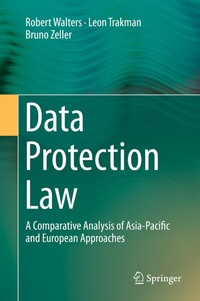
Data Protection Law
Description

This book provides a comparison and practical guide for academics, students, and the business community of the current data protection laws in selected Asia Pacific countries (Australia, India, Indonesia, Japan Malaysia, Singapore, Thailand) and the European Union.
The book shows how over the past three decades the range of economic, political, and social activities that have moved to the internet has increased significantly. This technological transformation has resulted in the collection of personal data, its use and storage across international boundaries at a rate that governments have been unable to keep pace. The book highlights challenges and potential solutions related to data protection issues arising from cross-border problems in which personal data is being considered as intellectual property, within transnational contracts and in anti-trust law. The book also discusses the emerging challenges in protecting personal data and promoting cyber security.
The book provides a deeper understanding of the legal risks and frameworks associated with data protection law for local, regional and global academics, students, businesses, industries, legal profession and individuals.
More details
Other editions
Additional editions
Persons
Robert Walters , Lecturer Law and Criminology and Adjunct Professor, European Faculty of Law, The New University, Slovenia, Europe. Dr Walters expert areas include international trade, investment and finance law, translational data protection and cyber security law. Dr Walters has trained as an international mediator and has more than two decades' experience in policy and law within government, developing and implementing major law reforms for the primary industry sector. Dr Walters has chaired government advisory committee. He is a member of the ASEAN Law Association - Singapore.
Leon Trakman
is Professor and Former Dean at the University of New South Wales in Sydney, Australia, specialising in contracts, international commercial arbitration, trade and investment law. A NAFTA panellist for two decades, he has presided over a number of trade disputes in which the US, Canada and Mexico were parties. Trained as an international commercial arbitrator and mediator, he has served as presiding arbitrator or arbitrator in more than 100 international disputes and has mediated in over 30 disputes in the fields of contracts, sales, construction, IP, sales, franchise, insurance law, and executive remuneration.
Bruno Zeller is Professor of Transnational Commercial Law at the University of Western Australia in Perth, Australia. Dr Zeller is also an Adjunct Professor with Murdoch University, Western Australia and Sir Zelman Cowen Centre, Victoria Australia. He is an expert in the United Nations Convention on Contracts for the International Sale of Goods. His research interests include international trade law, international arbitration, conflict of laws, maritime law, and harmonisation of contract law.
Content
Chapter 1: Technology and the Law.- Chapter 2: Australia and Singapore.- Chapter 3: Indonesia, Malaysia and Thailand.- Chapter 4: European Law.- Chapter 5: International Law.- Chapter 6: Conclusion.
