

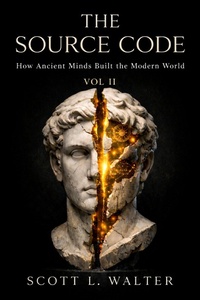
THE SOURCE CODE Vol II How Ancient Minds Built the Modern World 500 - 1700 AD MEDIEVAL TO RENAISSANCE From Preservation to Revolution
Description

Here it is, ready to paste:
What if the greatest scientific revolution in human history almost never happened - saved at the last moment by scholars working across three continents and a thousand years?
It was.
Between 500 and 1700 AD, humanity crossed its most treacherous intellectual bridge. Rome had collapsed. Its libraries were burning. The knowledge that took a millennium to build faced extinction. What followed was not the Dark Ages of popular myth - it was something far more remarkable: a thousand-year relay race across Islamic libraries, Chinese imperial workshops, Byzantine scriptoria, medieval universities, and Renaissance studios, passing the torch of human understanding from one civilization to the next until it finally ignited the Scientific Revolution.
The Source Code, Volume II: Medieval to Renaissance chronicles 110 discoveries across six civilizations that kept human knowledge alive - and then exploded it. Al-Khwarizmi inventing algebra in Baghdad. Gutenberg's press compressing a millennium of manuscript copying into fifty years. Kepler unlocking the mathematical laws of planetary motion. Newton synthesizing it all into a single unified system that would govern physics for the next two centuries.
Every entry is examined through eight lenses: what it is, when and where it emerged, who achieved it, the problem it solved, how the breakthrough happened, the science behind it, its immediate impact, and its living legacy today. MIT-level scholarship, written so anyone can follow it.
This volume is honest about the full picture. The same centuries that produced Copernicus produced the Inquisition. The compass that enabled trade enabled conquest. Gutenberg's press spread both the Reformation and censorship. Brilliance and barbarism coexisted - and both deserve acknowledgment.
The algebra powering every computer was born in 9th-century Baghdad. The printing press that democratized knowledge was built in 15th-century Mainz. The laws governing every satellite in orbit were written in 17th-century Prague. The circulatory system keeping you alive was mapped in 1628 London.
These were not inevitable discoveries. They were hard-won, nearly lost, and passed forward across centuries by people who understood that knowledge is civilization's most fragile inheritance.
Volume II of The Source Code. The bridge between the ancient world and the modern one.
More details
Person
Scott L. Walter is the author of the five-volume series The Source Code: How Ancient Minds Built the Modern World, as well as Dialogue Across Millennia, The Language of Idioms, and The Language of Slang. His work spans the history of science, technology, philosophy, and language ? tracing the discoveries and expressions that shaped human civilization from antiquity to the present day. He publishes under Freer Press.
