

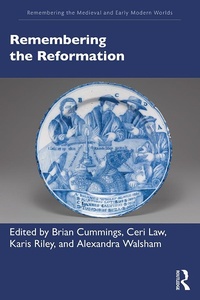
Remembering the Reformation
1st Edition
Published on 4. June 2020
326 pages
978-0-429-62207-6 (ISBN)
Description

This stimulating volume explores how the memory of the Reformation has been remembered, forgotten, contested, and reinvented between the sixteenth and twenty-first centuries.
Remembering the Reformation traces how a complex, protracted, and unpredictable process came to be perceived, recorded, and commemorated as a transformative event. Exploring both local and global patterns of memory, the contributors examine the ways in which the Reformation embedded itself in the historical imagination and analyse the enduring, unstable, and divided legacies that it engendered. The book also underlines how modern scholarship is indebted to processes of memory-making initiated in the early modern period and challenges the conventional models of periodisation that the Reformation itself helped to create. This collection of essays offers an expansive examination and theoretically engaged discussion of concepts and practices of memory and Reformation.
This volume is ideal for upper level undergraduates and postgraduates studying the Reformation, Early Modern Religious History, Early Modern European History, and Early Modern Literature.
Remembering the Reformation traces how a complex, protracted, and unpredictable process came to be perceived, recorded, and commemorated as a transformative event. Exploring both local and global patterns of memory, the contributors examine the ways in which the Reformation embedded itself in the historical imagination and analyse the enduring, unstable, and divided legacies that it engendered. The book also underlines how modern scholarship is indebted to processes of memory-making initiated in the early modern period and challenges the conventional models of periodisation that the Reformation itself helped to create. This collection of essays offers an expansive examination and theoretically engaged discussion of concepts and practices of memory and Reformation.
This volume is ideal for upper level undergraduates and postgraduates studying the Reformation, Early Modern Religious History, Early Modern European History, and Early Modern Literature.
Reviews / Votes
'This consistently stimulating and illuminating collection of essays examines not just how, across a wide range of contexts, the Reformation has been remembered, but what "remembering the Reformation" might actually mean. It is essential reading for anyone interested in memory as a constructive and creative, and often deceptive, cultural force.'Peter Marshall, University of Warwick, UK
'This volume offers the reader a survey of memory cultures, both seeded and sundered by the European Reformation, that is daringly imaginative in scope and unfailingly thought-provoking in content. Taken together, these essays constitute a richly suggestive theatre of memory which enables the reader to locate with precision and nuance the role played by the past in shaping the self-understanding of the protagonists as well as the retrospective comprehension of posterity.'
Simon Ditchfield, University of York, UK
'The essays in this volume advance the pressing discussion of how narratives of remembering and forgetting shaped the early modern world and its afterlife. Individually, they throw light on the diversity of ways in which the Reformation was construed, while collectively they make the case for the protean nature of complex, seismic and global change.'
Bruce Gordon, Yale University, USA
More details
Series
Edition
1. Auflage
Language
English
Place of publication
London
United Kingdom
Publishing group
Taylor & Francis Ltd
Target group
College/higher education
Illustrations
28 Halftones, black and white
ISBN-13
978-0-429-62207-6 (9780429622076)
Copyright in bibliographic data and cover images is held by Nielsen Book Services Limited or by the publishers or by their respective licensors: all rights reserved.
Schweitzer Classification
Other editions
Additional editions
Alexandra Walsham | Brian Cummings | Ceri Law
Remembering the Reformation
Book
07/2020
1st Edition
Routledge
€206.20
Shipment within 15-20 days
Alexandra Walsham | Brian Cummings | Ceri Law
Remembering the Reformation
Book
07/2020
1st Edition
Routledge
€63.90
Shipment within 15-20 days
Persons
Brian Cummings is Anniversary Professor of English at the University of York and a Fellow of the British Academy. He edited The Book of Common Prayer (2013) and his book Mortal Thoughts (2013) won the Dietz Prize of the Modern Language Association of America. With Alexandra Walsham, he co-directed the AHRC project 'Remembering the Reformation' between 2016 and 2019.
Ceri Law has worked at Queen Mary University of London, Cambridge University, and the University of Essex. She is the author of Contested Reformations in the University of Cambridge, c.1535-84 (2018). She was a Postdoctoral Research Associate on the AHRC 'Remembering the Reformation' project between 2016 and 2019.
Karis Riley has degrees in Philosophy, Classics, and English Literature and is currently completing a book on Milton and the passions. She was a Postdoctoral Research Associate on the AHRC 'Remembering the Reformation' project between 2018 and 2019.
Alexandra Walsham is Professor of Modern History at the University of Cambridge and a Fellow of the British Academy. She has published five books, including The Reformation of the Landscape (2011), which won the Wolfson History Prize in 2012. With Brian Cummings, she co-directed the AHRC project 'Remembering the Reformation' between 2016 and 2019.
Ceri Law has worked at Queen Mary University of London, Cambridge University, and the University of Essex. She is the author of Contested Reformations in the University of Cambridge, c.1535-84 (2018). She was a Postdoctoral Research Associate on the AHRC 'Remembering the Reformation' project between 2016 and 2019.
Karis Riley has degrees in Philosophy, Classics, and English Literature and is currently completing a book on Milton and the passions. She was a Postdoctoral Research Associate on the AHRC 'Remembering the Reformation' project between 2018 and 2019.
Alexandra Walsham is Professor of Modern History at the University of Cambridge and a Fellow of the British Academy. She has published five books, including The Reformation of the Landscape (2011), which won the Wolfson History Prize in 2012. With Brian Cummings, she co-directed the AHRC project 'Remembering the Reformation' between 2016 and 2019.
Content
1. Introduction: remembering the Reformation Part I: Repressed memory 2. Stilled lives, still lives: Reformation memorial focus 3. The inheritance of loss: post-Reformation memory culture and the limits of antiquarian discourse Part II: Divided memory 4. Bread and stone: Catholic memory in post-Reformation Leiden 5. Remembering the Holy League: material memories in early modern France Part III: Fragmented memory 6. Remembering the past in the Nordic Reformations 7. Rioting blacksmiths and Jewish women: pillarized Reformation memory in early modern Poland Part IV: Inherited memory 8. The first among the many: early modern cultural memory and the Hussites 9. Remembering and forgetting the dead in the churches of Reformation Germany Part V: Invented memory 10. The material of memory in the seventeenth-century Andes: the Cross of Carabuco and local history 11. The British invention of the Waldenses Part VI: Migrating memory 12. On the road: exile, experience, and memory in the Anabaptist diaspora 13. The legacy of exile and the rise of humanitarianism Part VII: Extended memory 14. The stones will cry out: Victorian and Edwardian memorials to the Reformation martyrs 15. Religious heritage and civic identity: remembering the Reformation in Geneva from the sixteenth to the twenty-first century 16. Afterword: memory practices and global Protestantism
