

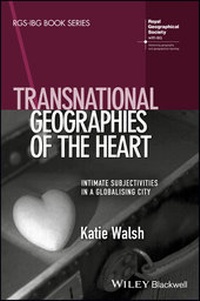
Transnational Geographies of The Heart
Description

* Draws on ethnographic research with British migrants in Dubai, United Arab Emirates, during a phase of rapid globalisation and economic diversification in 2002-2004
* Highlights the negotiation of inter-personal relationships as enormously significant in relation to the dialectic of home and migration
* Includes four empirical chapters focused on the production of 'expatriate' subjectivities, community and friendships, sex and romance, and families
* Demonstrates that a critical analysis of the geographies of intimacy might productively contribute to our understanding of the ways in which intimate subjectivities are embodied, emplaced, and co-produced across binaries of public/private and local/global space
More details
Other editions
Additional editions
Person
Katie Walsh is Senior Lecturer in Geography at the University of Sussex, UK. Her research focuses on home, intimacy and British migration. Katie's current work explores ageing, migration and home through the life-stories of British return migrants in later life. She is the co-editor of Transnational Migration and Home in Older Age (2016) and The New Expatriates: Postcolonial Approaches to Mobile Professionals (2012).
Content
Series Editor's Preface vi
Acknowledgements vii
1 Introduction 1
2 Geographies of Intimacy 23
3 A Globalising Gulf Region and the British in Dubai 45
4 British 'Expatriate' Subjectivities in Dubai 65
5 'Community', Clubs and Friendship 85
6 Sex, Desire and Romance in the Globalising City 106
7 Migration, Domesticity and 'Family Life' 126
8 Our Intimate Lives 145
References 155
Index 172
Chapter One
Introduction
In late 2002, I flew from London Heathrow to Dubai to join the approximately 60,000 other British nationals living in the United Arab Emirates at the time (Sriskandarajah & Drew 2006). So, 'Why Dubai?', I was frequently asked, by academics and British migrants alike. My attempt to explain why I had chosen this city as the site of my fieldwork mixed convoluted justifications of an academic kind with confessions of searching the internet to find information about a region of which I had previously been completely ignorant. Yet, for someone intrigued by migrant subjectivities, temporarily relocating there made sense: Dubai was, shortly afterwards, acknowledged as among the 'most global' of cities with over one million 'foreign born' residents (Price & Benton-Short 2007). Large and diverse migrant populations, especially from south Asia, were already present by the millennium, yet academic engagement with migration to the Gulf Cooperation Council (GCC) countries, at least by those writing in English, was still extremely limited. The United Arab Emirates, and especially Dubai, were undergoing a period of rapid economic transformation, accompanied by a 'super-fast urbanism' (Bagaeen 2007), and were showcasing a new mode of globalisation that would be replicated across the region and that continues to resonate with transformations in city-building across the world (Elsheshtawy 2010). In 2002, then, Dubai was not yet the global city it is today, at least not in traditional terms, but it was a rapidly globalising city nonetheless (see Yeoh 1999). As such, Dubai was a productive site through which to explore transnational migrants' 'intimate subjectivities' (Constable 2016; Mahdavi 2016) as they lived the global-local intersections of this newly unfolding postcolonial urbanity. Attention to the emplaced, embodied, and emotional production and negotiation of intimacy, I will suggest, responds to wider calls to examine the 'stickier' moments of migrants' everyday lives, illuminating the processes of reterritorialisation in transnational spaces (Jackson, Crang & Dwyer 2004).
The United Arab Emirates (UAE) is also a major destination for British migrants, equal in 10th place with Switzerland in terms of the number of UK nationals living abroad (Finch 2010)1. This is all the more remarkable since the nine countries that have more UK nationals living permanently abroad are either located within the European Union - where mobility for British nationals is at the time of writing still relatively straightforward (in the case of Spain, France, Ireland and Germany) - or are Anglophone former British settler colonies (Australia, USA, Canada, New Zealand and South Africa) where we might anticipate long-established patterns of migration to be maintained (see Finch 2010: 29). The British, and privileged migrants more generally, are frequently overlooked in mainstream policy and academic migration debates, especially in media discourses in the UK which almost entirely ignore out-migration. Most Britons resident in the UAE are living in Dubai or Abu Dhabi and are either there to work themselves or to accompany a spouse or parent. Indeed, the Kafala sponsorship system, discussed in more detail in Chapter 3, determines that residency in the UAE (as across the GCC countries more generally) is dependent on the sponsorship of an employer or a close family member.
It was only in the late 1960s that, following the discovery of oil and the political independence of the region, economic and infrastructural development started to bring Britons to live in what was, until independence in 1971, a British protectorate: the 'Trucial States' (Coles & Walsh 2010). Dubai's emergence on the global stage as an 'instant city' (Bagaeen 2007) from 2000 onwards negates the much longer histories of the region, including the ongoing implications of British imperial involvement. The initial communities of British residents remained very small, for example, in 1968, the first census in Dubai recorded only 400 Britons a highly skilled professional migrant group consisting of a handful of advisors to the government, as well as the managerial level staff of banks and trading, shipping, and oil companies and a few teachers, health professionals, and town planners (Coles & Walsh 2010). By the mid-1980s, however, Findlay (1988) identified the Middle East, with the Gulf countries of notable significance, as emerging ahead of the Old Commonwealth countries as a destination for professional and managerial level migrants from the UK. Though British migrants in Dubai are hugely outnumbered by the much larger south Asian communities resident in the city, an analysis of this particular 'postcolonial' positionality, and their reproduction of privileged 'expatriate' subjectivities marked by nationality, class and race, is an important part of understanding Gulf subjectivities and global mobilities more broadly.
In contrast, the same question, 'Why Dubai?', when directed towards the British migrants I had temporarily relocated to interview, received rapid and seemingly straightforward replies: 'It's a tax-free sunshine.' This response would not be a surprise to anyone who has spent time with British migrants on a personal or research basis. The significance of both income and lifestyle in shaping global flows of privileged migration are well established in a wider interdisciplinary literature (e.g. Knowles & Harper 2009). Indeed, this literature has critically examined the relative privilege of this group as something that migration often amplifies, especially in terms of the racialisation of expatriate identities through whiteness (e.g. Leonard 2010). The phrase 'tax-free sunshine' also illuminates the economic diversification strategies that, at the time of my fieldwork in the early 2000s, were transforming Dubai into the global city it has become today. One of these centred on the provision of themed free-zones (for instance, Media City, Internet City, Education City, Healthcare City) set up to attract companies through the provision of economic incentives such as the allowance of tax-free salaries to be paid to expatriate employees (Davidson 2008). Dubai's government has also actively sought to provide leisure and consumption opportunities to encourage a wealthy, highly skilled, and aspirational middle class to temporarily relocate from across the world. Arguably, Dubai has been hugely successful in this aim. Of course, its super-diversity is structured by massive inequalities and, as such, academics have critiqued its migrant labour regime (e.g. Buckley 2012; Davis 2005). From the perspective of British migrants, however, even non-graduates and those with a more modest skill set, 'tax-free' equates to more career opportunities and a higher disposable income than they could achieve at home, with the possibility of consuming an elite lifestyle. Meanwhile, highly skilled inter-company transfers and more traditional 'expatriate packages' in which accommodation, private healthcare, schooling and flights are added extras enable most families to move on the salary of one household member. This 'lead' migrant, whose career trajectory determines household mobility, is usually male so, for some couples at least, relocation to Dubai marks a shift from a more gender-neutral household structure based on the dual-career or dual-income strategies that have become increasingly common among middle-income couples in the UK.
Many of my interviewees suspected my interest in their lives had arisen from an 'expat' childhood, but I had never previously lived abroad. I was there to research their sense of home and belonging, prompted instead by questions about materialities and diaspora that had emerged, for me at least, from an academic curiosity fuelled by transformations in geography and cultural studies from the late 1990s. This book is still about those things, but it also departs massively from this primary objective of the fieldwork to consider the questions, narratives and observations that emerged unbidden during my fieldwork and invited me to explore their significance. Domesticity, transnationalism, belonging, home and identity, continue to be threads of analysis that run through this volume - they weave through the production of our intimate selves after all - but my focus is more directly on our geographies of the heart. Intimacy, highlighting personal relationships and the array of closer connections through which British migrants negotiate belonging in everyday life, turned out to dominate other people's telling of life in Dubai and my listening. I found myself increasingly exploring the textures of intimacy negotiated and enacted by British migrants in this particular spatial-temporal, and thoroughly transnational, urban site, but without a language for doing so.
Fortunately, geography, migration studies, and the wider social sciences have since been on their own theoretical journeys, providing me with the building blocks to more thoroughly explore these transnational geographies of the heart that I observed. With this analytical focus, I join a number of other scholars concerned with the embodied and emotional dimensions of mobilities (e.g. Boccagni & Baldassar 2015; Conradson & McKay 2007; Dunn 2009; Mai & King 2009) and with the links between...
