

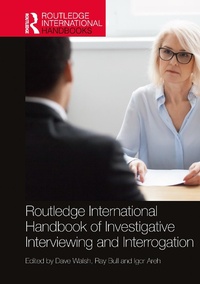
Routledge International Handbook of Investigative Interviewing and Interrogation
1st Edition
Published on 9. August 2024
542 pages
978-1-040-09573-7 (ISBN)
Description

This handbook provides readers with coverage of the various interview and interrogation techniques used across the world with victims, witnesses, and suspected offenders. It includes exclusive coverage on countries rarely, if ever, previously reported upon in the literature to any substantive depth.
Bringing together a collection of chapters from over 40 countries, this handbook advises and explains the practices used in crime interviewing and informs the reader of contemporary developments hitherto unreported in any current book on interviewing and interrogation. In doing so, the Routledge International Handbook of Investigative Interviewing and Interrogation showcases global exemplars of evidence-based practice informed by scientific research. Building on recent research, including protocols developed in a variety of countries, this book is particularly timely in the wake of the "Mendez Principles", a set of principles developed by the UN (i) to counter the ill-treatment of suspects during police questioning and (ii) to gather more reliable information.
This handbook will be an essential reference text across criminology, criminal justice, policing and investigation studies, and law.
Bringing together a collection of chapters from over 40 countries, this handbook advises and explains the practices used in crime interviewing and informs the reader of contemporary developments hitherto unreported in any current book on interviewing and interrogation. In doing so, the Routledge International Handbook of Investigative Interviewing and Interrogation showcases global exemplars of evidence-based practice informed by scientific research. Building on recent research, including protocols developed in a variety of countries, this book is particularly timely in the wake of the "Mendez Principles", a set of principles developed by the UN (i) to counter the ill-treatment of suspects during police questioning and (ii) to gather more reliable information.
This handbook will be an essential reference text across criminology, criminal justice, policing and investigation studies, and law.
Reviews / Votes
"As a long-term researcher and trainer of investigative interviewing-specifically on rapport-based approaches with suspects, I fully support this book. Its global focus on methods that are ethical and, critically, based on sound theory and empirical evidence is both timely and welcome. It is unique in its global reach and will doubtless be a stand-out text for academics, policy makers, and trainers alike".Laurence Alison, Professor of Psychology, The University of Liverpool
"Investigative interviewing is a critical aspect of intelligence gathering and criminal investigations, with varying practices across different countries, jurisdictions and police cultures. From the coercive interrogation methods of the past to the more humane and rapport-based approaches of today, the evolution of investigative interviewing has been significant. This book provides a comprehensive overview of investigative interviewing techniques in over 40 different countries, shedding light on the diverse legal systems, traditions and cultures that shape these practices. By bringing together international experts, this book offers valuable insights that can help improve investigative interviewing practices on a global scale, making it an essential resource for law enforcement professionals, researchers, and policymakers".
Ivar Fahsing, Chief Superintendent, Norwegian Police and Associate Professor at the Norwegian Police University College
"This volume provides an indispensable contribution to the need for international standards on investigative interviews in investigations. Its main merit is the extensive empirical study of how interrogation actually works in more than 40 countries studied. Justice is ill-served by coercive and hostile interrogation tactics that cut corners to get either confessions or declarations against interest, while it is still believed that in many countries the presumption of innocence and the exclusionary rule are systematically violated in criminal and other investigations, it is also rewarding that, as the book shows, there are also signs of optimism that many countries are progressing towards more ethical means of interviewing suspects, victims, and witnesses. Nevertheless, more work is needed and the book also shows the path to more-and more urgent-research, and lends support to the initiative to develop universal standards for non-coercive investigative interviews".
Juan E. Mendez, Professor of Human Rights Law in Residence, Washington College of Law and Former UN Special Rapporteur on Torture (2010-2016)
More details
Series
Edition
1. Auflage
Language
English
Place of publication
London
United Kingdom
Publishing group
Taylor & Francis Ltd
Target group
College/higher education
Illustrations
32 Tables, black and white; 5 Line drawings, black and white; 5 Illustrations, black and white
ISBN-13
978-1-040-09573-7 (9781040095737)
Copyright in bibliographic data and cover images is held by Nielsen Book Services Limited or by the publishers or by their respective licensors: all rights reserved.
Schweitzer Classification
Other editions
Additional editions
Dave Walsh | Ray Bull | Igor Areh
Routledge International Handbook of Investigative Interviewing and Interrogation
Book
approx. 06/2026
1st Edition
Routledge
€66.00
Not yet published
Dave Walsh | Ray Bull | Igor Areh
Routledge International Handbook of Investigative Interviewing and Interrogation
Book
08/2024
1st Edition
Routledge
€335.10
Shipment within 10-20 days
Persons
Dave Walsh is Professor of Criminal Investigation at De Montfort University, Leicester, UK.
Ray Bull is Professor of Criminal Investigation at the University of Derby, UK, and an Emeritus Professor at the University of Leicester, UK.
Igor Areh is Associate Professor in Forensic Psychology at the Faculty of Criminal Justice and Security, University of Maribor, Slovenia.
Ray Bull is Professor of Criminal Investigation at the University of Derby, UK, and an Emeritus Professor at the University of Leicester, UK.
Igor Areh is Associate Professor in Forensic Psychology at the Faculty of Criminal Justice and Security, University of Maribor, Slovenia.
Content
Introduction Part 1: Investigative interviews and interrogations with suspects, victims and witnesses 1.Interviewing of witnesses, victims, suspects in the Czech Republic Hedvika Boukalova and Julie Gabrisova 2.How cool can Mendez get? Investigative interviewing practices - an Icelandic perspective Eirikur Valberg and Rebecca Milne 3.Is it interviewing or interrogation in Lithuania (or somewhere in between)? Aleksandras Izotovas, Ilona Laurinaityte, Kristina Vanagaite, and Neringa Grigutyte 4.Investigative interviewing in the Philippines: Victims/complainants, witnesses/informants, and suspects Rachelle Ballesteros-Lintao and Rudy B. Gahar 5.Police questioning, investigative interviews, and interrogations in the Republic of Serbia Zvonimir Ivanovic, Valentina Baic, and Milan Oljaca 6.Police interviewing in Spain: Gathering information from suspects, witnesses, and victims Jose Luis Gonzalez, Jaume Masip and Jennifer Maria Schell-Leugers 7.Interviewing vulnerable witnesses and suspects in criminal justice proceedings: Evidence-based development in Taiwan Ching-Yu Huang and Chih-Hung Shih Part 2: Investigative interviews and interrogations with suspects 8.Interviewing and interrogating suspects: A theoretical, practical, and ethical model Christopher E. Kelly 9.The Mendez Principles: Suspects' rights in criminal proceedings in Austria Gerrit Zach and Nora Katona 10.Police interrogation of crime suspects: A study of current practices in Bangladesh Mohammed Bin Kashem and Ummey Sharaban Tahura 11.Police interrogation of suspects in Bosnia and Herzegovina Irma Deljkic and Adnan Fazlic 12.Interrogation of suspects in Brazil and a new path for policing William Weber Cecconello 13.The road to digitization: Transcription methods in Egyptian interrogations with suspects Neveen Al Saeed 14.Police interviewing practices with suspects in Greece and Cyprus Stavroula Soukara and Christina Kylla 15.Interrogation of suspects in Hungary Bence Meszaros and David Petretei 16.Custodial police interrogation of suspects in India Prejal Shah 17.Interviewing suspects in the Republic of Ireland: Establishing some sort of PEACE in a search for the truth Adrian Gates, Yvonne Daly and Rebecca Milne 18.Investigative interviewing of suspects in Malaysia: Challenges and ways forward Kai-Li Chung and Haezreena Begum binti Abdul Hamid 19.Montenegro - Policing and the interrogation of suspects in relation to the Mendez Principles Marijana Cerovic 20.Police interviewing practices in Pakistan: A critical outline Rais Nouman Ahmed and Rashid Minhas 21.Investigative interviews of crime suspects in Singapore Jeffery Chin and Majeed Khader 22.Interviewing techniques in eleven Sub-Saharan African nations Patricia Donovan and Patricia Perez 23.Investigative interviews in Tuerkiye: Implications of the Mendez Principles in advancing the field Ahmet Demirden Part 3: Interviewing Victims and Witnesses 24.A "world" of insight? On the need to discover universal victim/witness interviewing principles Brent Snook and Kirk Luther 25.Access to justice for victims of sexual offenses and its implication within the forensic interviews process in Colombia Gladys Hernandez-Sarmiento 26.Mozambican police and judicial investigative interviewing Georgina Heydon and Eliseu Mabasso 27.Reporting domestic violence in a patriarchal Nigerian society: Exploring interviewing experiences of battered women with police investigators Richard Abayomi Aborisade 28.Rape victim interviews in Polish criminal procedure Denis Solodov Part 4: Interviewing Children and Young People 29.An overview of best practices for interviewing children Sonja P. Brubacher and Martine B. Powell 30.The role of the psychologist in the State Police in Albania: Focusing on the minor Valbona Treska, Elona Mustafaraj and Elidon Shehu 31.Investigative interviewing of children and young people in Chile Francisco Maffioletti Celedon and Lorena Contreras Taibo 32.Children's testimony in Croatia Ante Novokmet and Zvonimir Tomicic 33.Developing investigative interviewing practice in Finland - starting from child victims and witnesses Hanna Lahtinen and Maria Hietajaervi 34.Interviewing child witnesses in Greece Olga Themeli and Fenia Ferra 35.Interviews with children in Lithuania Neringa Grigutyte, Ilona Laurinaityte, and Aleksandras Izotovas 36.Investigative interviews with children in Tuerkiye: From the past to the present Huseyin Batman and M.Burak Goenueltas Conclusion: Towards a global understanding of what is effective interviewing for investigations and information gathering Dave Walsh, Igor Areh and Ray Bull
