

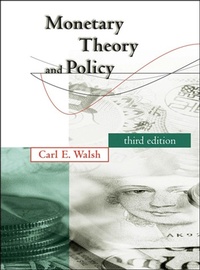
Monetary Theory and Policy, third edition
Description

This text presents a comprehensive treatment of the most important topics in monetary economics, focusing on the primary models monetary economists have employed to address topics in theory and policy. It covers the basic theoretical approaches, shows how to do simulation work with the models, and discusses the full range of frictions that economists have studied to understand the impacts of monetary policy. Among the topics presented are money-in-the-utility function, cash-in-advance, and search models of money; informational, portfolio, and nominal rigidities; credit frictions; the open economy; and issues of monetary policy, including discretion and commitment, policy analysis in new Keynesian models, and monetary operating procedures. The use of models based on dynamic optimization and nominal rigidities in consistent general equilibrium frameworks, relatively new when introduced to students in the first edition of this popular text, has since become the method of choice of monetary policy analysis.
This third edition reflects the latest advances in the field, incorporating new or expanded material on such topics as monetary search equilibria, sticky information, adaptive learning, state-contingent pricing models, and channel systems for implementing monetary policy. Much of the material on policy analysis has been reorganized to reflect the dominance of the new Keynesian approach. Monetary Theory and Policy continues to be the only comprehensive and up-to-date treatment of monetary economics, not only the leading text in the field but also the standard reference for academics and central bank researchers.
More details
Other editions
Additional editions
Person
Content
- Intro
- Title Page
- Copyright
- Contents
- Preface
- Introduction
- 1. Empirical Evidence on Money, Prices, and Output
- 1.1. Introduction
- 1.2. Some Basic Correlations
- 1.2.1. Long-Run Relationships
- 1.2.2. Short-Run Relationships
- 1.3. Estimating the Effect of Money on Output
- 1.3.1. The Evidence of Friedman and Schwartz
- 1.3.2. Granger Causality
- 1.3.3. Policy Uses
- 1.3.4. The VAR Approach
- 1.3.5. Structural Econometric Models
- 1.3.6. Alternative Approaches
- 1.4. Summary
- 2. Money-in-the-Utility Function
- 2.1. Introduction
- 2.2. The Basic MIU Model
- 2.2.1. Steady-State Equilibrium
- 2.2.2. Steady States with a Time-Varying Money Stock
- 2.2.3. The Interest Elasticity of Money Demand
- 2.2.4. Limitations
- 2.3. The Welfare Cost of Inflation
- 2.4. Extensions
- 2.4.1. Interest on Money
- 2.4.2. Nonsuperneutrality
- 2.5. Dynamics in an MIU Model
- 2.5.1. The Decision Problem
- 2.5.2. The Steady State
- 2.5.3. The Linear Approximation
- 2.5.4. Calibration
- 2.5.5. Simulation Results
- 2.6. Summary
- 2.7. Appendix: Solving the MIU Model
- 2.7.1. The Linear Approximation
- 2.7.2. Collecting All Equations
- 2.7.3. Solving Linear Rational-Expectations Models with Forward-Looking Variables
- 2.8. Problems
- 3. Money and Transactions
- 3.1. Introduction
- 3.2. Resource Costs of Transacting
- 3.2.1. Shopping-Time Models
- 3.2.2. Real Resource Costs
- 3.3. CIA Models
- 3.3.1. The Certainty Case
- 3.3.2. A Stochastic CIA Model
- 3.4. Search
- 3.5. Summary
- 3.6. Appendix: The CIA Approximation
- 3.6.1. The Steady State
- 3.6.2. The Linear Approximation
- 3.7. Problems
- 4. Money and Public Finance
- 4.1. Introduction
- 4.2. Budget Accounting
- 4.2.1. Intertemporal Budget Balance
- 4.3. Money and Fiscal Policy Frameworks
- 4.4. Deficits and Inflation
- 4.4.1. Ricardian and (Traditional) Non-Ricardian Fiscal Policies
- 4.4.2. The Government Budget Constraint and the Nominal Rate of Interest
- 4.4.3. Equilibrium Seigniorage
- 4.4.4. Cagan's Model
- 4.4.5. Rational Hyperinflation
- 4.5. The Fiscal Theory of the Price Level
- 4.5.1. Multiple Equilibria
- 4.5.2. The Fiscal Theory
- 4.6. Optimal Taxation and Seigniorage
- 4.6.1. A Partial Equilibrium Model
- 4.6.2. Optimal Seigniorage and Temporary Shocks
- 4.6.3. Friedman's Rule Revisited
- 4.6.4. Nonindexed Tax Systems
- 4.7. Summary
- 4.8. Problems
- 5. Money in the Short Run: Informational and Portfolio Rigidities
- 5.1. Introduction
- 5.2. Informational Frictions
- 5.2.1. Imperfect Information
- 5.2.2. The Lucas Model
- 5.2.3. Sticky Information
- 5.2.4. Learning
- 5.3. Limited Participation and Liquidity Effects
- 5.3.1. A Basic Limited-Participation Model
- 5.3.2. Endogenous Market Segmentation
- 5.3.3. Assessment
- 5.4. Summary
- 5.5. Appendix: An Imperfect-Information Model
- 5.6. Problems
- 6. Money in the Short Run: Nominal Price and Wage Rigidities
- 6.1. Introduction
- 6.2. Sticky Prices and Wages
- 6.2.1. An Example of Nominal Rigidities in General Equilibrium
- 6.2.2. Early Models of Intertemporal Nominal Adjustment
- 6.2.3. Imperfect Competition
- 6.2.4. Time-Dependent Pricing (TDP) Models
- 6.2.5. State-Dependent Pricing (SDP) Models
- 6.2.6. Summary on Models of Price Adjustment
- 6.3. Assessing Alternatives
- 6.3.1. Microeconomic Evidence
- 6.3.2. Evidence on the New Keynesian Phillips Curve
- 6.3.3. Sticky Prices versus Sticky Information
- 6.4. Summary
- 6.5. Appendix: A Sticky Wage MIU Model
- 6.6. Problems
- 7. Discretionary Policy and Time Inconsistency
- 7.1. Introduction
- 7.2. Inflation under Discretionary Policy
- 7.2.1. Policy Objectives
- 7.2.2. The Economy
- 7.2.3. Equilibrium Inflation
- 7.3. Solutions to the Inflation Bias
- 7.3.1. Reputation
- 7.3.2. Preferences
- 7.3.3. Contracts
- 7.3.4. Institutions
- 7.3.5. Targeting Rules
- 7.4. Is the Inflation Bias Important?
- 7.5. Summary
- 7.6. Problems
- 8. New Keynesian Monetary Economics
- 8.1. Introduction
- 8.2. The Basic Model
- 8.2.1. Households
- 8.2.2. Firms
- 8.3. A Linearized New Keynesian Model
- 8.3.1. The Linearized Phillips Curve
- 8.3.2. The Linearized IS Curve
- 8.3.3. Uniqueness of the Equilibrium
- 8.3.4. The Monetary Transmission Mechanism
- 8.3.5. Adding Economic Disturbances
- 8.3.6. Sticky Wages and Prices
- 8.4. Monetary Policy Analysis in New Keynesian Models
- 8.4.1. Policy Objectives
- 8.4.2. Policy Trade-offs
- 8.4.3. Optimal Commitment and Discretion
- 8.4.4. Commitment to a Rule
- 8.4.5. Endogenous Persistence
- 8.4.6. Targeting Regimes and Instrument Rules
- 8.4.7. Model Uncertainty
- 8.5. Summary
- 8.6. Appendix
- 8.6.1. The New Keynesian Phillips Curve
- 8.6.2. Approximating Utility
- 8.7. Problems
- 9. Money and the Open Economy
- 9.1. Introduction
- 9.2. The Obstfeld-Rogoff Two-Country Model
- 9.2.1. The Linear Approximation
- 9.2.2. Equilibrium with Flexible Prices
- 9.2.3. Sticky Prices
- 9.3. Policy Coordination
- 9.3.1. The Basic Model
- 9.3.2. Equilibrium with Coordination
- 9.3.3. Equilibrium without Coordination
- 9.4. The Small Open Economy
- 9.4.1. Flexible Exchange Rates
- 9.4.2. Fixed Exchange Rates
- 9.5. Open-Economy Models with Optimizing Agents and Nominal Rigidities
- 9.5.1. A Model of the Small Open Economy
- 9.5.2. The Relationship to the Closed-Economy NK Model
- 9.5.3. Imperfect Pass-Through
- 9.6. Summary
- 9.7. Appendix
- 9.7.1. The Obstfeld-Rogoff Model
- 9.7.2. The Small-Open-Economy Model
- 9.8. Problems
- 10. Financial Markets and Monetary Policy
- 10.1. Introduction
- 10.2. Interest Rates and Monetary Policy
- 10.2.1. Interest Rate Rules and the Price Level
- 10.2.2. Interest Rate Policies in General Equilibrium
- 10.2.3. Liquidity Traps
- 10.3. The Term Structure of Interest Rates
- 10.3.1. The Expectations Theory of the Term Structure
- 10.3.2. Policy and the Term Structure
- 10.3.3. Expected Inflation and the Term Structure
- 10.4. Macrofinance
- 10.5. Financial Frictions in Credit Markets
- 10.5.1. Adverse Selection
- 10.5.2. Moral Hazard
- 10.5.3. Monitoring Costs
- 10.5.4. Agency Costs
- 10.5.5. Macroeconomic Implications
- 10.6. Does Credit Matter?
- 10.6.1. The Bank Lending Channel
- 10.6.2. The Broad Credit Channel
- 10.7. Summary
- 10.8. Problems
- 11. Monetary Policy Operating Procedures
- 11.1. Introduction
- 11.2. From Instruments to Goals
- 11.3. The Instrument Choice Problem
- 11.3.1. Poole's Analysis
- 11.3.2. Policy Rules and Information
- 11.3.3. Intermediate Targets
- 11.3.4. Real Effects of Operating Procedures
- 11.4. Operating Procedures and Policy Measures
- 11.4.1. Money Multipliers
- 11.4.2. The Reserve Market
- 11.4.3. A Simple Model of a Channel System
- 11.5. A Brief History of Fed Operating Procedures
- 11.5.1. 1972-1979
- 11.5.2. 1979-1982
- 11.5.3. 1982-1988
- 11.5.4. After 1988
- 11.6. Other Countries
- 11.7. Problems
- References
- Name Index
- Subject Index
