

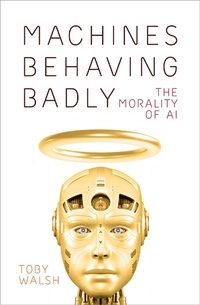
Machines Behaving Badly
The Morality of AI
Published on 26. May 2022
288 pages
978-1-80399-084-2 (ISBN)
Description

Can we build moral machines?
Artificial intelligence is an essential part of our lives - for better or worse. It can be used to influence what we buy, who gets shortlisted for a job and even how we vote. Without AI, medical technology wouldn't have come so far, we'd still be getting lost in our GPS-free cars, and smartphones wouldn't be so, well, smart. But as we continue to build more intelligent and autonomous machines, what impact will this have on humanity and the planet?
Professor Toby Walsh, a world-leading researcher in the field of artificial intelligence, explores the ethical considerations and unexpected consequences AI poses. Can AI be racist? Can robots have rights? What happens if a self-driving car kills someone? What limitations should we put on the use of facial recognition? Machines Behaving Badly is a thought-provoking look at the increasing human reliance on robotics and the decisions that need to be made now to ensure the future of AI is a force for good, not evil.
Artificial intelligence is an essential part of our lives - for better or worse. It can be used to influence what we buy, who gets shortlisted for a job and even how we vote. Without AI, medical technology wouldn't have come so far, we'd still be getting lost in our GPS-free cars, and smartphones wouldn't be so, well, smart. But as we continue to build more intelligent and autonomous machines, what impact will this have on humanity and the planet?
Professor Toby Walsh, a world-leading researcher in the field of artificial intelligence, explores the ethical considerations and unexpected consequences AI poses. Can AI be racist? Can robots have rights? What happens if a self-driving car kills someone? What limitations should we put on the use of facial recognition? Machines Behaving Badly is a thought-provoking look at the increasing human reliance on robotics and the decisions that need to be made now to ensure the future of AI is a force for good, not evil.
Reviews / Votes
'[Walsh] makes a persuasive case that AI will eventually have as big an impact as the Industrial Revolution. ... [his] sparky book provides a useful history of AI, a good analysis of our current state of knowledge, and a provocative guide to the future.' * <i>Financial Times</i> * 'AI is more than the machine. It's as much about us and our society that creates and, in turn, is changed by it. This is a thrilling and alarming vision that Machines Behaving Badly effortlessly shares through engaging stories and insights from a researcher at the forefront of this global transformation.' -- Alan Duffy 'Walsh reminds us that machines can gather data really well but they can't think, so we're in charge.' -- RObyn Douglass * <i>The Daily Telegraph</i> * Author featured in The Guardian. 'Machines Behaving Badly is a good introduction to the unintended consequences of AI, and contains some genuinely thought-provoking insights into the quirks of the people behind them.' * <i>Engineering and Technology Magazine</i> * 'Walsh speaks from a position of authority about the benefits of caution and reflection, which serves as a critical counterweight to the breathless utopianism that is not uncommon in the field.' -- Lizzy O'Shea * <i>The Saturday Paper</i> * 'Walsh demystifies the utopian promises of AI and attacks the dangerous but resilient fallacy that computers never lie.' -- Kurt Johnson * <i>The Age</i> *More details
Language
English
Place of publication
Stroud
United Kingdom
File size
1,57 MB
ISBN-13
978-1-80399-084-2 (9781803990842)
Copyright in bibliographic data and cover images is held by Nielsen Book Services Limited or by the publishers or by their respective licensors: all rights reserved.
Schweitzer Classification
Other editions
Additional editions
Book
05/2022
The History Press Ltd
€25.00
Shipment within 10-15 days
Person
TOBY WALSH is one of the world's leading researchers in Artificial Intelligence. He is a Professor of Artificial Intelligence at the University of New South Wales and leads a research group at Data61, Australia's Centre of Excellence for ICT Research. He has been elected a fellow of the Association for the Advancement of AI for his contributions to AI research, and has won the prestigious Humboldt research award. He regularly appears on the BBC and writes for The Guardian, New Scientist, and The New York Times.
Content
- Cover
- Title
- Copyright
- Contents
- AI
- Strange intruders
- Warning signs
- Breaking bad
- The People
- The geeks taking over
- The sea of dudes
- The godfathers of AI
- The crazy Valley
- The shadow of Ayn Rand
- Techno-libertarians
- Transhumanists
- Wishful thoughts
- The Tenderloin
- Project Maven
- The Companies
- The new titans
- Nothing ventured
- Super-intelligence
- The climate emergency
- Bad behaviour
- Corporate values
- Google's principles
- IBM's thinking
- Rethinking the corporation
- Autonomy
- A new challenge
- The rubber hits the road
- The upside
- The downside
- High stakes
- How self-driving cars drive
- Magnificent machines
- Trolley problems
- Moral machines
- Killer robots
- Laws banning LAWS
- The rules of war
- Humans v. Machines
- Life 1.0
- The demon in the machine
- Emotions
- Pain and suffering
- AI = alien intelligence
- Robot rights
- Sophia the puppet
- Human weaknesses
- Ethical Rules
- The last invention
- Fictional rules
- Responsible robots
- The academy speaks
- Europe leads
- The ethics bandwagon
- Human, not robot rights
- This isn't the first time
- Medical lessons
- Powerful concerns
- Fairness
- Mutant algorithms
- Predictive policing
- Sentencing
- Prediction errors
- The Partnership
- Alexa is racist
- Alexa is sexist
- Your computer boss
- Insuring fairness
- Algorithmic fairness
- The future
- Privacy
- The history of privacy
- Privacy and technology
- Predicting the future
- Intrusive platforms
- Face recognition
- The 'gaydar' machine
- Trees in the forest
- Analogue privacy
- A private future
- The Planet
- Green AI
- On the edge
- Big Oil
- Climate action
- AI for good
- The Way Ahead
- Moral machines
- Trusting AI
- Transparency
- Technical fixes
- Regulatory fixes
- Educational fixes
- The gift of the machines
- Epilogue: The Child of Our Brains
- 31 December 2061
- About the Author
- Acknowledgements
- Notes
