

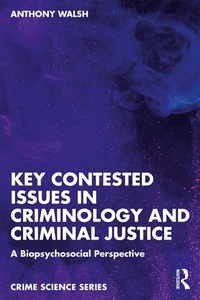
Key Contested Issues in Criminology and Criminal Justice
A Biopsychosocial Perspective
1st Edition
Published on 24. September 2025
288 pages
978-1-040-43758-2 (ISBN)
Description

Key Contested Issues in Criminology and Criminal Justice addresses the key issues within criminology and criminal justice that are strongly contested among scholars in the field.
Covering 18 different themes, the book identifies the ways in which different issues are contested and demonstrates how biopsychosocial concepts and methods can inform most of them. It is divided into four broad sections. The first section examines philosophical issues such as the value of philosophy in criminology/criminal justice, the role of ideology in our disciplines, and the issues of human nature and free will versus determinism. The second section explains the biopsychosocial perspective that provides the framework used in exploring the various issues. It explores the possibility of integrating the natural sciences with criminology, behavioral and molecular genetics, evolutionary theory, and neuroscience. It also considers issues related to child maltreatment, brain development, and the role of rationality vis-a-vis emotion in decision-making. The third section examines crime causation and contains chapters on social learning versus control theories, radical/critical theories, the relationship between intelligence and criminal behavior, issues of socioeconomic status (SES), poverty, and crime, and whether religion is a barrier or bridge to antisocial behavior. The final section looks at four issues in criminal justice: the police abolition movement, the nature of punishment and its justifications by the criminal justice system, and issues in sentencing and the death penalty.
Key Contested Issues in Criminology and Criminal Justice will be of value to students and scholars in criminology and criminal justice, as well as to criminal justice practitioners.
Covering 18 different themes, the book identifies the ways in which different issues are contested and demonstrates how biopsychosocial concepts and methods can inform most of them. It is divided into four broad sections. The first section examines philosophical issues such as the value of philosophy in criminology/criminal justice, the role of ideology in our disciplines, and the issues of human nature and free will versus determinism. The second section explains the biopsychosocial perspective that provides the framework used in exploring the various issues. It explores the possibility of integrating the natural sciences with criminology, behavioral and molecular genetics, evolutionary theory, and neuroscience. It also considers issues related to child maltreatment, brain development, and the role of rationality vis-a-vis emotion in decision-making. The third section examines crime causation and contains chapters on social learning versus control theories, radical/critical theories, the relationship between intelligence and criminal behavior, issues of socioeconomic status (SES), poverty, and crime, and whether religion is a barrier or bridge to antisocial behavior. The final section looks at four issues in criminal justice: the police abolition movement, the nature of punishment and its justifications by the criminal justice system, and issues in sentencing and the death penalty.
Key Contested Issues in Criminology and Criminal Justice will be of value to students and scholars in criminology and criminal justice, as well as to criminal justice practitioners.
More details
Series
Edition
1. Auflage
Language
English
Place of publication
London
United Kingdom
Publishing group
Taylor & Francis Ltd
Target group
College/higher education
File size
10,09 MB
ISBN-13
978-1-040-43758-2 (9781040437582)
Copyright in bibliographic data and cover images is held by Nielsen Book Services Limited or by the publishers or by their respective licensors: all rights reserved.
Schweitzer Classification
Other editions
Additional editions
Book
09/2025
1st Edition
Routledge
€208.00
Shipment within 15-20 days
Book
09/2025
1st Edition
Routledge
€64.00
Shipment within 15-20 days
Person
Anthony Walsh is an emeritus professor at Boise State University, from which he retired at age 77 after 34 years of service. He has worked as a marine, police officer, and adult probation officer and entered academia at the ripe old age of 43. He has published 57 books and over 150 articles/book chapters/encyclopedia entries. He has received lifetime achievement awards from the Biosocial Criminology Association (2014) and the Biopsychosocial Division of the American Society of Criminology (2019).
Content
Section 1: Philosophical Issues 1. Philosophy in Criminology/Criminal Justice 2. Ideology and Criminology 3. Human Nature and Criminology 4. The Issue of Free Will Versus Determinism Section 2: Biopsychosocial Issues 5. Integrating the Natural Sciences with Criminology 6. Behavioral and Molecular Genetics 7. The Human Brain 8. Childhood Maltreatment and Brain Development 9. Rationality or Emotion: Which One Drives the Bus? Section 3: Issues of Crime Causation 10. Social Learning v. Social and Self-Control Theories 11. Radical/Critical Idealism Versus Orthodox Realism 12. What is Intelligence and How is it Related to Crime? 13. Issues Related to Socioeconomic Status, Poverty, and Crime 14. Religion: Barrier or Bridge to Antisocial Behavior? Section 4: Issues in Criminal Justice 15. Abolish the Police: Why or Why Not 16. Issues in Criminal Punishment 17. Issues in Criminal Sentencing 18. The Death Penalty Issue
