

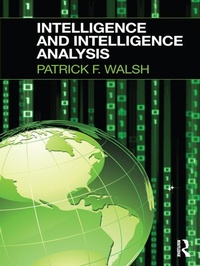
Intelligence and Intelligence Analysis
1st Edition
Published on 31. May 2011
352 pages
978-1-136-71855-7 (ISBN)
Description

This book tracks post 9/11 developments in national security and policing intelligence and their relevance to new emerging areas of intelligence practice such as: corrections, biosecurity, private industry and regulatory environments. Developments are explored thematically across three broad sections:
applying intelligence
understanding structures
developing a discipline.
Issues explored include: understanding intelligence models; the strategic management challenges of intelligence; intelligence capacity building; and the ethical dimensions of intelligence practice. Using case studies collected from wide-ranging interviews with leaders, managers and intelligence practitioners from a range of practice areas in Australia, Canada, New Zealand, the UK and US, the book indentifies examples of good practice across countries and agencies that may be relevant to other settings.
Uniquely bringing together significant theoretical and practical developments in a sample of traditional and emerging areas of intelligence, this book provides readers with a more holistic and inter-disciplinary perspective on the evolving intelligence field across several different practice contexts.
Intelligence and Intelligence Analysis will be relevant to a broad audience including intelligence practitioners and managers working across all fields of intelligence (national security, policing, private industry and emerging areas) as well as students taking courses in policing and intelligence analysis.
applying intelligence
understanding structures
developing a discipline.
Issues explored include: understanding intelligence models; the strategic management challenges of intelligence; intelligence capacity building; and the ethical dimensions of intelligence practice. Using case studies collected from wide-ranging interviews with leaders, managers and intelligence practitioners from a range of practice areas in Australia, Canada, New Zealand, the UK and US, the book indentifies examples of good practice across countries and agencies that may be relevant to other settings.
Uniquely bringing together significant theoretical and practical developments in a sample of traditional and emerging areas of intelligence, this book provides readers with a more holistic and inter-disciplinary perspective on the evolving intelligence field across several different practice contexts.
Intelligence and Intelligence Analysis will be relevant to a broad audience including intelligence practitioners and managers working across all fields of intelligence (national security, policing, private industry and emerging areas) as well as students taking courses in policing and intelligence analysis.
Reviews / Votes
'It has been almost a decade since the 9/11 attacks - but we still struggle to conceptualize intelligence in a broader context beyond the traditional foreign policy arena and to find ways to move easily between foreign and domestic intelligence issues. Patrick Walsh, in Intelligence and Intelligence Analysis, offers that broader context, not only by examining a range of both foreign and domestic intelligence issues, but by focusing across the "Five Eyes" intelligence enterprises: the U.S., Britain, Australia, Canada and New Zealand. This is a unique and long-needed approach; Walsh has made a real contribution to the intelligence canon.' - Mark M. Lowenthal, President and CEO, The Intelligence and Security Academy'This is a thought-provoking and comparative analysis. Discussing intelligence structures and processes both in the national security domain and beyond, it develops a research strategy for more effective and resourced intelligence that will be of much interest to practitioners and researchers alike.' - Professor Peter Gill, Liverpool University
More details
Language
English
Place of publication
London
United Kingdom
Publishing group
Taylor & Francis Ltd
Target group
College/higher education
Product notice
Reflowable
Illustrations
4 s/w Abbildungen, 2 s/w Tabellen, 4 s/w Zeichnungen
2 Tables, black and white; 4 Line drawings, black and white; 4 Illustrations, black and white
File size
2,26 MB
ISBN-13
978-1-136-71855-7 (9781136718557)
Copyright in bibliographic data and cover images is held by Nielsen Book Services Limited or by the publishers or by their respective licensors: all rights reserved.
Schweitzer Classification
Other editions
Additional editions
Patrick Walsh
Intelligence and Intelligence Analysis
Book
06/2011
1st Edition
Willan Publishing
€77.20
Shipment within 3-4 weeks
Patrick Walsh
Intelligence and Intelligence Analysis
Book
06/2011
1st Edition
Willan Publishing
€273.00
Shipment within 3-4 weeks
Person
Patrick F. Walsh is a senior lecturer (criminal intelligence) at the Australian Graduate School of Policing, Charles Sturt University, Australia; Vice President (admin) of the Australian Institute of Professional Intelligence Officers (AIPIO); and managing editor of the AIPIO Journal.
Content
Foreword. Preface Part 1: Applying Intelligence 1. Introduction 2. Traditional Intelligence Practice 3. Emerging Intelligence Practice Areas 4. Intelligence and Capacity Building Part 2: Understanding Structures 5. Intelligence Models and Frameworks 6. Building Better Intelligence Frameworks 7. Intelligence Leadership and Management Part 3: Developing a Discipline 8. Ethics and Legislation 9. Analytical Innovations 10. Intelligence Education and Professionalism 11. Research and Theory Building 12. Conclusion. References. Index
