

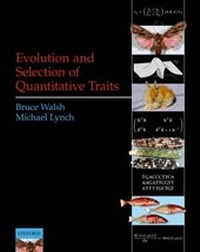
Evolution and Selection of Quantitative Traits
1st Edition
Published on 21. June 2018
1504 pages
978-0-19-256664-5 (ISBN)
Description

Quantitative traits-be they morphological or physiological characters, aspects of behavior, or genome-level features such as the amount of RNA or protein expression for a specific gene-usually show considerable variation within and among populations. Quantitative genetics, also referred to as the genetics of complex traits, is the study of such characters and is based on mathematical models of evolution in which many genes influence the trait and in which non-genetic factors may also be important.
Evolution and Selection of Quantitative Traits presents a holistic treatment of the subject, showing the interplay between theory and data with extensive discussions on statistical issues relating to the estimation of the biologically relevant parameters for these models. Quantitative genetics is viewed as the bridge between complex mathematical models of trait evolution and real-world data, and the authors have clearly framed their treatment as such. This is the second volume in a planned trilogy that summarizes the modern field of quantitative genetics, informed by empirical observations from wide-ranging fields (agriculture, evolution, ecology, and human biology) as well as population genetics, statistical theory, mathematical modeling, genetics, and genomics. Whilst volume 1 (1998) dealt with the genetics of such traits, the main focus of volume 2 is on their evolution, with a special emphasis on detecting selection (ranging from the use of genomic and historical data through to ecological field data) and examining its consequences.
More details
Other editions
Additional editions

Bruce Walsh | Michael Lynch
Evolution and Selection of Quantitative Traits
Software
09/2018
Oxford University Press, USA
€163.70
Shipment within 15-20 days
Bruce Walsh | Michael Lynch
Evolution and Selection of Quantitative Traits
Book
07/2018
Oxford University Press
€197.50
Shipment within 15-20 days
Persons
Bruce Walsh is Professor of Ecology and Evolutionary Biology at the University of Arizona. He has taught advanced classes on quantitative genetics in 25 different countries and his research interests are at the interface of biology, genetics, mathematical modelling, and statistics. He is also an avid lepidopterist, having described over two dozen species of new moths and has three species named after him.
Michael Lynch is Professor in the Schoool of Life Sciences at Arizona State University and is Center Director of the Biodesign Center for Mechanims of Evolution. His research is focused on mechanisms of evolution at the gene, genomic, cellular, and phenotypic levels, with special attention being given to the roles of mutation, random genetic drift, and recombination. He is a member of the US National Academy of Sciences, and a fellow of the American Academy of Arts and Sciences.
Content
- Preface
- I
- Introduction
- 1: Changes in quantitative traits over time
- II
- Evolution at one and two loci
- 2: Neutral evolution in one- and two-locus systems
- 3: The genetic effective size of a population
- 4: The nonadaptive forces of evolution
- 5: The population genetics of selection
- 6: Theorems of natural selection: Results of Price, Fisher, and Robertson
- 7: Interaction of selection, mutation, and drift
- 8: Hitchhiking and selective sweeps
- 9: Using molecular data to detect selection: Signatures from recent single events
- 10: Using molecular data to detect selection: Signatures from multiple historical events
- III
- Drift and quantitative traits
- 11: Changes in genetic variance induced by drift
- 12: The neutral divergence of quantitative traits
- IV
- Short-term response on a single character
- 13: Short-term changes in the mean: 1. The breeder's equation
- 14: Short-term changes in the mean: 2. Truncation and threshold selection
- 15: Short-term changes in the mean: 3. Permanent versus transient response
- 16: Short-term changes in the variance: 1. Changes in the additive variance
- 17: Short-term changes in the variance: 2. Changes in environmental variance
- 18: Analysis of short-term selection experiments: 1. Least-squares approaches
- 19: Analysis of short-term selection experiments: 2. Mixed-model and bayesian approaches
- 20: Selection response in natural populations
- V
- Selection in structured populations
- 21: Family-based selection
- 22: Associative effects: Competition, social interactions, group and kin selection
- 23: Selection under inbreeding
- VI
- Population-genetic models of trait response
- 24: The infinitesimal model and its extensions
- 25: Long-term response: 1. Deterministic aspects
- 26: Long-term response: 2. Finite population size and mutation
- 27: Long-term response: 3. Adaptive walks
- 28: Maintenance of quantitative genetic variation
- VII
- Measuring selection on traits
- 29: Individual fitness and the measurement of univariate selecton
- 30: Measuring multivariate selection
- VIII
- Appendices
- A1: Diffusion theory
- A2: Introduction to Bayesian Analysis
- A3: Markov Chain Monte Carlo and Gibbs sampling
- A4: Multiple comparisons: Bonferroni corrections, false-discovery rates, and meta-analysis
- A5: The geometry of vectors and matrices: Eigenvalues and eigenvectors
- A6: Derivatives of vectors and vector-valued functions
- Literature Cited
- Author Index
- Organism and Trait Index
- Subject Index
