

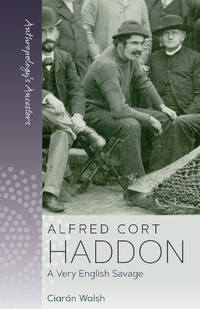
Alfred Cort Haddon
A Very English Savage
1st Edition
Published on 15. September 2023
248 pages
978-1-80073-983-3 (ISBN)
Description

An innovative account of one of the least-understood characters in the history of anthropology.
Using previously overlooked, primary sources Ciaran Walsh argues that Haddon, the grandson of anti-slavery activists, set out to revolutionize anthropology in the 1890s in association with a network of anarcho-utopian activists and philosophers. His book regards most of what has been written about Haddon in the past as a form of disciplinary folklore shaped by a theory of scientific revolutions.
The main action takes place in Ireland, where Haddon adopted the persona of a very English savage in a new form of performed photo-ethnography that constituted a singularly modernist achievement in anthropology.
From the Introduction:
Alfred Cort Haddon was written out of the story of anthropology for the same reasons that make him interesting today. He was passionately committed to the protection of simpler societies and their civilisations from colonists and their supporters in parliament and the armed forces.
Using previously overlooked, primary sources Ciaran Walsh argues that Haddon, the grandson of anti-slavery activists, set out to revolutionize anthropology in the 1890s in association with a network of anarcho-utopian activists and philosophers. His book regards most of what has been written about Haddon in the past as a form of disciplinary folklore shaped by a theory of scientific revolutions.
The main action takes place in Ireland, where Haddon adopted the persona of a very English savage in a new form of performed photo-ethnography that constituted a singularly modernist achievement in anthropology.
From the Introduction:
Alfred Cort Haddon was written out of the story of anthropology for the same reasons that make him interesting today. He was passionately committed to the protection of simpler societies and their civilisations from colonists and their supporters in parliament and the armed forces.
Reviews / Votes
"The book is lively, well-written, and has the conviction of an author who has thought deeply about the subject. It is also the case that there is room for much more work on Haddon, and the author has provided a more fully-rounded account than we yet have." * David Shankland, Royal Anthropological Institute (RAI)More details
Series
Edition
1. Auflage
Language
English
Place of publication
Oxford
United Kingdom
Target group
Professional and scholarly
ISBN-13
978-1-80073-983-3 (9781800739833)
Copyright in bibliographic data and cover images is held by Nielsen Book Services Limited or by the publishers or by their respective licensors: all rights reserved.
Schweitzer Classification
Other editions
Additional editions
Book
09/2023
Berghahn Books
€147.10
Shipment within 3-4 weeks
Book
09/2023
Berghahn Books
€30.90
Shipment within 3-4 weeks
Person
Ciaran Walsh curated in 2010 an internationally acclaimed exhibition of photography by John Millington Synge which brought the photography of Alfred Cort Haddon into focus. He works as a freelance curator and writer.
Content
List of Figures
Preface
Acknowledgements
Introduction: Ancestral Knowledges
Part I: Becoming an Ethnologist
Chapter 1. Becoming an Anthropologist
Chapter 2. Lessons from Utopia
Chapter 3. Becoming an Ethnologist
Part II: The Skull Measuring Business
Chapter 4. Ethnical Islands
Chapter 5. The Laboratory
Chapter 6. Fieldwork
Part III: The Fifth Field
Chapter 7. Tedious Texts
Chapter 8. The Magic Lantern
Chapter 9. The Last Dance
Conclusion: A Legacy?
References
Index
Preface
Acknowledgements
Introduction: Ancestral Knowledges
Part I: Becoming an Ethnologist
Chapter 1. Becoming an Anthropologist
Chapter 2. Lessons from Utopia
Chapter 3. Becoming an Ethnologist
Part II: The Skull Measuring Business
Chapter 4. Ethnical Islands
Chapter 5. The Laboratory
Chapter 6. Fieldwork
Part III: The Fifth Field
Chapter 7. Tedious Texts
Chapter 8. The Magic Lantern
Chapter 9. The Last Dance
Conclusion: A Legacy?
References
Index
