

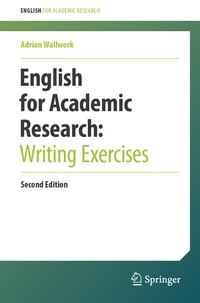
English for Academic Research: Writing Exercises
Description

This book is based on a study of referees' reports and letters from journal editors on reasons why papers written by non-native researchers are rejected due to problems with English (long sentences, redundancy, poor structure etc.).
The exercises in this new edition are organized into twelve chapters on:
- punctuation and spelling
- word order
- writing short sentences and paragraphs
- link words - connecting phrases and sentences together
- being concise and removing redundancy
- ambiguity and political correctness
- paraphrasing and avoiding plagiarism
- defining, comparing, evaluating and highlighting
- anticipating possible objections, indicating level of certainty, discussing limitations, hedging, future work
- using Large Language Models for writing papers, emails and presentation scripts
Some exercises require no actual writing but simply choosing between various options. In those exercises where extended writing is required, model answers are given.
The exercises can also be integrated into English for Academic Purposes (EAP) and English for Special Purposes (ESP) courses at universities and research institutes.
The book can be used in conjunction with the other exercise books in the series and is cross-referenced to:
English for Research: Usage, Style, and Grammar English for Writing Research Papers
English for Academic Research: Grammar Exercises
English for Academic Research: Teacher's Guide
Adrian Wallwork edits scientific papers and teaches English for Academic Purposes (EAP) to PhD students. In addition to his many books for Springer, he has written course books for Oxford University Press and discussion books for Cambridge University Press.
More details
Other editions
Additional editions
Previous edition
Person
Adrian Wallwork edits scientific papers and teaches English for Academic Purposes (EAP) to PhD students. In addition to his many books for Springer, he has written course books for Oxford University Press and discussion books for Cambridge University Press.
