

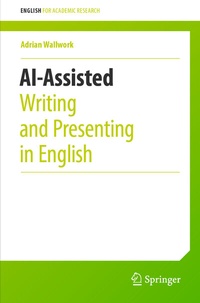
AI-Assisted Writing and Presenting in English
Description

This book is part of the English for Academic Research series. It shows university students and researchers how to optimize their use of chatbots and machine translation in order to correct the English usage of a research paper, and write emails, letters, and presentation scripts and slides in English. English-speaking language editors, translators, and EAP teachers will also find this book useful.
The main focus is on ChatGPT and Google Translate. However the techniques proposed will also work with equivalent tools. You will learn the areas where ChatGPT works well: correcting, improving, paraphrasing, reducing, and summarizing texts; generating / suggesting texts; answering queries; and simulating academic scenarios. A key strategy for enhancing the output of machine translation is to pre-edit and post-edit your texts - this book tells you how.
You will also learn what ChatGPT is currently NOT able to do, e.g. differentiating between 'essential' and 'non-essential'; listing all the changes it has made; highlighting your key findings; and advising you when you have written too much, plagiarized, used biased language, or forgotten to mention the limitations of your work.
The book lists over 170 prompts that you can use with a chatbot. The author recommends using ChatGPT as an assistant, but not for generating an entire paper.
Adrian Wallwork edits scientific papers and teaches English for Academic Purposes (EAP) to PhD students. In addition to his many books for Springer, he has written course books for Oxford University Press and discussion books for Cambridge University Press. He is passionate about exploiting the advances in artificial intelligence to help researchers around the world write and publish their work.
More details
Other editions
Additional editions
Person
Adrian Wallwork edits scientific papers and teaches English for Academic Purposes (EAP) to PhD students. In addition to his many books for Springer, he has written course books for Oxford University Press and discussion books for Cambridge University Press. He is passionate about exploiting the advances in artificial intelligence to help researchers around the world write and publish their work.
Content
Chapter 1 Being realistic about what AI can and cannot do.- Chapter 2 Prompts for correcting or paraphrasing your English.- Chapter 3 Pre-editing.- Chapter 4 ChatGPT as a language editor to check your English.- Chapter 5 How to interact with ChatGPT and simulate typical scenarios that take place in academia.- Chapter 6 Communicating with lay audiences.- Chapter 7 Presentations.- Chapter 8 Email and other forms of correspondence.- Chapter 9 The added value of a professional editing/translation agency.- Chapter 10 For EAP teachers: How to use AI in the classroom.- Back Matter.- Full table of contents.- Index.
