

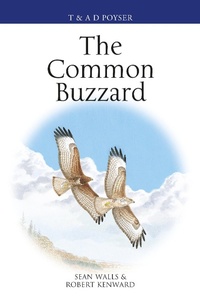
The Common Buzzard
1st Edition
Published on 23. January 2020
320 pages
978-1-4729-7002-2 (ISBN)
Description

'Based on many years of personal research, and a thorough knowledge of the European literature, the authors provide an eminently readable account of the biology of the Common Buzzard. Whatever your interests in birds, I can recommend this book for its content of information and insight.' - Professor Ian Newton OBE, FRS, FRSE
Soaring majestically on thermals with broad wings raised, the Common Buzzard is a familiar sight for many people across Eurasia. In fact, thanks to a remarkable ability to adapt to local conditions, it is now one of the most abundant hawks in the world. The Common Buzzard can exploit a variety of nest sites, and has an eclectic diet that ranges from earthworms and voles to woodpigeons and even deer carcasses.
This is a species rich in paradoxes. Why does a hawk evolved for hunting small mammals thrive on invertebrates and carrion? How can a raptor renowned for dramatic territorial displays occur at such high densities? And why does such a large bird that can travel long distances spend so much time in small areas? Sean Walls and Robert Kenward delve deep into the ecology of the Common Buzzard to provide answers to these questions and many more, as well as examining the conservation conundrums raised by this bird.
Bringing together a wealth of research on the species' origins, feeding behaviour and breeding, along with information on movement and survival from the authors' own studies, The Common Buzzard provides an invaluable insight into exactly what has enabled this marvellous raptor to return to old haunts to impress, inspire and connect people with nature.
Soaring majestically on thermals with broad wings raised, the Common Buzzard is a familiar sight for many people across Eurasia. In fact, thanks to a remarkable ability to adapt to local conditions, it is now one of the most abundant hawks in the world. The Common Buzzard can exploit a variety of nest sites, and has an eclectic diet that ranges from earthworms and voles to woodpigeons and even deer carcasses.
This is a species rich in paradoxes. Why does a hawk evolved for hunting small mammals thrive on invertebrates and carrion? How can a raptor renowned for dramatic territorial displays occur at such high densities? And why does such a large bird that can travel long distances spend so much time in small areas? Sean Walls and Robert Kenward delve deep into the ecology of the Common Buzzard to provide answers to these questions and many more, as well as examining the conservation conundrums raised by this bird.
Bringing together a wealth of research on the species' origins, feeding behaviour and breeding, along with information on movement and survival from the authors' own studies, The Common Buzzard provides an invaluable insight into exactly what has enabled this marvellous raptor to return to old haunts to impress, inspire and connect people with nature.
More details
Series
Edition
1. Auflage
Language
English
Place of publication
London
United Kingdom
Publishing group
Bloomsbury Publishing PLC
Target group
Professional and scholarly
Illustrations
8pp colour photo section, 10 black and white line artworks
ISBN-13
978-1-4729-7002-2 (9781472970022)
Copyright in bibliographic data and cover images is held by Nielsen Book Services Limited or by the publishers or by their respective licensors: all rights reserved.
Schweitzer Classification
Other editions
Additional editions
Sean Walls | Robert Kenward
The Common Buzzard
Book
01/2020
T & AD Poyser
€112.85
Article not available at the moment
Sean Walls | Robert Kenward
The Common Buzzard
Book
01/2020
T & AD Poyser
€63.33
Article not available at the moment
Persons
Awed and inspired by wildlife, and especially raptors, both Sean Walls and Robert Kenward read Zoology at the University of Oxford before going on to carry out radio-tracking and other research on a variety of animals. In 1990, they started a project on the Common Buzzard with the government agency The Institute of Terrestrial Ecology and the company Biotrack Ltd. Until that point, Buzzards had only been studied visually, but by using radio-tracking techniques to study many individuals the team were able to conduct groundbreaking research on survival, foraging and dispersal
movements of the species.
Sean Walls has spent the last 30 years advising people on the best animal-tracking equipment, and currently directs the Avian Segment for Lotek Wireless Inc. During this time he has also enjoyed free-flying a Common Buzzard, acquired from domestic breeding, which has helped provide invaluable insights into their behaviour. Sean is currently an Associate Editor of the Journal of Raptor Research.
Robert Kenward has been conducting fieldwork and writing books, including A Manual for Wildlife Radio Tagging and The Goshawk, to inform and help ecologists for 40 years, with interludes for wider technology transfer. He now chairs groups for the International Union for Conservation of Nature (IUCN), and still enjoys working with raptors and conservation networks, both local and global.
movements of the species.
Sean Walls has spent the last 30 years advising people on the best animal-tracking equipment, and currently directs the Avian Segment for Lotek Wireless Inc. During this time he has also enjoyed free-flying a Common Buzzard, acquired from domestic breeding, which has helped provide invaluable insights into their behaviour. Sean is currently an Associate Editor of the Journal of Raptor Research.
Robert Kenward has been conducting fieldwork and writing books, including A Manual for Wildlife Radio Tagging and The Goshawk, to inform and help ecologists for 40 years, with interludes for wider technology transfer. He now chairs groups for the International Union for Conservation of Nature (IUCN), and still enjoys working with raptors and conservation networks, both local and global.
Content
Preface
1 A Common Buzzard
2 Prey
3 Hunting
4 Habitat use
5 Territoriality and nest defence
6 Courtship and nesting
7 Incubating and chick-rearing
8 Dispersal and migration
9 Longevity and survival
10 Common Buzzard populations
11 Our relationship with the Common Buzzard
Appendix 1 Scientific names of species mentioned in the text
Appendix 2 References for figures with many sources
Appendix 3 Map of UK study sites and flightpaths
Appendix 4 Abbreviations
References
Index
1 A Common Buzzard
2 Prey
3 Hunting
4 Habitat use
5 Territoriality and nest defence
6 Courtship and nesting
7 Incubating and chick-rearing
8 Dispersal and migration
9 Longevity and survival
10 Common Buzzard populations
11 Our relationship with the Common Buzzard
Appendix 1 Scientific names of species mentioned in the text
Appendix 2 References for figures with many sources
Appendix 3 Map of UK study sites and flightpaths
Appendix 4 Abbreviations
References
Index
