

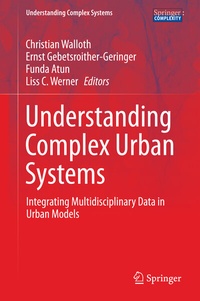
Understanding Complex Urban Systems
Description

This book is devoted to the modeling and understanding of complex urban systems. This second volume of Understanding Complex Urban Systems focuses on the challenges of the modeling tools, concerning, e.g., the quality and quantity of data and the selection of an appropriate modeling approach. It is meant to support urban decision-makers-including municipal politicians, spatial planners, and citizen groups-in choosing an appropriate modeling approach for their particular modeling requirements. The contributors to this volume are from different disciplines, but all share the same goal: optimizing the representation of complex urban systems. They present and discuss a variety of approaches for dealing with data-availability problems and finding appropriate modeling approaches-and not only in terms of computer modeling.
The selection of articles featured in this volume reflect a broad variety of new and established modeling approaches such as:
- An argument for using Big Data methods in conjunction with Agent-based Modeling;
- The introduction of a participatory approach involving citizens, in order to utilize an Agent-based Modeling approach to simulate urban-growth scenarios;
- A presentation of semantic modeling to enable a flexible application of modeling methods and a flexible exchange of data;
- An article about a nested-systems approach to analyzing a city's interdependent subsystems (according to these subsystems' different velocities of change);
- An article about methods that use Luhmann's system theory to characterize cities as systems that are composed of flows;
- An article that demonstrates how the Sen-Nussbaum Capabilities Approach can be used in urban systems to measure household well-being shifts that occur in response to the resettlement of urban households;
- A final article that illustrates how Adaptive Cycles of Complex Adaptive Systems, as well as innovation, can be applied to gain a better understanding of cities and to promote more resilient and more sustainable urban futures.
More details
Other editions
Additional editions
Content
Introduction.- Combining Agent-Based Modeling with Big Data Methods to Support.- Urban Development Simulator: How Can Participatory Data Gathering Support Modeling of Complex Urban Systems.- Bypassing Data Unavailability in Urban Systems Modeling.- Big Data? No Data. How to Pro-actively Deal With Unexpected Change in Cities Where (Big) Data is Not Available.- Conceptualizing the Urban System as a System of Flows.- Operationalizing the Capabilities Approach for Modeling Household Welfare Shifts in Urban Systems: A Special Focus on the Transportation Outcomes of Urban Resettlement.- Interventions in Complex Urban Systems: How to Enable Modeling to Account for Disruptive Innovation.
