

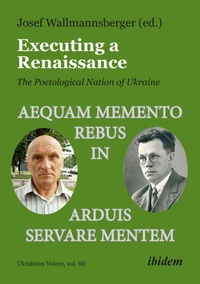
Executing a Renaissance: The Poetological Nation of Ukraine
Description

Whoever may have expected that Ukraine's "Executed Renaissance"-i.e. the annihilation of the most creative, innovative and productive poets, thinkers, and artists in the 1920ies and 1930ies-may gloomily, but finally have receded to a distant past and remains a highly stimulating and controversial topic only for specialists in the fields of Ukrainian poetry, literature, and philosophy, will have experienced a distinct reminder that history is not finished. The "Executed Renaissance" is not even past in an independent Ukraine fighting for its liberty and cultural survival against genocidal imperialist aggression.
Executing a Renaissance as the title of this collection responds both to the poets, thinkers, and scholars who are again persecuted and executed by the Russian soldateska. It is also an attempt at existential optimism against all odds, made possible by the courage and determination of the Ukrainian people. It insists on the monumental fact of the matter that Ukrainian intellectuals and artists are in the process of executing cultural and linguistic Renaissances in the grimmest of circumstances.
With contributions by Olga Bertelsen, Polly Corrigan, Victoria Malko, Josef Wallmannsberger, and Mykola Zerov.
More details
Other editions
Additional editions
Persons
Dr. Josef Wallmannsberger is Professor of Computational Linguistics at the University of Kassel. A native Austrian, he was educated in Classics, Linguistics, and Philosophy at the universities of Innsbruck, Salzburg, Konstanz, and Stanford, and taught at the universities of Leicester, Innsbruck, and Siegen. He was inducted to the highly arcane order of aficionados of Ukrainian neoclassicist literature during conversations with Polish and Ukrainian scholars in the basement cafeteria at Humboldt Univesity, East Berlin. Both the city and the scholar have fittingly opted to continue their existence in parallel imaginaries ever open for semiotic walkabouts. Relevant publications in this context include Kritische Apparate (Semiotica 2002), and Heteroglossaries: Philological Inventions of Ukraine (Innsbruck UP 2023).
