

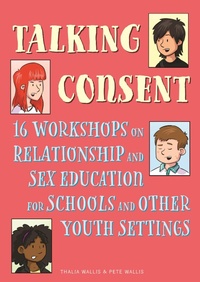
Talking Consent
16 Workshops on Relationship and Sex Education for Schools and Other Youth Settings
Published on 21. October 2020
304 pages
978-1-78775-082-1 (ISBN)
Description

This book provides teachers and parents with the 'need-to-knows' to educate groups of young people about consent, pornography, sexting and many other related topics, as well as giving them the tools to ward themselves against abusive behaviour.
Initiating a discussion with young people on topics around sex can seem daunting, but Talking Consent is full of lesson plans, workshops and creative ideas for introducing and promoting constructive discussions around these areas - while also dispelling common myths, and giving appropriate answers to difficult questions that may arise from these discussions.
Inclusive of everybody, including the LGBT+ community and people with disabilities, this book will provide professionals with the information they need to spark and shape conversation around these complex issues in an assured way.
Initiating a discussion with young people on topics around sex can seem daunting, but Talking Consent is full of lesson plans, workshops and creative ideas for introducing and promoting constructive discussions around these areas - while also dispelling common myths, and giving appropriate answers to difficult questions that may arise from these discussions.
Inclusive of everybody, including the LGBT+ community and people with disabilities, this book will provide professionals with the information they need to spark and shape conversation around these complex issues in an assured way.
More details
Edition
Digital original
Language
English
Place of publication
London
United Kingdom
Target group
Professional and scholarly
Primary & secondary/elementary & high school
Interest Age: From 12 to 99 years
Edition type
Digital original
File size
6,94 MB
ISBN-13
978-1-78775-082-1 (9781787750821)
Copyright in bibliographic data and cover images is held by Nielsen Book Services Limited or by the publishers or by their respective licensors: all rights reserved.
Schweitzer Classification
Other editions
Additional editions
Pete Wallis | Thalia Wallis
Talking Consent
16 Workshops on Relationship and Sex Education for Schools and Other Youth Settings
Book
10/2020
Jessica Kingsley Publishers
€37.50
Shipment within 15-20 days
Persons
Pete Wallis is Senior Practitioner (Restorative Justice) for Oxfordshire Youth Offending Service UK and a founding member of the charity SAFE! Support for young people affected by crime. He has written and co-written several books on restorative justice and related topics for JKP.
Content
- Intro
- Talking Consent
- Cover
- Title page
- Copyright
- Contents
- Introduction
- Workshop 1. What Does Consent Really Mean?
- Exercise 1: Introducing Consent
- Exercise 2: Exploring Values and Beliefs - Group Debate
- Exercise 3: Defining Consent
- Exercise 4: Exploring Freedom and Capacity
- Exercise 5: Free Choice and Forced 'Choice' Continuum
- Exercise 6: The Rules of Consent - Case Studies
- Exercise 7: Is Consent as Simple as a Cup of Tea?
- Workshop 2. Personal Space
- Exercise 1: Personal Space
- Exercise 2: Exploring My Boundaries
- Exercise 3: Personal Boundaries
- Exercise 4: Exploring Different Types of Personal Boundaries
- Exercise 5: Rights and Responsibilities
- Workshop 3. Protective Behaviours
- Exercise 1: Exploring Values and Beliefs - Group Debate
- Exercise 2: Creative Group Exercise - Body Map
- Exercise 3: Survival Mode
- Exercise 4: Sense of Adventure
- Exercise 5: The Safety Continuum
- Workshop 4. What the Law Says
- Exercise 1: Interactive Quiz
- Exercise 2: Exploring Values and Beliefs - Group Debate
- Exercise 3: Legal or Illegal?
- Exercise 4: The History of the Law
- Exercise 5: Consent Laws Across the Globe
- Exercise 6: If Something Happens, What Happens Next?
- Workshop 5. Social and Antisocial Media
- Exercise 1: Exploring Values and Beliefs - Group Debate
- Exercise 2: Exploring Social Media Platforms
- Exercise 3: Exploring the #MeToo Movement
- Exercise 4: Exploring 'Catfishing'
- Exercise 5: Cyberbullying Behaviours
- Exercise 6: Exploring Our Online Behaviour
- Exercise 7: Bystanders and Upstanders
- Exercise 8: Prevention Is Better Than Cure
- Workshop 6. Sexting and Nudes
- Exercise 1: Exploring Nude Photos and Sexting
- Exercise 2: Quiz - What the Law Says
- Exercise 3: The Impact of Sexting and Nudes
- Exercise 4: Pass the Pulse
- Exercise 5: In Control
- Workshop 7. Dating and Relationships
- Exercise 1: Exploring Values and Beliefs - Group Debate
- Exercise 2: Exploring Healthy Relationships
- Exercise 3: One Size Doesn't Fit All
- Exercise 4: Managing Strong Emotions and Endings
- Exercise 5: Ending a Relationship
- Exercise 6: Speed Endings - Role Plays
- Exercise 7: Coping with Break-Ups
- Exercise 8: Agony Aunts and Uncles
- Workshop 8. Power, Control and Harassment
- Exercise 1: Exploring Unhealthy Relationships
- Exercise 2: Relational Violence and Abuse
- Exercise 3: Media Messages about Relationships
- Exercise 4: Power, Control and Equality
- Exercise 5: Power, Control and Exploitation
- Exercise 6: Exploring Sexual Harassment
- Exercise 7: Equality and Upstanding
- Workshop 9. Drugs, Alcohol and Consent
- Exercise 1: Quick Decision Making
- Exercise 2: Exploring Values and Beliefs - Group Debate
- Exercise 3: Alcohol, Drugs and Our Brains
- Exercise 4: Drugs, Alcohol, Sexual Behaviour and Consent
- Exercise 5: Under the Influence
- Exercise 6: Exploring Campaigns
- Exercise 7: Why? vs Why Not?
- Exercise 8: Role Play - 'Persuade Me'
- Exercise 9: How Much Is Too Much?
- Exercise 10: Skills Practice
- Workshop 10. Communication
- Exercise 1: Exploring Communication - Silent Birthday Line-Up
- Exercise 2: Verbal Communication and Active Listening
- Exercise 3: Nonverbal Communication and Teamwork
- Exercise 4: Types of Communication
- Exercise 5: Facts and Interpretations
- Exercise 6: Communication Styles
- Exercise 7: How to Be Assertive
- Exercise 8: Yes-No-Unsure
- Workshop 11. Rape Culture (Including Gender Double Standards, Sexual Objectification and Victim Blaming)
- Exercise 1: Exploring Values and Beliefs - Group Debate
- Exercise 2: Definitions
- Exercise 3: Challenging Victim Blaming
- Exercise 4: Exploring Rape Culture
- Exercise 5: Dismantling the Pyramid
- Workshop 12. Pornography
- Exercise 1: Introduction to Pornography/Porn
- Exercise 2: Exploring Values and Beliefs - Group Debate
- Exercise 3: Pornography Quiz
- Exercise 4: World Café - Exploring the Impact of Porn
- Exercise 5: When it Comes to Porn.
- Exercise 6: Challenging Beliefs
- Workshop 13. Positive Sexuality
- Exercise 1: Exploring Values and Beliefs - Group Debate
- Exercise 2: My Personal Values and Beliefs
- Exercise 3: Myth or Fact?
- Exercise 4: Readiness for Sex
- Exercise 5: Masturbation and Self-Pleasure
- Exercise 6: Practising Consent Agreements - The Wheel of Consent
- Exercise 7: Frequently and Non-Frequently Asked Questions
- Workshop 14. Gender Expectations
- Exercise 1: Exploring Values and Beliefs - Group Debate
- Exercise 2: Sex, Gender and Gender Identity
- Exercise 3: Gender Identity
- Exercise 4: Exploring Gender Expectations and Pressure
- Exercise 5: Exploring Gender Stereotypes in the Media
- Exercise 6: Societal 'Norms'
- Exercise 7: If I Could Ask Anything, It Would Be.
- Workshop 15. Resilience, Self-Esteem and Body Image
- Exercise 1: Emotional Alphabet Icebreaker
- Exercise 2: Exploring Emotions
- Exercise 3: Emotional Health
- Exercise 4: Body Image
- Exercise 5: Exploring Resilience
- Exercise 6: A Resilient Mindset
- Workshop 16. Equality, Diversity, Inclusion and Individuality
- Exercise 1: Stand Up If.
- Exercise 2: Exploring Values and Beliefs - Group Debate
- Exercise 3: Difference and Diversity
- Exercise 4: Exploring Gender and Sexuality as a Spectrum
- Exercise 5: The Equality Journey and Celebrating Difference
- Exercise 6: Respecting, Accepting and Celebrating Difference
- Exercise 7: Inclusion
- Appendix 1. Ten Principles of PSHE Education
- Appendix 2. Information about RSE
- Appendix 3. Key Organizations
- Appendix 4. Resources Out There
- Appendix 5. Working in a Circle
- Appendix 6. Eliciting Ground Rules
- Appendix 7. Example Ground Rules
- Appendix 8. The Body Scan: A Grounding/Ending Exercise
- Appendix 9. Games and Safe Place Visualization
- Ultimate Rock, Paper, Scissors
- Count 21
- Safe Place - Facilitator-Guided Visualization
- Acknowledgements
