

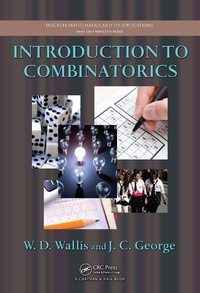
Introduction to Combinatorics
Published on 7. September 2010
396 pages
978-1-4398-9499-6 (ISBN)
Description

Accessible to undergraduate students, Introduction to Combinatorics presents approaches for solving counting and structural questions. It looks at how many ways a selection or arrangement can be chosen with a specific set of properties and determines if a selection or arrangement of objects exists that has a particular set of properties.To give stu
Reviews / Votes
... thoughtfully written, contain[s] plenty of material and exercises ... provides numerous fragments of Mathematica code and this is a nice touch. ...-MAA Reviews, February 2011 ... thoughtfully written, contain[s] plenty of material and exercises ... provides numerous fragments of Mathematica code and this is a nice touch. ...
-MAA Reviews, February 2011
More details
Series
Language
English
Place of publication
London
United Kingdom
Publishing group
Taylor & Francis Ltd
Target group
College/higher education
Illustrations
154 s/w Abbildungen
154 b/w images and 79 in text boxes
File size
2,99 MB
ISBN-13
978-1-4398-9499-6 (9781439894996)
Copyright in bibliographic data and cover images is held by Nielsen Book Services Limited or by the publishers or by their respective licensors: all rights reserved.
Schweitzer Classification
Other editions
Additional editions
Walter D. Wallis | John C. George
Introduction to Combinatorics
Book
09/2010
1st Edition
Taylor & Francis
€81.70
Article exhausted; check for reprint
Persons
W.D. Wallis is Emeritus Professor of Mathematics at Southern Illinois University. His research interests include combinatorial designs, Latin squares, graph labeling, one-factorizations, and intelligent networks. Dr. Wallis is the author of Introduction to Combinatorial Designs, Second Edition (CRC Press, 2007).
J.C. George is an assistant professor of mathematics in the Division of Mathematics and Natural Sciences at Gordon College in Barnesville, Georgia. His research interests include one-factorizations, graph products, and the relationships of algebraic structures to combinatorial objects.
J.C. George is an assistant professor of mathematics in the Division of Mathematics and Natural Sciences at Gordon College in Barnesville, Georgia. His research interests include one-factorizations, graph products, and the relationships of algebraic structures to combinatorial objects.
Content
Introduction. Fundamentals of Enumeration. The Pigeonhole Principle and Ramsey's Theorem. The Principle of Inclusion and Exclusion. Generating Functions and Recurrence Relations. Catalan, Bell and Stirling Numbers. Symmetries and the Polya-Redfield Method. Introduction to Graph Theory. Further Graph Theory. Coding Theory. Latin Squares. Balanced Incomplete Block Designs. Linear Algebra Methods in Combinatorics. Appendices. Solutions to Set A Exercises. Hints for Problems. Solutions to Problems. References. Index.
