

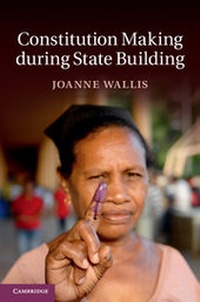
Constitution Making during State Building
1st Edition
Published on 3. September 2014
978-1-316-15698-8 (ISBN)
Description

How can fragmented, divided societies that are not immediately compatible with centralised statehood best adjust to state structures? This book employs both comparative constitutional law and comparative politics, as it proposes the idea of a 'constituent process', whereby public participation in constitution making plays a positive role in state building. This can help to foster a sense of political community and produce a constitution that enhances the legitimacy and effectiveness of state institutions because a liberal-local hybrid can emerge to balance international liberal practices with local customary ones. This book represents a sustained attempt to examine the role that public participation has played during state building and the consequences it has had for the performance of the state. It is also the first attempt to conduct a detailed empirical study of the role played by the liberal-local-hybrid approach in state building.
Reviews / Votes
'Joanne Wallis has made an extraordinary contribution to our understanding of the constituent process in twenty-first-century state-building. Based on empirically grounded studies of constitution-making processes in Timor-Leste and Bougainville, Wallis uses a comparative historical method to explore how public participation in constitution-making processes may assist state-building in deeply divided societies. Wallis persuasively argues that the effectiveness of new state institutions is linked to the success in achieving a liberal-local hybridity through popular participation. Her contextually rich analysis is a must-read for lawyers, political scientists, and policy makers around the world who are confronted with the failure of state institutions that were imposed or inherited in the postcolonial and World War II era.' Heinz Klug, Evjue-Bascom Professor of Law and Director of the Global Legal Studies Center, University of Wisconsin Law School 'One of the signal successes of [Wallis's] book is her thorough and wide-ranging survey of the literature on the topic. Moreover, she draws from the survey an extensive and detailed menu for constitutional planning committees on how best to go about creating a process that includes broad representation and that shows due respect for all segments of the new state.' Jean G. Zorn, Pacific AffairsMore details
Language
English
Place of publication
Cambridge
United Kingdom
Publishing group
Cambridge University Press
Target group
Professional and scholarly
Illustrations
2 Tables, unspecified; 3 Maps
File size
3157,80 MB
ISBN-13
978-1-316-15698-8 (9781316156988)
Copyright in bibliographic data and cover images is held by Nielsen Book Services Limited or by the publishers or by their respective licensors: all rights reserved.
Schweitzer Classification
Other editions
Additional editions
Joanne Wallis
Constitution Making during State Building
Book
08/2016
Cambridge University Press
€51.90
Shipment within 15-20 days
Joanne Wallis
Constitution Making during State Building
Book
09/2014
Cambridge University Press
€143.60
Shipment within 15-20 days
Person
Joanne Wallis is a lecturer in the College of Asia and the Pacific at the Australian National University, Canberra. She has previously taught at the University of Cambridge, the University of Melbourne and Swinburne University of Technology, Victoria. She completed her PhD in politics and international studies at the University of Cambridge in 2011. From January 2009 to January 2012 she was an honorary Fellow of the School of Social and Political Sciences at the University of Melbourne. In 2006, she was a Fulbright Scholar at the Walker Institute of International and Area Studies at the University of South Carolina. She has also worked as a lawyer and has conducted research consultancies for Australian and international NGOs. Her research considers the role that constitution making plays in building states and nations in post-conflict societies, with a particular emphasis on the opportunities for engagement between liberal and local approaches to law, governance and development.
Content
Part I. Normative Justification for Participatory Constitution Making: 1. The normative justification; 2. A constituent process; Part II. Minimal Participation in Timor-Leste: 3. State building and constitution making in Timor-Leste; 4. Constituent power in Timor-Leste; 5. Constituted power in Timor-Leste; Part III. Extensive Participation in Bougainville: 6. State building and constitution making in Bougainville; 7. Constituent power in Bougainville; 8. Constituted power in Bougainville; Part IV. Evidence for and against Participatory Constitution Making: 9. Comparing the constitution-making processes; 10. Role in state building.
