

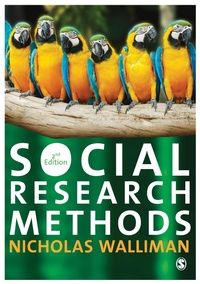
Social Research Methods
The Essentials
2nd Edition
Published on 3. December 2015
264 pages
978-1-4739-5274-4 (ISBN)
Description

Nicholas Walliman is the supervisor in your students' pockets, making sure they understand all the essential methods for successfully carrying out a research project and negotiating the challenges and pitfalls. In this book, he:
? Takes students step-by-step through the research process
? Helps them formulate clear aims and objectives
? Explains all the vocabulary to understand the A - Z of research methods
? Ends each chapter with a reading guide for taking learning further with more resources to help get a deeper understanding of the issues discussed
? Improves research reports with practical advice on presenting findings in great tables, graphs and diagrams
? Opens his office door with reflective questions (and answers)
? Delivers the confidence to get started and get finished!
Social Research Methods: The Essentials is the perfect starting point and guide for your students' research project.
? Takes students step-by-step through the research process
? Helps them formulate clear aims and objectives
? Explains all the vocabulary to understand the A - Z of research methods
? Ends each chapter with a reading guide for taking learning further with more resources to help get a deeper understanding of the issues discussed
? Improves research reports with practical advice on presenting findings in great tables, graphs and diagrams
? Opens his office door with reflective questions (and answers)
? Delivers the confidence to get started and get finished!
Social Research Methods: The Essentials is the perfect starting point and guide for your students' research project.
Reviews / Votes
This text takes a well-balanced view of research in the social sciences and gives the reader a basic theoretical grounding and structure on which to develop their understanding of research and support their practices. The theory and methods discussed in this edition would be of interest to a wide range of disciplines where research considers the thoughts, feelings and actions of people. -- Frances TracyMore details
Edition
Second Edition
Language
English
Place of publication
London
United Kingdom
Target group
College/higher education
Product notice
Reflowable
File size
0,80 MB
ISBN-13
978-1-4739-5274-4 (9781473952744)
Copyright in bibliographic data and cover images is held by Nielsen Book Services Limited or by the publishers or by their respective licensors: all rights reserved.
Schweitzer Classification
Other editions
Additional editions
Book
12/2015
2nd Edition
SAGE Publications Ltd
€76.70
Shipment within 15-20 days
Book
12/2015
2nd Edition
SAGE Publications Ltd
€142.50
Shipment within 15-20 days
Person
After twenty years in architectural practice in Scotland, England and Switzerland designing a wide range of buildings, industrial, commercial, residential, and renovating and restoring historic buildings, I returned to academic activities when I embarked on a Ph.D. at Oxford Brookes University.
My university teaching and examining experience has been at all levels, with the preponderance at postgraduate level. I have supervised to successful completion twenty Ph.D. students and two MPhils, 1 KTP, and examined 13 Ph.D. candidates. I have published several popular textbooks and guides on construction aspects and on how to do research for students and practitioners and how to write Ph.D. theses, Masters and Undergraduate dissertations.
As Senior Researcher, Oxford Institute of Sustainable Development - Architectural Engineering Group, my research was based mainly on the technology of building construction - innovative, existing and historic, on vernacular architecture, and issues regarding accessibility in buildings and surroundings. My published papers and reports are read internationally and have been presented at international conferences.
My university teaching and examining experience has been at all levels, with the preponderance at postgraduate level. I have supervised to successful completion twenty Ph.D. students and two MPhils, 1 KTP, and examined 13 Ph.D. candidates. I have published several popular textbooks and guides on construction aspects and on how to do research for students and practitioners and how to write Ph.D. theses, Masters and Undergraduate dissertations.
As Senior Researcher, Oxford Institute of Sustainable Development - Architectural Engineering Group, my research was based mainly on the technology of building construction - innovative, existing and historic, on vernacular architecture, and issues regarding accessibility in buildings and surroundings. My published papers and reports are read internationally and have been presented at international conferences.
Content
PART ONE: PLANNING AND DESIGNING YOUR RESEARCH
Chapter 1: Theoretical background
Chapter 2: Research basics
Chapter 3: Research strategies and design
Chapter 4: The nature of data
Chapter 5: Doing a literature review
Chapter 6: Defining the research problem
Chapter 7: Ethics
Chapter 8: Writing a research proposal
PART TWO: COLLECTING AND ANALYSING YOUR DATA
Chapter 9: Sampling
Chapter 10: Data collection methods
Chapter 11: Quantitative data analysis
Chapter 12: Qualitative data analysis
PART THREE: WRITING UP YOUR RESEARCH
Chapter 13: Presenting Data Graphically
Chapter 14: Writing up a dissertation or research project
PART FOUR: SUCCEEDING IN YOUR RESEARCH METHODS COURSE
Chapter 15: How to get the most out of your lectures and seminars
Chapter 16: How to Get the Best out of Reading and Note Taking
Chapter 17: How to Write Great Essays
Chapter 1: Theoretical background
Chapter 2: Research basics
Chapter 3: Research strategies and design
Chapter 4: The nature of data
Chapter 5: Doing a literature review
Chapter 6: Defining the research problem
Chapter 7: Ethics
Chapter 8: Writing a research proposal
PART TWO: COLLECTING AND ANALYSING YOUR DATA
Chapter 9: Sampling
Chapter 10: Data collection methods
Chapter 11: Quantitative data analysis
Chapter 12: Qualitative data analysis
PART THREE: WRITING UP YOUR RESEARCH
Chapter 13: Presenting Data Graphically
Chapter 14: Writing up a dissertation or research project
PART FOUR: SUCCEEDING IN YOUR RESEARCH METHODS COURSE
Chapter 15: How to get the most out of your lectures and seminars
Chapter 16: How to Get the Best out of Reading and Note Taking
Chapter 17: How to Write Great Essays
