

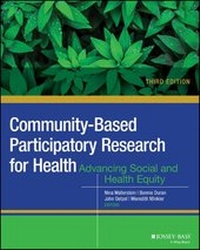
Community-Based Participatory Research for Health
Description

More details
Other editions
Additional editions
Persons
Content
The Editors xiii
The Contributors xv
Preface xxxiii
Camara Phyllis Jones
Acknowledgments xxxvii
PART ONE: INTRODUCTION: HISTORY AND PRINCIPLES
ONE: ON COMMUNITY-BASED PARTICIPATORY RESEARCH 3
Nina Wallerstein, Bonnie Duran, John G. Oetzel, and Meredith Minkler
TWO: THEORETICAL, HISTORICAL, AND PRACTICE ROOTS OF CBPR 17
Nina Wallerstein and Bonnie Duran
THREE: CRITICAL ISSUES IN DEVELOPING AND FOLLOWING CBPR PRINCIPLES 31
Barbara A. Israel, Amy J. Schulz, Edith A. Parker, Adam B. Becker, Alex J. Allen, III, J. Ricardo Guzman, and Richard Lichtenstein
PART TWO: POWER, TRUST, AND DIALOGUE: WORKING WITH DIVERSE COMMUNITIES
FOUR: UNDERSTANDING CONTEMPORARY RACISM, POWER, AND PRIVILEGE AND THEIR IMPACTS ON CBPR 47
Michael Muhammad, Catalina Garzón, Angela Reyes, and The West Oakland Environmental Indicators Project
FIVE: TRUST DEVELOPMENT IN CBPR PARTNERSHIPS 61
Julie E. Lucero, Kathrine E. Wright, and Abigail Reese
PART THREE: CBPR CONCEPTUAL MODEL: CONTEXT AND PROMISING RELATIONSHIP PRACTICES
SIX: SOCIO-ECOLOGIC FRAMEWORK FOR CBPR: DEVELOPMENT AND TESTING OF A MODEL 77
Sarah L. Kastelic, Nina Wallerstein, Bonnie Duran, and John G. Oetzel
SEVEN: YOUTH-LED PARTICIPATORY ACTION RESEARCH (YPAR): PRINCIPLES APPLIED TO THE US AND DIVERSE GLOBAL SETTINGS 95
Emily J. Ozer and Amber Akemi Piatt
EIGHT:PARTNERSHIP, TRANSPARENCY, AND ACCOUNTABILITY: CHANGING SYSTEMS TO ENHANCE RACIAL EQUITY IN CANCER CARE AND OUTCOMES 107
Eugenia Eng, Jennifer Schaal, Stephanie Baker, Kristin Black, Samuel Cykert, Nora Jones, Alexandra Lightfoot, Linda Robertson, Cleo Samuel, Beth Smith, and Kari Thatcher
NINE:SOUTH VALLEY PARTNERS FOR ENVIRONMENTAL JUSTICE: A STORY OF ALIGNMENT AND MISALIGNMENT 123
Magdalena Avila, Shannon Sanchez-Youngman, Michael Muhammad, Lauro Silva, and Paula Domingo de Garcia
PART FOUR: PROMISING PRACTICES: INTERVENTION DEVELOPMENT AND RESEARCH DESIGN
TEN: CBPR IN HEALTH CARE SETTINGS 141
Margarita Alegría, Chau Trinh-Shevrin, Bowen Chung, Andrea Ault, Alisa Lincoln, and Kenneth B. Wells
ELEVEN: NATIONAL CENTER FOR DEAF HEALTH RESEARCH: CBPR WITH DEAF COMMUNITIES 157
Steven Barnett, Jessica Cuculick, Lori Dewindt, Kelly Matthews, and Erika Sutter
TWELVE: CBPR IN ASIAN AMERICAN COMMUNITIES 175
Nadia Islam, Charlotte Yu-Ting Chang, Pam Tau Lee, and Chau Trinh-Shevrin
THIRTEEN: ENGAGED FOR CHANGE: AN INNOVATIVE CBPR STRATEGY TO INTERVENTION DEVELOPMENT 189
Scott D. Rhodes, Lilli Mann, Florence M. Simán, Jorge Alonzo, Aaron T. Vissman, Jennifer Nall, and Amanda E. Tanner
PART FIVE: PROMISING PRACTICES: ETHICAL ISSUES
FOURTEEN:CBPR PRINCIPLES AND RESEARCH ETHICS IN INDIAN COUNTRY 207
Myra Parker
FIFTEEN: DEMOCRATIZING ETHICAL OVERSIGHT OF RESEARCH THROUGH CBPR 215
Rachel Morello-Frosch, Phil Brown, and Julia Green Brody
SIXTEEN: EVERYDAY CHALLENGES IN THE LIFE CYCLE OF CBPR: BROADENING OUR BANDWIDTH ON ETHICS 227
Sarah Flicker, Adrian Guta, and Robb Travers
PART SIX: PROMISING PRACTICES TO OUTCOMES: CBPR CAPACITY AND HEALTH
SEVENTEEN: EVALUATION OF CBPR PARTNERSHIPS AND OUTCOMES: LESSONS AND TOOLS FROM THE RESEARCH FOR IMPROVED HEALTH STUDY 237
John G. Oetzel, Bonnie Duran, Andrew Sussman, Cynthia Pearson, Maya Magarati, Dmitry Khodyakov, and Nina Wallerstein
EIGHTEEN:PARTICIPATORY EVALUATION AS A PROCESS OF EMPOWERMENT: EXPERIENCES WITH COMMUNITY HEALTH WORKERS IN THE UNITED STATES AND LATIN AMERICA 251
Noelle Wiggins, Laura Chanchien Parajón, Chris M. Coombe, Aileen Alfonso Duldulao, Leticia Rodriguez Garcia, and Pei-Ru Wang
NINETEEN: ACADEMIC POSITIONS FOR FACULTY OF COLOR: COMBINING LIFE CALLING, COMMUNITY SERVICE, AND RESEARCH 265
Lorenda Belone, Derek M. Griffith, and Barbara Baquero
PART SEVEN: PROMISING PRACTICES TO OUTCOMES: HEALTHY PUBLIC POLICY
TWENTY: COMMUNITY-BASED PARTICIPATORY RESEARCH FOR HEALTH EQUITY POLICY MAKING 277
Lisa Cacari-Stone, Meredith Minkler, Nicholas Freudenberg, and Makani N. Themba
TWENTY ONE: IMPROVING FOOD SECURITY AND TOBACCO CONTROL THROUGH POLICY-FOCUSED CBPR: A CASE STUDY OF HEALTHY RETAIL IN SAN FRANCISCO 293
Meredith Minkler, Jennifer Falbe, Susana Hennessey Lavery, Jessica Estrada, and Ryan Thayer
TWENTY TWO: CRIMINAL JUSTICE REFORM THROUGH PARTICIPATORY ACTION RESEARCH 305
Saneta deVuono-Powell, Meredith Minkler, Evan Bissell, Tamisha Walker, LaVern Vaughn, Eli Moore, and The Morris Justice Project
TWENTY THREE: GLOBAL HEALTH POLICY: SLUM SETTLEMENT MAPPING IN NAIROBI AND RIO DE JANEIRO 321
Jason Corburn, Ives Rocha, Alexei Dunaway, and Jack Makau
APPENDIX 1: CHALLENGING OURSELVES: CRITICAL SELF-REFLECTION ON POWER AND PRIVILEGE 337
Cheryl Hyde
APPENDIX 2: GUIDING CBPR PRINCIPLES: FOSTERING EQUITABLE HEALTH CARE FOR LGBTQ+ PEOPLE 345
Miria Kano, Kelley P. Sawyer, and Cathleen E. Willging
APPENDIX 3: QUALITY CRITERIA OF THE INTERNATIONAL COLLABORATION FOR PARTICIPATORY HEALTH RESEARCH (ICPHR) 351
Michael T. Wright
APPENDIX 4: CULTURAL HUMILITY: REFLECTIONS AND RELEVANCE FOR CBPR 357
Vivian Chávez
APPENDIX 5: FUNDING IN CBPR IN US GOVERNMENT AND PHILANTHROPY 363
Laura C. Leviton and Lawrence W. Green
APPENDIX 6: REALIST EVALUATION AND REVIEW FOR COMMUNITY-BASED PARTICIPATORY RESEARCH: WHAT WORKS, FOR WHOM, UNDER WHAT CIRCUMSTANCES, AND HOW? 369
Justin Jagosh
APPENDIX 7: PARTNERSHIP RIVER OF LIFE: CREATING A HISTORICAL TIME LINE 375
Shannon Sanchez-Youngman and Nina Wallerstein
APPENDIX 8: PURPOSING A COMMUNITY-GROUNDED RESEARCH ETHICS TRAINING INITIATIVE 379
Cynthia Pearson and Victoria Sánchez
APPENDIX 9: PARTNERSHIP AGREEMENTS: A PRACTICAL GUIDE TO DEVELOPING DATA SHARING, OWNERSHIP, AND PUBLISHING AGREEMENTS 385
Patricia Rodríguez Espinosa and Al Richmond
APPENDIX 10: INSTRUMENTS AND MEASURES FOR EVALUATING COMMUNITY ENGAGEMENT AND PARTNERSHIPS 393
Nina Wallerstein
APPENDIX 11: PARTICIPATORY MONITORING AND EVALUATION OF COMMUNITY HEALTH INITIATIVES USING THE COMMUNITY CHECK BOX EVALUATION SYSTEM 399
Stephen Fawcett, Jerry Schultz, Vicki Collie-Akers, Christina Holt, Jomella Watson-Thompson, and Vincent Francisco
APPENDIX 12: POWER MAPPING: A USEFUL TOOL FOR UNDERSTANDING THE POLICY ENVIRONMENT AND ITS APPLICATION TO A LOCAL SODA TAX INITIATIVE 405
Jennifer Falbe, Meredith Minkler, Robin Dean, and Jana Cordeiero
APPENDIX 13: CBPR INTERACTIVE ROLE-PLAYS: THREE SCENARIOS 411
Michele Polacsek and Gail Dana-Sacco
AFTERWORD 417
Budd Hall and Rajesh Tandon
INDEX 419
THE CONTRIBUTORS
MARGARITA ALEGRÍA, PhD, is the chief of the Disparities Research Unit at Massachusetts General Hospital and professor in the Departments of Medicine and Psychiatry at Harvard Medical School. Alegría has served as PI on more than fifteen federally funded research grants and has published more than two hundred professional publications on topics such as the improvement of health care services delivery for diverse racial and ethnic populations, conceptual and methodological issues with multicultural populations, and ways to bring the community's perspective into the design and implementation of health services.
ALEX J. ALLEN, III, MSA, is the president and CEO of the Chandler Park Conservancy. He collaborates with residents, stakeholders, local institutions, business, government, and the philanthropic community to transform Chandler Park into a campus with exceptional educational, recreational, and conservation opportunities for youth and families on Detroit's eastside and the region. He has effectively led organizations, collaborative initiatives, and has improved the quality of life for people who live, work, play, and visit communities in the United States. His experience includes managing grants for compliance and budget integrity, convening stakeholders for planning and project implementation, supervising and monitoring youth programs, fund-raising, reporting and evaluation, and CBPR.
JORGE ALONZO, JD, is a research associate at Wake Forest School of Medicine and is part of a team that specializes in HIV-prevention research using CBPR with immigrant Latinos. He has been involved in the design, implementation, and evaluation of HIV-prevention interventions for Latino gay and bisexual men and men who have sex with men (MSM) and Latina transgender women. He has also been involved in projects exploring the impact of immigration enforcement on access to and use of public health services among Latinos.
ANDREA AULT, PhD, MPA, is the senior director of the Mental Health Innovation Lab in the New York City Department of Health and Mental Hygiene. She was previously the associate director of the Health Equity Lab at Cambridge Health Alliance, where her research focused on racial-ethnic disparities in mental health care, dissemination and implementation research, and CBPR.
MAGDALENA AVILA, DrPH, MPH, MSW, is associate professor, community health education, Department of Health, Exercise and Sports Science, College of Education, University of New Mexico. She self-identifies as an activist scholar in community health and CBPR, in her partnering with Latino and other Indigenous communities of color, and in her use of a social justice framework. Her areas of research are environmental health, environmental racism, and community health impact assessments in working with rural and urban communities, and she has expanded her research capacity by incorporating digital story making into her CBPR work with Latino communities.
STEPHANIE BAKER, PhD, MS, PT, is assistant professor of public health at Elon University and a member of the Greensboro Health Disparities Collaborative. Her work is focused on social determinants of racial inequities in health, community organizing as a tool for public health change, antiracism pedagogy, and CBPR.
BARBARA BAQUERO, PhD, MPH, is assistant professor of community and behavioral health at the University of Iowa, College of Public Health. She is a founding member of the Healthy Equity Advancement Lab (HEAL), an academic-community research lab dedicated to advancing health equity through research and training. She serves as PI and deputy director of the University of Iowa, Prevention Research Center, funded by the CDC.
STEVEN BARNETT, MD, is associate professor of family medicine and public health sciences at the University of Rochester and director of the Rochester Prevention Research Center: National Center for Deaf Health Research. He is a sign language-skilled family physician researcher with a career focus on health care and collaborative health research with deaf sign language users and people with hearing loss, their families, and communities.
ADAM B. BECKER, PhD, MPH, is associate professor of pediatrics and preventive medicine in the Feinberg School of Medicine at Northwestern University. He is also executive director of the Consortium to Lower Obesity in Chicago Children (CLOCC) at Ann and Robert H. Lurie Children's Hospital of Chicago. He has used CBPR to examine and address the impact of stressful community conditions on the health of women raising children, youth violence prevention, and the impact of the social and physical environment on physical activity.
LORENDA BELONE, PhD, MPH, (Diné/Navajo) is assistant professor at the University of New Mexico (UNM) College of Education. She is a senior fellow with the Center for Participatory Research, a center that supports networks of research with community partners in New Mexico addressing health inequities, and a senior fellow with the UNM Center for Health Policy. Since 2000, she has been actively engaged in CBPR research that has involved southwest Native American communities. She currently is co-PI on a NIDA-funded RIO multi-tribal implementation and evaluation study (1R01DA037174-03).
EVAN BISSELL, MPH, MCP, is an artist based in the Bay Area. He teaches art and social change at UC Berkeley and is involved in participatory research and art projects in multiple settings across the country that support equitable systems and liberatory processes. His work has been exhibited in institutions and galleries across the country. He is the creator of knottedline.com and freedoms-ring.org.
KRISTIN BLACK, PhD, MPH, is a postdoctoral fellow in the Cancer Health Disparities Training Program in the Department of Health Behavior at the University of North Carolina at Chapel Hill. Her PhD is in maternal and child health, and her career commitment is to use CBPR approaches to understand and address race-specific inequities in cancer survivorship and reproductive health.
JULIA GREEN BRODY, PhD, is executive director and senior scientist at Silent Spring Institute, an independent research group founded in 1994 by breast cancer activists to create a "lab of their own" focused on environmental factors and prevention. Her research, supported by the National Institutes of Health, investigates everyday exposures to carcinogens and endocrine-disrupting chemicals from consumer products, workplaces, and pollution.
PHIL BROWN, PhD, is University Distinguished Professor of Sociology and Health Sciences at Northeastern, where he directs the Social Science Environmental Health Research Institute. His books include No Safe Place: Toxic Waste, Leukemia, and Community Action; Toxic Exposures: Contested Illnesses and the Environmental Health Movement; and Contested Illnesses: Citizens, Science, and Health Social Movements. He directs an NIEHS training program "Transdisciplinary Training at the Intersection of Environmental Health and Social Science."
LISA CACARI-STONE, PhD, MA, MS, is associate professor in the College of Population Health and assistant director with the RWJF Center for Health Policy at the University of New Mexico. Her scholarly interests focus on upstream determinants of health, including societal and political structures and relationships that differentially affect population health and policy interventions that influence health equity. Her community-engaged research with Latino and US-Mexico border communities encompass macro-level determinants (e.g., immigration policy, health reform); the community level (e.g., impact of neighborhood context and migration on substance use); and the interpersonal level (e.g., the role of promotores de salud in chronic disease management among Latinos). Cacari Stone is widely trusted for her work in translating and disseminating data for policy making with governments, community-based organizations, coalitions, and foundations.
CHARLOTTE YU-TING CHANG, DrPH, MPH, is coordinator of research to practice and evaluation and associate project scientist at the Labor Occupational Health Program, School of Public Health, University of California, Berkeley. Her work has focused on advancing the movement of research into practice in worker health and safety, with a particular interest in the role and processes of research partnerships with workers and community members. She has worked and written on a range of projects involving immigrant worker populations and communities as well as on research to practice lessons learned in construction health and safety.
VIVIAN CHÁVEZ, DrPH, is associate professor of health education at San Francisco State University. A storyteller by nature, she has collaborated with community-based organizations to disseminate their work. She coedited Prevention Is Primary: Strategies in Community Well-Being, coauthored Drop That Knowledge: Youth Radio Stories, translated Media Advocacy into Spanish, and made a film about cultural humility that is widely accessible. Her work integrates the language of the arts, culture, and the body for health and social change.
BOWEN CHUNG, MD, MSHS, is associate professor-in-residence of psychiatry at the UCLA David Geffen School of Medicine, an adjunct scientist at the RAND Corporation, and an attending physician at Harbor-UCLA Medical Center. He has been a PI and co-PI on ten federally funded research grants and is the author of more than thirty scientific publications. He has been working with the same community partners for nearly fifteen years.
VICKI COLLIE-AKERS, PhD, MPH, is associate director of health promotion research...
