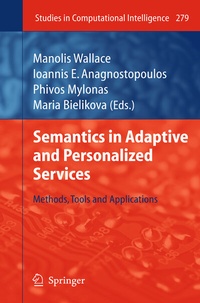
Semantics in Adaptive and Personalized Services
Description

Semantics in Adaptive and Personalised Services, initially strikes one as a specific and perhaps narrow domain. Yet, a closer examination of the term reveals much more. On one hand there is the issue of semantics. Nowadays, this most often refers to the use of OWL, RDF or some other XML based ontology description language in order to represent the entities of problem. Still, semantics may also very well refer to the consideration of the meanings and concepts, rather than arithmetic measures, regardless of the representation used. On the other hand, there is the issue of adaptation, i.e. automated re-configuration based on some context. This could be the network and device context, the application context or the user context; we refer to the latter case as personalization. From a different perspective, there is the issue of the point of view from which to examine the topic. There is the point of view of tools, referring to the algorithms and software tools one can use, the point of view of the methods, referring to the abstract methodologies and best practices one can follow, as well as the point of view of applications, referring to successful and pioneering case studies that lead the way in research and innovation. Or at least so we thought.
Based on the above reasoning, the editors identified key researchers and practitioners in each of the aforementioned categories and invited them to contribute a corresponding work to this book. However, as the authors' contributions started to arrive, the editors also started to realize that although these categories participate in each chapter to different degrees, none of them can ever be totally obsolete from them. Moreover, it seems that theory and methods are inherent in the development of tools and applications and inversely the application is also inherent in the motivation and presentation of tools and methods.
More details
Other editions
Additional editions