

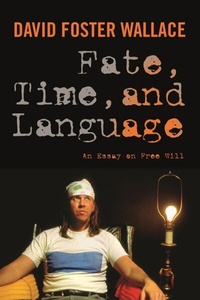
Fate, Time, and Language
An Essay on Free Will
1st Edition
Published on 27. November 2015
264 pages
978-0-231-52707-1 (ISBN)
Description

In 1962, the philosopher Richard Taylor used six commonly accepted presuppositions to imply that human beings have no control over the future. David Foster Wallace not only took issue with Taylor's method, which, according to him, scrambled the relations of logic, language, and the physical world, but also noted a semantic trick at the heart of Taylor's argument.
Fate, Time, and Language presents Wallace's brilliant critique of Taylor's work. Written long before the publication of his fiction and essays, Wallace's thesis reveals his great skepticism of abstract thinking made to function as a negation of something more genuine and real. He was especially suspicious of certain paradigms of thought-the cerebral aestheticism of modernism, the clever gimmickry of postmodernism-that abandoned "the very old traditional human verities that have to do with spirituality and emotion and community." As Wallace rises to meet the challenge to free will presented by Taylor, we witness the developing perspective of this major novelist, along with his struggle to establish solid logical ground for his convictions. This volume, edited by Steven M. Cahn and Maureen Eckert, reproduces Taylor's original article and other works on fatalism cited by Wallace. James Ryerson's introduction connects Wallace's early philosophical work to the themes and explorations of his later fiction, and Jay Garfield supplies a critical biographical epilogue.
Fate, Time, and Language presents Wallace's brilliant critique of Taylor's work. Written long before the publication of his fiction and essays, Wallace's thesis reveals his great skepticism of abstract thinking made to function as a negation of something more genuine and real. He was especially suspicious of certain paradigms of thought-the cerebral aestheticism of modernism, the clever gimmickry of postmodernism-that abandoned "the very old traditional human verities that have to do with spirituality and emotion and community." As Wallace rises to meet the challenge to free will presented by Taylor, we witness the developing perspective of this major novelist, along with his struggle to establish solid logical ground for his convictions. This volume, edited by Steven M. Cahn and Maureen Eckert, reproduces Taylor's original article and other works on fatalism cited by Wallace. James Ryerson's introduction connects Wallace's early philosophical work to the themes and explorations of his later fiction, and Jay Garfield supplies a critical biographical epilogue.
All prices
More details
Other editions
Additional editions
Book
12/2010
Columbia University Press
€68.09
Article not available at the moment
Book
12/2010
Columbia University Press
€19.00
Shipment within 10-20 days
Persons
Cahn Steven :
Steven M. Cahn (PhD, Philosophy, Columbia) is Professor of Philosophy at The City University of New York Graduate Center, where he served for nearly a decade as Provost and Vice President for Academic Affairs, then as Acting President. He is the author and editor of numerous books, including From Student to Scholar (Columbia, 2008), Fate, Time, and Language (Columbia, 2010), Polishing Your Prose (Columbia, 2013), Freedom and the Self (Columbia, 2015), Happiness and Goodness (Columbia, 2015), and Religion Within Reason (Columbia, 2017); his textbooks and anthologies on ethics, philosophy of religion, and introduction to philosophy, published by Oxford, have appeared in multiple editions.David Foster Wallace (1962-2008) wrote the acclaimed novels Infinite Jest and The Broom of the System and the story collections Oblivion, Brief Interviews with Hideous Men, and Girl with Curious Hair. His nonfiction includes the essay collections Consider the Lobster and A Supposedly Fun Thing I'll Never Do Again and the full-length work Everything and More.
Steven M. Cahn (PhD, Philosophy, Columbia) is Professor of Philosophy at The City University of New York Graduate Center, where he served for nearly a decade as Provost and Vice President for Academic Affairs, then as Acting President. He is the author and editor of numerous books, including From Student to Scholar (Columbia, 2008), Fate, Time, and Language (Columbia, 2010), Polishing Your Prose (Columbia, 2013), Freedom and the Self (Columbia, 2015), Happiness and Goodness (Columbia, 2015), and Religion Within Reason (Columbia, 2017); his textbooks and anthologies on ethics, philosophy of religion, and introduction to philosophy, published by Oxford, have appeared in multiple editions.David Foster Wallace (1962-2008) wrote the acclaimed novels Infinite Jest and The Broom of the System and the story collections Oblivion, Brief Interviews with Hideous Men, and Girl with Curious Hair. His nonfiction includes the essay collections Consider the Lobster and A Supposedly Fun Thing I'll Never Do Again and the full-length work Everything and More.
Content
Preface, by Steven M. Cahn and Maureen Eckert
Introduction: A Head That Throbbed Heartlike: The Philosophical Mind of David Foster Wallace, by James Ryerson
Part I: The Background
Introduction, by Steven M. Cahn
1. Fatalism, by Richard Taylor
2. Professor Taylor on Fatalism, by John Turk Saunders
3. Fatalism and Ability, by Richard Taylor
4. Fatalism and Ability II, by Peter Makepeace
5. Fatalism and Linguistic Reform, by John Turk Saunders
6. Fatalism and Professor Taylor, by Bruce Aune
7. Taylor's Fatal Fallacy, by Raziel Abelson
8. A Note on Fatalism, by Richard Taylor
9. Tautology and Fatalism, by Richard Sharvy
10. Fatalistic Arguments, by Steven Cahn
11. Comment, by Richard Taylor
12. Fatalism and Ordinary Language, by John Turk Saunders
13. Fallacies in Taylor's "Fatalism," by Charles D. Brown
Part II: The Essay
14. Renewing the Fatalist Conversation, by Maureen Eckert
15. Richard Taylor's "Fatalism" and the Semantics of Physical Modality, by David Foster Wallace
Part III: Epilogue
16. David Foster Wallace as Student: A Memoir, by Jay Garfield
Appendix: The Problem of Future Contingencies, by Richard Taylor
Introduction: A Head That Throbbed Heartlike: The Philosophical Mind of David Foster Wallace, by James Ryerson
Part I: The Background
Introduction, by Steven M. Cahn
1. Fatalism, by Richard Taylor
2. Professor Taylor on Fatalism, by John Turk Saunders
3. Fatalism and Ability, by Richard Taylor
4. Fatalism and Ability II, by Peter Makepeace
5. Fatalism and Linguistic Reform, by John Turk Saunders
6. Fatalism and Professor Taylor, by Bruce Aune
7. Taylor's Fatal Fallacy, by Raziel Abelson
8. A Note on Fatalism, by Richard Taylor
9. Tautology and Fatalism, by Richard Sharvy
10. Fatalistic Arguments, by Steven Cahn
11. Comment, by Richard Taylor
12. Fatalism and Ordinary Language, by John Turk Saunders
13. Fallacies in Taylor's "Fatalism," by Charles D. Brown
Part II: The Essay
14. Renewing the Fatalist Conversation, by Maureen Eckert
15. Richard Taylor's "Fatalism" and the Semantics of Physical Modality, by David Foster Wallace
Part III: Epilogue
16. David Foster Wallace as Student: A Memoir, by Jay Garfield
Appendix: The Problem of Future Contingencies, by Richard Taylor

