

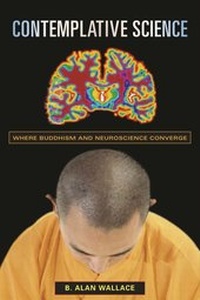
Contemplative Science
Where Buddhism and Neuroscience Converge
1st Edition
Published on 24. October 2006
256 pages
978-0-231-51095-0 (ISBN)
Description

Science has long treated religion as a set of personal beliefs that have little to do with a rational understanding of the mind and the universe. However, B. Alan Wallace, a respected Buddhist scholar, proposes that the contemplative methodologies of Buddhism and of Western science are capable of being integrated into a single discipline: contemplative science.
The science of consciousness introduces first-person methods of investigating the mind through Buddhist contemplative techniques, such as samatha, an organized, detailed system of training the attention. Just as scientists make observations and conduct experiments with the aid of technology, contemplatives have long tested their own theories with the help of highly developed meditative skills of observation and experimentation. Contemplative science allows for a deeper knowledge of mental phenomena, including a wide range of states of consciousness, and its emphasis on strict mental discipline counteracts the effects of conative (intention and desire), attentional, cognitive, and affective imbalances.
Just as behaviorism, psychology, and neuroscience have all shed light on the cognitive processes that enable us to survive and flourish, contemplative science offers a groundbreaking perspective for expanding our capacity to realize genuine well-being. It also forges a link between the material world and the realm of the subconscious that transcends the traditional science-based understanding of the self.
The science of consciousness introduces first-person methods of investigating the mind through Buddhist contemplative techniques, such as samatha, an organized, detailed system of training the attention. Just as scientists make observations and conduct experiments with the aid of technology, contemplatives have long tested their own theories with the help of highly developed meditative skills of observation and experimentation. Contemplative science allows for a deeper knowledge of mental phenomena, including a wide range of states of consciousness, and its emphasis on strict mental discipline counteracts the effects of conative (intention and desire), attentional, cognitive, and affective imbalances.
Just as behaviorism, psychology, and neuroscience have all shed light on the cognitive processes that enable us to survive and flourish, contemplative science offers a groundbreaking perspective for expanding our capacity to realize genuine well-being. It also forges a link between the material world and the realm of the subconscious that transcends the traditional science-based understanding of the self.
All prices
More details
Other editions
Additional editions
Book
03/2009
Columbia University Press
€30.95
Article not available at the moment
Book
10/2006
Columbia University Press
€99.04
Shipment within 10-20 days
Persons
B. Alan Wallace spent fourteen years as a Buddhist monk, ordained by H. H. the Dalai Lama. He then earned his undergraduate degree in physics and the philosophy of science at Amherst College and his doctorate in religious studies from Stanford University. His Columbia University Press books are Hidden Dimensions: The Unification of Physics and Consciousness; Mind in the Balance: Meditation in Science, Buddhism, and Christianity; and Buddhism and Science: Breaking New Ground (editor). He is the founder and president of the Santa Barbara Institute for Consciousness Studies (http://www.sbinstitute.com).
Content
Acknowledgments
1 - Principles of Contemplative Science
2 - Where Science and Religion Collide
3 - The Study of Consciousness, East and West
4 - Spiritual Awakening and Objective Knowledge
5 - Buddhist Nontheism, Polytheism, and Monotheism
6 - Worlds of Intersubjectivity
7 - Samatha: The Contemplative Refinement of Attention
8 - Beyond Idolatry: The Renaissance of a Spirit of Empiricism
Notes
Bibliography
1 - Principles of Contemplative Science
2 - Where Science and Religion Collide
3 - The Study of Consciousness, East and West
4 - Spiritual Awakening and Objective Knowledge
5 - Buddhist Nontheism, Polytheism, and Monotheism
6 - Worlds of Intersubjectivity
7 - Samatha: The Contemplative Refinement of Attention
8 - Beyond Idolatry: The Renaissance of a Spirit of Empiricism
Notes
Bibliography
