

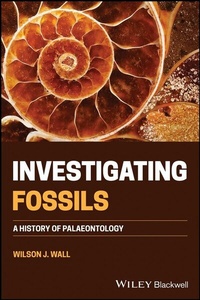
Investigating Fossils
A History of Palaeontology
1st Edition
Published on 8. June 2021
256 pages
978-1-119-69848-7 (ISBN)
Description

INVESTIGATING FOSSILS
INVESTIGATING FOSSILS
A HISTORY OF PALAEONTOLOGY
Investigating Fossils - A History of Palaeontology is a concise and accessible look at changing attitudes to palaeontology in general, and fossils in particular. From the existential and philosophical debates arising from fossils - such as their implications for the age of the Earth - to their role as markers in Darwin's theory of evolution, fossils have been the centre of highly charged debate for over two centuries.
This book, which is aimed at anyone with an interest in the history and philosophy of science, not only describes the process of fossil formation and the history of the discovery of fossils. It goes further, and highlights the continuing importance of fossils to our ever-developing understanding of where the planet and its myriad species have come from.
Painting a vivid, lively portrait of the history and development of palaeontology, Investigating Fossils is a fascinating and informative tour of the recent history - and possible future - of the science of fossils.
INVESTIGATING FOSSILS
A HISTORY OF PALAEONTOLOGY
Investigating Fossils - A History of Palaeontology is a concise and accessible look at changing attitudes to palaeontology in general, and fossils in particular. From the existential and philosophical debates arising from fossils - such as their implications for the age of the Earth - to their role as markers in Darwin's theory of evolution, fossils have been the centre of highly charged debate for over two centuries.
This book, which is aimed at anyone with an interest in the history and philosophy of science, not only describes the process of fossil formation and the history of the discovery of fossils. It goes further, and highlights the continuing importance of fossils to our ever-developing understanding of where the planet and its myriad species have come from.
Painting a vivid, lively portrait of the history and development of palaeontology, Investigating Fossils is a fascinating and informative tour of the recent history - and possible future - of the science of fossils.
More details
Other editions
Additional editions
Book
07/2021
1st Edition
Wiley-Blackwell
€47.50
Shipment within 15-20 days
Software
06/2021
Wiley
€41.29
No shipping information available
Person
Dr Wilson J. Wall trained in zoology and genetics and is the author of several science books, including Forensic Science in Court: The Role of the Expert Witness (Wiley, 2009).
Content
Acknowledgements vii
People in the text viii
Introduction 1
1 How are Fossils Formed? 10
2 Descriptions and Uses of Fossils 25
3 The Unfolding Understanding of Fossils 48
4 Reconstructing Animals from Fossils 81
5 How Fossils Changed Ideas Associated with Species 118
6 Fossils and Evolution 137
7 Fossil Collecting 172
8 The Rise of Fossil Fraud and Special Sites 193
Index 217People in the Text
- Agassiz, Louis (1807-1873).
- Born in Switzerland, he was initially educated at home and later at more formal schools. He attended university at Zürich, Heidelberg and Munich. He received his PhD in 1829 from Erlangen and MD from Munich in 1830. In 1832, Agassiz was appointed professor of natural history at the University of Neuchâtel. He was appointed Professor of Zoology and Geology at Harvard University where he stayed until his death. In 1850, he married Elizabeth Cary, his second wife. His married his first wife, Cecilie Braun, the sister of one of his college friends, in 1833. They had three children.
- Agricola,
- see Bauer
- Anaximander (611-547 BCE).
- A Greek philosopher from Ionia, Anaximander was a pupil of Thales. Although his writings did not survive the vicissitudes of history, he is credited by third parties with many ideas new for his age. He speculated on the origins of the earth and of man. Appreciating the curvature of the horizon he imagined the earth as cylindrical and poised in space.
- Anning, Mary (1799-1848).
- Born in Lyme Regis, Mary's father supplemented his income by searching for fossils in the coastal cliffs that could be sold. Mary carried on the tradition with notable finds, such as the Ichthyosaur, now in the Natural History Museum, London, in 1828 she discovered the first Plesiosaurus, and also the first Pterodactyl. She died, reportedly of breast cancer, and was buried locally. During her illness she was financially helped by the Geological Society of London.
- Aristotle (384-322 BCE).
- Born in Stagira, northern Greece he was the son of a doctor and a member of Plato's academy. Philip of Macedonia invited Aristotle to be tutor to his son Alexander. He retired to Euboea in 323 BCE.
- Bacon, Francis (1561-1626).
- His father was a Statesman and it was the intention that Bacon would follow the same path, starting with training in law. He became Lord High Chancellor in 1618 under James I. This success was short-lived as he was banished from Court in 1621 for taking bribes. It is said that he was difficult to get on with and his writings were abstruse, but were influential in science and philosophy. Bacon's scientific work was very limited, but he was an advocate of the accumulation of data.
- Bateson, William (1861-1926).
- Born in Whitby, and although not regarded as a youth of any potential while at Rugby school, he gained a 1st Class degree at Cambridge in 1883. He then went to the USA to work and returned to the UK where, after some years teaching, he became director of the John Innes Institute. He was married to Caroline Durham and they had three children.
- Bauer, Georg (1494-1555).
- Often called Agricola, he was born in Glauchau, Saxony and became the rector Zwickau school. Although for a while he was a practising physician, his interest in mineralogy led him to become a mining engineer and pioneering mineralogist.
- Bede, Venerable (c. 673-735).
- Bede was born near Weremouth, Durham. At the age of about seven, he was given over to the care of the monastery of Wearmouth and then in 682 he moved to the monastery at Jarrow, becoming an ordained priest in 703. In his new position he became a renowned Anglo-Saxon scholar, theologian and historian. In 1899, he was ordained.
- Beringer, Johann Bartholomew Adam (1667-1738).
- Born in Würzburg, he attended the university there, studying medicine. At the age of 27 he was appointed professor at the university and a year later became the keeper of the university botanical gardens.
- Beswick, Thomas (1753-1828)
- Beswick was born in Northumberland, the son of tenant farmers. He was the eldest of eight children. Although not academically gifted, he was quickly recognised as a skilled artist. When he left school at 14, he was apprenticed to a local engraver. He developed from an engraver of baronial cutlery to book illustrations. He became a partner in the engraving works in 1776, developing the reputation of the company as the finest of engravers. As well as his feelings against war, his moral code towards animals was exemplary, campaigning against docking of horses' tails and cruelty to circus animals. Many of these issues appear in allegorical form in his engravings. He married in 1786 and had four children.
- Black, Davidson (1884-1934).
- Born in Toronto, he graduated in medicine in 1906 from the University of Toronto. He continued there as an instructor in anatomy. Between 1917 and 1919, he was in the Canadian Army as a medic, after which he went to work in Peking (Wade-Giles), becoming head of anatomy in 1924. In 1913, he married Adena Nevitt and they had two children, both being born in Beijing.
- Boniface VIII (c. 1235-1303).
- His non-ecclesiastical name was Benedetto Caetani. He became Cardinal in 1291, being elected Pope in 1294. It was his intention to reassert Papal authority over temporal powers, such as Edward I and Philip IV of France, who disregarded the papal bulls. Boniface VIII was briefly kidnapped in 1303 by the French at Anagni. Shortly after being released he died in Rome.
- Bourguet, Louis (1678-1742).
- Born in Nimes, Bouruet was a polymath, writing on many different subjects. He was Professor of Philosophy and Mathematics at Neuchatel.
- Boyle, Robert (1627-1691).
- The youngest of 14 children of the Earl of Cork, Robert was born in Ireland. Good at languages and algebra, he was tutored at home and then went to school at Eton. He travelled through Europe for six years and came back to his family estate in Dorset. In 1654, he moved to Oxford where Robert Hooke was his assistant. He was a director of the East India Company, an alchemist and a founder of the Royal Society.
- Brongniart, Adolphe (1801-1876).
- The son of geologist Alexandre Brongniart, Adolphe was a French botanist, born in Sèvres, France. He travelled widely in Europe while in his teens, with his father. In 1833, he became professor of botany at the National Museum of Natural History, Paris, a position that he held for the rest of his life.
- Bronn, Heinrich Georg (1800-1862).
- Bronn was born in what is now Heidelberg, where he attended the university. In 1837, he was appointed Professor of Zoology and became the head of the first Institute of Zoology at Heidelberg. He proposed a tree of life as a method demonstrating graphically the relationships between species and groups. He married Luise Penzel and they had five children.
- Broom, Robert (1866-1951).
- Born in Paisley, Scotland, Broom studied medicine at Glasgow University. After graduating in 1889, he travelled to Australia and then on to South Africa in 1897 where he settled. From 1903 to 1910, he was professor of Zoology and Geology at Victoria College, losing the position for advocating evolution. In 1934, he gave up medicine and was appointed palaeontologist at Transvaal Museum, Pretoria. He married Mary Baillie in 1893.
- Buckland, William (1784-1856).
- Buckland was born in Axminster and educated in Tiverton before going to Winchester College after which he won a scholarship to Corpus Christi Oxford. He was ordained as a priest in 1809 and in 1813 he was appointed reader in mineralogy as well. He married in 1825 a girl from Abingdon, Mary Morland, who was an accomplished illustrator in her own right. They had nine children, five of which survived to adulthood.
- Buffon, Georges-Louis Leclerc Comte de (1707-1788).
- Born in Montbard, Burgundy, Buffon was left a considerable sum at the age of 7 by his uncle. Buffon attended the Jesuit college of Godrans in Dijon from the age of 10 and then, from 1723 he studied law at Dijon. In 1728, Buffon left Dijon to study mathematics and medicine at the University of Angers. With a large fortune he set himself up in Paris to study scientific subjects, initially mathematics but later the biological world. He was married and succeeded by a single child, a son. During the French Revolution, his tomb was ransacked for lead to make bullets.
- Burman, John.
- Little is known of Burman other than he joined Robert Plot as part of his family when Plot married Rebecca Burman soon after resigning his position at Oxford in 1690. Thus John became his stepson. In the second edition of Plot's Natural History of Oxfordshire, Burman made several additions.
- Burnet, Thomas (c. 1635-1715).
- Born in Croft, Yorkshire, Burnet was a clergy man who worked in the court of William III. He had to leave the position when his written work treated the account of The Fall as an allegory, not a literal story.
- Butler, Samuel (1835-1902).
- Born in Nottinghamshire and educated at Shrewsbury and St John's College Cambridge, he gave up the idea of joining the clergy and became a sheep farmer in New Zealand, leaving England in 1859 and returning in 1864. He painted and composed music as well as writing extensively. His financial independence was assured by a legacy.
- Chambers, Robert (1802-1871).
- Born in Peebles, Scotland, he joined with his brother, William, as a bookseller in Edinburgh. He developed his writing in his spare...
