

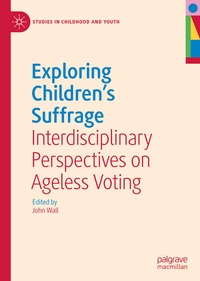
Exploring Children's Suffrage
Description

This edited volume offers a critical, thorough, and interdisciplinary examination of arguments for eliminating the minimum democratic voting age. As children and youth increasingly assert their political voices on issues such as climate change, gun legislation, Black Lives Matter, and education reform, calls for youth enfranchisement merit further academic conversation. Leading scholars in childhood studies, political science, philosophy, history, law, medicine, and economics come together in this collection to explore the diverse assumptions behind excluding children from voting rights and why these are open to question. While arriving at different and sometimes competing conclusions, each chapter deconstructs the idea of voting as necessarily tied to age while reconstructing a more democratic imagination able to enfranchise the third of humanity made up by children and youth. Thus, this book defines and establishes a new field of academic study and public debate around children'ssuffrage.
Chapter "The Reform that never happened: a history of children's suffrage restrictions" is available open access under a Creative Commons Attribution 4.0 International License via link.springer.com.More details
Other editions
Additional editions
Person
John Wall is Professor of Philosophy, Religion, and Childhood Studies, at Rutgers University Camden, USA. He also co-founded the international organization Children's Voting Colloquium. He has previously written and edited eight books, including Give Children the Vote (2021).
Content
Chapter1: Introduction: Children's Suffrage Studies.- Part I. Theoretical Frameworks.- Chapter2: Silence is Poison: Explaining and Curing Adult "Apathy,".- Chapter3: How Low Can You Go? The Capacity to Vote Among Young Citizens.- Chapter4: The Case for Children's Voting.- Part II. Historical Contexts.- Chapter5: The Enfranchisement of Women vs the Enfranchisement of Children.- Chapter6: De-Colonizing Children's Suffrage: Engagements with Dr. B R Ambedkar's Ideas on Democracy.- Chapter7: The Reform that Never Happened: A History of Children's Suffrage Restrictions.- Part III. Practical Considerations.- Chapter8: Generational Economics.- Chapter9: Legality of Age Restrictions on Voting: A Canadian Perspective.- Chapter10: A View from Paediatric Medicine: Competence, Best Interests, and Operational Pragmatism.
