

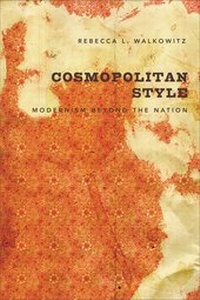
Cosmopolitan Style
Modernism Beyond the Nation
1st Edition
Published on 25. April 2006
248 pages
978-0-231-51053-0 (ISBN)
Description

In this broad-ranging and ambitious intervention in the debates over the politics, ethics, and aesthetics of cosmopolitanism, Rebecca L. Walkowitz argues that modernist literary style has been crucial to new ways of thinking and acting beyond the nation. While she focuses on modernist narrative, Walkowitz suggests that style conceived expansively as attitude, stance, posture, and consciousness helps to explain many other, nonliterary formations of cosmopolitanism in history, anthropology, sociology, transcultural studies, and media studies.
Walkowitz shows that James Joyce, Joseph Conrad, Virginia Woolf, Salman Rushdie, Kazuo Ishiguro, and W. G. Sebald use the salient features of literary modernism in their novels to explore different versions of transnational thought, question moral and political norms, and renovate the meanings of national culture and international attachment. By deploying literary tactics of naturalness, triviality, evasion, mix-up, treason, and vertigo, these six authors promote ideas of democratic individualism on the one hand and collective projects of antifascism or anti-imperialism on the other. Joyce, Conrad, and Woolf made their most significant contribution to this "critical cosmopolitanism" in their reflection on the relationships between narrative and political ideas of progress, aesthetic and social demands for literalism, and sexual and conceptual decorousness. Specifically, Walkowitz considers Joyce's critique of British imperialism and Irish nativism; Conrad's understanding of the classification of foreigners; and Woolf's exploration of how colonizing policies rely on ideas of honor and masculinity.
Rushdie, Ishiguro, and Sebald have revived efforts to question the definitions and uses of naturalness, argument, utility, attentiveness, reasonableness, and explicitness, but their novels also address a range of "new ethnicities" in late-twentieth-century Britain and the different internationalisms of contemporary life. They use modernist strategies to articulate dynamic conceptions of local and global affiliation, with Rushdie in particular adding playfulness and confusion to the politics of antiracism.
In this unique and engaging study, Walkowitz shows how Joyce, Conrad, and Woolf developed a repertoire of narrative strategies at the beginning of the twentieth century that were transformed by Rushdie, Ishiguro, and Sebald at the end. Her book brings to the forefront the artful idiosyncrasies and political ambiguities of twentieth-century modernist fiction.
Walkowitz shows that James Joyce, Joseph Conrad, Virginia Woolf, Salman Rushdie, Kazuo Ishiguro, and W. G. Sebald use the salient features of literary modernism in their novels to explore different versions of transnational thought, question moral and political norms, and renovate the meanings of national culture and international attachment. By deploying literary tactics of naturalness, triviality, evasion, mix-up, treason, and vertigo, these six authors promote ideas of democratic individualism on the one hand and collective projects of antifascism or anti-imperialism on the other. Joyce, Conrad, and Woolf made their most significant contribution to this "critical cosmopolitanism" in their reflection on the relationships between narrative and political ideas of progress, aesthetic and social demands for literalism, and sexual and conceptual decorousness. Specifically, Walkowitz considers Joyce's critique of British imperialism and Irish nativism; Conrad's understanding of the classification of foreigners; and Woolf's exploration of how colonizing policies rely on ideas of honor and masculinity.
Rushdie, Ishiguro, and Sebald have revived efforts to question the definitions and uses of naturalness, argument, utility, attentiveness, reasonableness, and explicitness, but their novels also address a range of "new ethnicities" in late-twentieth-century Britain and the different internationalisms of contemporary life. They use modernist strategies to articulate dynamic conceptions of local and global affiliation, with Rushdie in particular adding playfulness and confusion to the politics of antiracism.
In this unique and engaging study, Walkowitz shows how Joyce, Conrad, and Woolf developed a repertoire of narrative strategies at the beginning of the twentieth century that were transformed by Rushdie, Ishiguro, and Sebald at the end. Her book brings to the forefront the artful idiosyncrasies and political ambiguities of twentieth-century modernist fiction.
All prices
More details
Other editions
Additional editions
Book
10/2007
Columbia University Press
€34.66
Shipment within 10-20 days
Book
04/2006
Columbia University Press
€108.94
Article not available at the moment
Person
Rebecca L. Walkowitz is associate professor of English and director of the seminar on modernism and globalization at Rutgers University. She is the editor or coeditor of several anthologies, including Immigrant Fictions: Contemporary Literature in an Age of Globalization; Bad Modernisms; and The Turn to Ethics.
Content
Acknowledgments
Introduction. Critical Cosmopolitanism and Modernist Narrative
Part 1. Cosmopolitan Modernism
1. Conrad's Naturalness
2. Joyce's Triviality
3. Woolf's Evasion
Part 2. Modernist Cosmopolitanism
4. Ishiguro's Treason
5. Rushdie's Mix-Up
6. Sebald's Vertigo
Notes
Bibliography
Index
Introduction. Critical Cosmopolitanism and Modernist Narrative
Part 1. Cosmopolitan Modernism
1. Conrad's Naturalness
2. Joyce's Triviality
3. Woolf's Evasion
Part 2. Modernist Cosmopolitanism
4. Ishiguro's Treason
5. Rushdie's Mix-Up
6. Sebald's Vertigo
Notes
Bibliography
Index
Read an >excerpt from the introduction to Cosmopolitan Style (pdf).
