

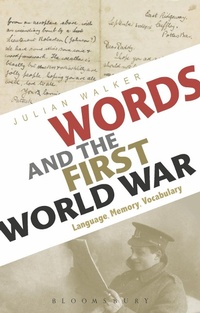
Words and the First World War
Language, Memory, Vocabulary
1st Edition
Published on 28. December 2017
416 pages
978-1-350-00195-4 (ISBN)
Description

"An illustrated analytical study, Words and the First World War considers the situation at home, at war, and under categories such as race, gender and class to give a many-sided picture of language used during the conflict." The Spectator
First World War expert Julian Walker looks at how the conflict shaped English and its relationship with other languages. He considers language in relation to mediation and authenticity, as well as the limitations and potential of different kinds of verbal communication. Walker also examines:
- How language changed, and why changed language was used in communications
- Language used at the Front and how the 'language of the war' was commercially exploited on the Home Front
- The relationship between language, soldiers and class
- The idea of the 'indescribability' of the war and the linguistic codes used to convey the experience
'Languages of the front' became linguistic souvenirs of the war, abandoned by soldiers but taken up by academics, memoir writers and commentators, leaving an indelible mark on the words we use even today.
First World War expert Julian Walker looks at how the conflict shaped English and its relationship with other languages. He considers language in relation to mediation and authenticity, as well as the limitations and potential of different kinds of verbal communication. Walker also examines:
- How language changed, and why changed language was used in communications
- Language used at the Front and how the 'language of the war' was commercially exploited on the Home Front
- The relationship between language, soldiers and class
- The idea of the 'indescribability' of the war and the linguistic codes used to convey the experience
'Languages of the front' became linguistic souvenirs of the war, abandoned by soldiers but taken up by academics, memoir writers and commentators, leaving an indelible mark on the words we use even today.
More details
Edition
1. Auflage
Language
English
Place of publication
London
United Kingdom
Publishing group
Bloomsbury Publishing PLC
Illustrations
50 bw images
ISBN-13
978-1-350-00195-4 (9781350001954)
Copyright in bibliographic data and cover images is held by Nielsen Book Services Limited or by the publishers or by their respective licensors: all rights reserved.
Schweitzer Classification
Other editions
Additional editions
Book
12/2017
Bloomsbury Academic
€44.75
Shipment within 15-20 days
Person
Julian Walker is a writer, researcher, artist and educator. He is the co-author of Languages and the First World War: Communicating in a Transnational War (2016), the author of The Roar of the Crowd (2016) and Trench Talk (2012) among many others. His website is www.julianwalker.net
Content
Part I: Language, Dialect and the Need to Communicate
1. Slang, dialect and status
2. The need to communicate
3. Understanding 'the other'
Part II: Language at the Front
4. Our language
5. Etymologies
6. How lingua franca developed
7. Glossaries
8. Language as weapon and trophy
9. Control, and self-control
10. Avoidance
11. Wordplay
12. The sound of war
13. Language in combat
14. The destruction of the body
15. Failure
16. Unacceptable weapons
Part III: 'Us' and 'Them'
17. Race
18. Naming the enemy
19. How others spoke
20. Naming 'our' side
21. The female
Part IV: The Home Front
22. Commerce and war language
23. DORA and the control of words
24. Outrage
25. Women and children
Part V: Owning the Language
26. Class war
27. 'Not us'
28. Our language
Part VI: Letting Go
29. Losing the language of war
30. The language of commemoration
31. Silence
32. Post-war war talk
33. War porn
34. Then and now
Bibliography
Index
1. Slang, dialect and status
2. The need to communicate
3. Understanding 'the other'
Part II: Language at the Front
4. Our language
5. Etymologies
6. How lingua franca developed
7. Glossaries
8. Language as weapon and trophy
9. Control, and self-control
10. Avoidance
11. Wordplay
12. The sound of war
13. Language in combat
14. The destruction of the body
15. Failure
16. Unacceptable weapons
Part III: 'Us' and 'Them'
17. Race
18. Naming the enemy
19. How others spoke
20. Naming 'our' side
21. The female
Part IV: The Home Front
22. Commerce and war language
23. DORA and the control of words
24. Outrage
25. Women and children
Part V: Owning the Language
26. Class war
27. 'Not us'
28. Our language
Part VI: Letting Go
29. Losing the language of war
30. The language of commemoration
31. Silence
32. Post-war war talk
33. War porn
34. Then and now
Bibliography
Index
