

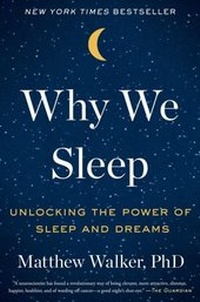
Why We Sleep
Unlocking the Power of Sleep and Dreams
1st Edition
Published on 3. October 2017
368 pages
978-1-5011-4433-2 (ISBN)
Description

"Why We Sleep is an important and fascinating book…Walker taught me a lot about this basic activity that every person on Earth needs. I suspect his book will do the same for you." ?Bill Gates
A New York Times bestseller and international sensation, this "stimulating and important book" (Financial Times) is a fascinating dive into the purpose and power of slumber.
With two appearances on CBS This Morning and Fresh Air's most popular interview of 2017, Matthew Walker has made abundantly clear that sleep is one of the most important but least understood aspects of our life. Until very recently, science had no answer to the question of why we sleep, or what good it served, or why we suffer such devastating health consequences when it is absent. Compared to the other basic drives in life?eating, drinking, and reproducing?the purpose of sleep remains more elusive.
Within the brain, sleep enriches a diversity of functions, including our ability to learn, memorize, and make logical decisions. It recalibrates our emotions, restocks our immune system, fine-tunes our metabolism, and regulates our appetite. Dreaming creates a virtual reality space in which the brain melds past and present knowledge, inspiring creativity.
In this "compelling and utterly convincing" (The Sunday Times) book, preeminent neuroscientist and sleep expert Matthew Walker provides a revolutionary exploration of sleep, examining how it affects every aspect of our physical and mental well-being. Charting the most cutting-edge scientific breakthroughs, and marshalling his decades of research and clinical practice, Walker explains how we can harness sleep to improve learning, mood and energy levels, regulate hormones, prevent cancer, Alzheimer's and diabetes, slow the effects of aging, and increase longevity. He also provides actionable steps towards getting a better night's sleep every night.
Clear-eyed, fascinating, and accessible, Why We Sleep is a crucial and illuminating book. Written with the precision of Atul Gawande, Andrew Solomon, and Sherwin Nuland, it is "recommended for night-table reading in the most pragmatic sense" (The New York Times Book Review).
A New York Times bestseller and international sensation, this "stimulating and important book" (Financial Times) is a fascinating dive into the purpose and power of slumber.
With two appearances on CBS This Morning and Fresh Air's most popular interview of 2017, Matthew Walker has made abundantly clear that sleep is one of the most important but least understood aspects of our life. Until very recently, science had no answer to the question of why we sleep, or what good it served, or why we suffer such devastating health consequences when it is absent. Compared to the other basic drives in life?eating, drinking, and reproducing?the purpose of sleep remains more elusive.
Within the brain, sleep enriches a diversity of functions, including our ability to learn, memorize, and make logical decisions. It recalibrates our emotions, restocks our immune system, fine-tunes our metabolism, and regulates our appetite. Dreaming creates a virtual reality space in which the brain melds past and present knowledge, inspiring creativity.
In this "compelling and utterly convincing" (The Sunday Times) book, preeminent neuroscientist and sleep expert Matthew Walker provides a revolutionary exploration of sleep, examining how it affects every aspect of our physical and mental well-being. Charting the most cutting-edge scientific breakthroughs, and marshalling his decades of research and clinical practice, Walker explains how we can harness sleep to improve learning, mood and energy levels, regulate hormones, prevent cancer, Alzheimer's and diabetes, slow the effects of aging, and increase longevity. He also provides actionable steps towards getting a better night's sleep every night.
Clear-eyed, fascinating, and accessible, Why We Sleep is a crucial and illuminating book. Written with the precision of Atul Gawande, Andrew Solomon, and Sherwin Nuland, it is "recommended for night-table reading in the most pragmatic sense" (The New York Times Book Review).
More details
Other editions
Additional editions
Book
06/2018
Simon & Schuster
€18.50
Shipment within 10-20 days
Book
10/2017
Simon & Schuster
€28.50
Shipment within 10-20 days
Person
Matthew Walker is a professor of neuroscience and psychology at UC Berkeley, the Director of its Sleep and Neuroimaging Lab, and a former professor of psychiatry at Harvard University. He has published over 100 scientific studies and has appeared on 60 Minutes, Nova, BBC News, and NPR's Science Friday. Why We Sleep is his first book.
Content
- Intro
- Title Page
- Dedication
- Part 1: This Thing Called Sleep
- Chapter 1: To Sleep.
- Chapter 2: Caffeine, Jet Lag, and Melatonin
- Chapter 3: Defining and Generating Sleep
- Chapter 4: Ape Beds, Dinosaurs, and Napping with Half a Brain
- Chapter 5: Changes in Sleep Across the Life Span
- Part 2: Why Should You Sleep?
- Chapter 6: Your Mother and Shakespeare Knew
- Chapter 7: Too Extreme for the Guinness Book of World Records
- Chapter 8: Cancer, Heart Attacks, and a Shorter Life
- Part 3: How and Why We Dream
- Chapter 9: Routinely Psychotic
- Chapter 10: Dreaming as Overnight Therapy
- Chapter 11: Dream Creativity and Dream Control
- Part 4: From Sleeping Pills to Society Transformed
- Chapter 12: Things That Go Bump in the Night
- Chapter 13: iPads, Factory Whistles, and Nightcaps
- Chapter 14: Hurting and Helping Your Sleep
- Chapter 15: Sleep and Society:
- Chapter 16: A New Vision for Sleep in the Twenty-First Century
- Conclusion
- Appendix
- Illustration Permissions
- Acknowledgments
- About the Author
- Index
- Copyright
