

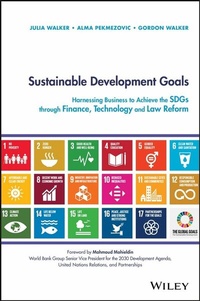
Sustainable Development Goals
Description

More details
Other editions
Additional editions
Persons
JULIA WALKER is a senior global business executive with 20 years experience in the private sector principally in finance, technology, and risk management. She currently runs market growth and strategy in Asia for one of the world's largest providers of financial markets data, Infrastructure, and Risk Intelligence and is a member of the United Nations Secretary General's Task Force of Digital Financing of the Sustainable Development Goals.
DR ALMA PEKMEZOVIC is a consultant to the Asian Development Bank, Sydney, Australia. Her key areas of expertise include capital markets law, corporate law and governance, and commercial law reform. During 2006 to 2015, Dr. Pekmezovic taught corporate and commercial law at La Trobe University School of Law, Melbourne, Australia. She was formerly a Lecturer in Law at Bucerius Law School in Hamburg (2015-2018) and a Visiting Research Fellow at the Max Planck Institute for Comparative and International Private Law in Hamburg, Germany.
DR GORDON WALKER SJD (Duke) is an Emeritus Professor of La Trobe University; Adjunct Professor at Curtin University School of Law; Visiting Professor, University of Padua Law School, Italy; and an advisor to the Asian Development Bank (ADB) designated as International Business Law Expert and International Financial Sector Expert. His research contracts at the ADB principally involve law reform in the areas of securities regulation, company, secured transactions and FinTech within the Private Sector Development Initiative (PSDI-III) in the South Pacific.
Content
About the Editors xvii
Notes on Contributors xix
Foreword xxix
Foreword: Implementation of the SDGs xxxi
Preface xxxv
Introduction 1
Part One: Overview and Context 9
Part Two: Where Will the Money Come From? Financing the SDGs 10
Part Three: Technology, Innovation, and Entrepreneurship 12
Part Four: Facilitating the SDGs by Legal Infrastructure Reform 15
Part I Overview and Context 17
1 The UN and Goal Setting: From the MDGs to the SDGs 19
Alma Pekmezovic
Introduction 19
What is Development? 20
Is There a Right to Development? 22
Measuring Economic Development 22
Measuring Non-Economic Aspects of Development 23
The Sustainable Development Goals (SDGs) 24
Situating the SDGs in the International Legal Framework 28
Theories of Development: Towards a New Theory of Sustainable Development 29
Economic Theories of Development 30
Cultural Theories of Development 30
Geographic Theories of Development 31
Institutional Theories of Development 32
A New Theory of Sustainable Development 34
Measuring Progress Towards the SDGs 34
Conclusions 35
2 SDGs and the Role of International Financial Institutions 37
Suresh Nanwani
Introduction 37
Response and Implementation of the SDGs by IFIs 38
Project Processing and Actions Taken by IFIs to Implement the SDGs, and Responses from Other Development Actors 44
Conclusion and Recommendations for IFIs to Meet SDG Goals and Targets 48
3 Towards a New Global Narrative for the Sustainable Development Goals 53
Iason Gabriel and Varun Gauri
Introduction 53
How SMART Are the SDGs? 55
Goals That Stretch 59
Goals That Inspire 62
Sloganising the SDGs 64
Towards a New Global Narrative? 66
Conclusion 69
4 Overcoming Scarcity: The Paradox of Abundance: Harnessing Digitalisation in Financing Sustainable Development 71
Simon Zadek
Scarcity: The Paradox of Abundance 71
Financing: A Systemic Challenge 72
Action on System Design 74
Digital Financing of the SDGs 76
Dilemmas: Digitalisation and Dark Financing 80
Sizing the Prize 82
What Next? 84
Concluding Comments 85
Part II Where Will the Money Come From? Financing the SDGs 87
5 The New Framework for Financing the 2030 Agenda for Sustainable Development and the SDGs 89
Alma Pekmezovic
Introduction 89
Sources of Development Finance 90
Domestic Public and Private Sources 90
Domestic Resource Mobilisation (DRM) 90
International Public and Private Finance 93
The Role of International Official Development Assistance (ODA) 94
Private Philanthropy 95
Sovereign Wealth Funds, Pension Funds, Insurance Companies, and Investment Funds 96
Barriers to Greater Private Investment 97
The Role of Private and Blended Finance in Development 98
The Development Impact and Risks of Blended Finance 100
An Overview of Blended Finance Mechanisms 101
Innovative Financing Tools: Social Impact Bonds (SIBs) and Development Impact Bonds (DIBs) 102
Best Practices for Engaging the Private Sector 105
Conclusions 105
6 The Contribution of the International Private Sector to a More Sustainable Future 107
Martin Blessing and Tom Naratil
Ready and Able to Invest 108
Commercial and Investment Benefits 109
What is Needed to Mobilise Private Sector Money? 110
Partnerships for a More Sustainable Future 112
Partnerships to Rationalise Sustainable Investment Markets 112
Partnerships to Democratise Sustainable Investment Markets 116
7 Re-Orienting the Global Financial System Towards Sustainability 121
Alma Pekmezovic
Introduction 121
Background 123
The Legal and Regulatory Framework 125
Company Reporting: Sustainability Disclosure Requirements 128
Institutional Investors: Responsible Investing and Investing for Impact 132
Fiduciary Duties of Institutional Investors and Other Financial Intermediaries 136
Fostering Long-Term Sustainability 140
Conclusion 142
8 How Asset Managers Can Better Align Public Markets Investing with the SDGs 143
Emily Chew and Margaret Childe
Why the SDGs Could Transform Sustainability Investing 143
Implementing the SDGs as an Analytical Framework to Align Investing with the SDGs 145
Objectives of Manulife Investment Management's Approach to SDG-Aligned Investing 145
SDG Assessment Methodology Overview 147
Investable Themes 147
SDG Alignment Assessment 150
Exclusions 152
Applying the SDG Analytical Framework to the S&P 500 Index 152
The Current State of Corporate Goals with Respect to SDG Impact 153
The Current Opportunity Capture of SDG-Related Profit Opportunities 156
Areas in which Corporate Operational Conduct is Most Strongly Aligned with SDG Impact 159
What SDG Developments Can We Expect in the Public Markets Investor Community in 2020 and Beyond? 161
SDG-aligned Investing is Expected to Become Easier 162
Corporate Reporting on the SDGs Will Improve 163
Constructive Dialogue or Engagement with Companies is Necessary to Achieve the SDGs 163
A Call to Action 164
Disclaimer 165
9 The Significance of Sustainable Development Goals for Government Credit Quality 167
Alastair Wilson
Environmental Preservation Influences Credit Quality, Including Through the Impact of Climate Change on Growth and Institutions' Resilience to It 168
Social Risks Such as Poverty and Inequality Feed into Economic and Institutional Strength 170
Strong Institutions Are Closely Related to Ratings and Ratings Factors 174
SDGs Influence Government Credit Quality Through Different Channels, to Varying Degrees 176
Part III Technology, Innovation, and Entrepreneurship 177
10 FinTech for Financial Inclusion: Driving Sustainable Growth 179
Dirk A. Zetzsche, Ross P. Buckley, and Douglas W. Arner
Introduction 179
Financial Inclusion and Sustainability: Introducing the Long-Term Perspective 180
Financial Inclusion: Why It Matters 180
Two Sides of the Same Coin 181
FinTech as a Tool for the SDGs 181
FT4FI Initiatives 183
Four Pillars of Digital Financial Transformation 184
Experiences and Lessons 184
Financial Inclusion Initiatives Since 2008: G20 184
Financial Inclusion Initiatives Since 2008: AFI 185
FinTech and Financial Inclusion: The Foundation of Digital Financial Transformation 185
Pillar I: Digital ID and eKYC: Establishing the Foundation 186
Example: The Indian Aadhaar System 186
IrisGuard 187
Regional Approaches: eIDAS in the EU 188
eKYC and KYC Utilities 188
Example 1: South Africa Web-Based KYC Database 188
Example 2: India's e-KYC System 188
Example 3: eIDAS and eKYC 189
Synthesising the Lessons 189
Pillar II: Open Electronic Payment Systems: Building Connectivity 189
Mobile Money 190
Designing Regulatory Infrastructure for an Open Electronic Payments System 191
Pillar III: Account Opening and Electronic Government Provision of Services: Expanding Usage 192
Electronic Payment: Government Salaries and Transfers 193
Electronic Payment and Provision: Other Core Services 194
Pillar IV: Design of Financial Market Infrastructure and Systems: Enabling New Wider Development 195
Transforming Credit Provision: From Collateral and Microfinance to Cash Flow 195
Adding Insurance and Investments to Savings and Credit 196
M-Akiba 197
Building Better Financial Infrastructure 198
The EU Example: GDPR, PSD2, MiFID2 198
Developing a Comprehensive Strategy 198
Strategic Approach 198
The Challenge of Technology 198
Regulatory Sandboxes, Piloting, and Test-and-Learn Approaches 199
Balancing Inclusion with Other Regulatory Objectives 201
Designing Regulatory Systems: The Example of Mexico 201
Towards Inclusive and Sustainable Growth 202
11 Financing and Self-Financing of SDGs through Financial Technology, Legal, and Fiscal Tools 205
Jon Truby
Introduction 205
Self-Sufficient Financing and Achievement of SDGs through Tax Reform 207
Shifting the Tax Burden to Create a Double Dividend 207
Base Erosion and Digital Services Taxation 208
Digitisation of Tax Administration 209
Amendment of the Chicago Convention 210
Self-Sufficient Financing of SDGs through Financial Technology 212
Digitisation of Money 212
Digital Identity 214
Financing SDG 7 and Related Goals through Financial Technology 215
Offsetting Investments in Energy-Intensive Digital Currencies 215
Digital Token Investments 216
Conclusion 217
12 SDG Challenges in G20 Countries 219
Guillaume Lafortune and Guido Schmidt-Traub
Introduction 219
The SDGs as Problem-Solving Tools for Transformative Actions and Policies 229
Long-Term Planning and Back-Casting 230
Data and Monitoring 231
Financing 232
Technology Missions 233
Conclusion 234
13 The Future-Fit Business Benchmark: Flourishing Business in a Truly Sustainable Future 235
Geoff Kendall and Martin Rich
Introduction 235
The Journey Ahead 236
The World We Want 236
The World We Have (and How We Got Here) 236
The World We Can Create 238
Why a Systems View is Good for Business 240
A Star to Steer By 243
Current Assessment Methods Are Flawed 243
Starting with the End in Mind 244
How Much is Enough? 244
A Holistic View of Future-Fitness 245
A Practical Tool 246
Future-Fit Break-Even Goals 246
Future-Fit Positive Pursuits 248
Engaging Stakeholders More Effectively 250
Conclusion 251
14 Financing for Youth Entrepreneurship in Sustainable Development 253
Inna Amesheva, Alex Clark, and Julian Payne
The Role of Young Entrepreneurs in Sustainable Development 253
The Needs of Young Entrepreneurs Working on the SDGs 254
Barriers to Innovation and Scale 254
Supporting Young Entrepreneurs Working on the SDGs 257
The Financing Options Available to Young Entrepreneurs Working on the SDGs 258
Sources and Instruments of Finance for Young Entrepreneurs 259
Bridging the Gap Between Young Entrepreneurs and the SDGs 262
Sectoral Coverage 262
Geographical Coverage 264
Beyond Banks: Alternative Financial Structures for Youth-oriented Sustainable Development Initiatives 266
Prioritising Financial Interventions for Youth Entrepreneurs and the SDGs 267
Non-financial Services 268
Developing a Robust Investment Pipeline 270
Designing Youth-focused Funding Vehicles for the SDGs 271
15 Transparency in the Supply Chain 275
Julia Walker
Introduction 275
Supplier prequalification tools 279
Emerging Technology in Supply Chains 281
The diamond industry 282
Summary 284
Part IV Facilitating the SDGs by Legal Infrastructure Reform 285
16 Facilitating Sustainable Development Goal 8 by Legal Reform Measures 287
Gordon Walker
Introduction 287
Contextual Issues 288
Legal Traditions 288
Regulators and Policymakers 289
Implementation Problems 290
Capital Formation for Micro-, Small-, and Medium-Sized Enterprises 291
Meta-Strategy: The Promise of e-Government 291
The SDGs and Domestic Policy Formation 292
Facilitating SDG 8 by Law Reform 293
Hong Kong 293
Fundraising Law in Hong Kong: A Brief Overview 294
Safe Harbours in the 17th Schedule of CWUMPO 295
ECF and P2PL in Hong Kong 296
Supporting FinTech and MSME Fundraising Solutions in Papua New Guinea 297
Survey of Papua New Guinea Legislation 297
Offers Excluded from the Prospectus Requirements: CMA, Schedule 6 298
Issues Excluded from the Prospectus Requirements: CMA, Schedule 7 299
Securities Commission Power to Amend Schedules: CMA, Section 470 299
Legal Reform Opportunities for ECF and P2PL in PNG 299
Conclusion 300
17 Facilitating SDGs by Tax System Reform 303
Benjamin Walker
Introduction 303
Sustainable Development Goals 304
Goal 3: Good Health and Well-Being 304
Goal 8: Decent Work and Economic Growth 304
Goal 10: Reduce Inequality within and among Countries 305
Goal 12: Ensure Sustainable Consumption and Production Patterns 307
Goal 16: Peace, Justice and Strong Institutions 308
Goal 17: Strengthen the Means of Implementation and Revitalize Global Partnership for Sustainable Development 309
A Wider Picture of Development 310
Taxes and Economic Development 310
Tax Effort 311
Taxes and Spending 312
Taxes and Technology 313
Blockchain 313
Artificial Intelligence 314
Tax Law Reform 314
Recent Developments 316
Conclusion 316
18 Facilitating the SDGs by Competition and Consumer Law and Policy Reform: Aspirations and Challenges in Papua New Guinea 317
Brent Fisse
Introduction 317
Proposed PNG Competition and Consumer Reforms and SDGs 318
Tailoring Law and Policy to the Particular Needs and Circumstances of PNG 320
Removing Statutory and Regulatory Barriers to Entry 322
Designing Competition Rules That Are Practical and Avoid Excessive Technicality 324
Harnessing Consumer Protection Laws to Protect and Promote Small Business 327
Using Enforcement Mechanisms That Have Some Chance of Working in PNG 329
Conclusion 331
Resolution Adopted by the General Assembly on 25 September 2015 333
Transforming Our World: The 2030 Agenda for Sustainable Development 333
Preamble 333
People 334
Declaration 335
Introduction 335
Our vision 336
Our shared principles and commitments 336
Our world today 337
The new Agenda 339
Means of implementation 344
Follow-up and review 346
A call for action to change our world 347
Sustainable Development Goals and targets 347
Goal 1. End poverty in all its forms everywhere 349
Goal 2. End hunger, achieve food security and improved nutrition and promote sustainable agriculture 350
Goal 3. Ensure healthy lives and promote well-being for all at all ages 351
Goal 4. Ensure inclusive and equitable quality education and promote lifelong learning opportunities for all 352
Goal 5. Achieve gender equality and empower all women and girls 353
Goal 6. Ensure availability and sustainable management of water and sanitation for all 354
Goal 7. Ensure access to affordable, reliable, sustainable and modern energy for all 354
Goal 8. Promote sustained, inclusive and sustainable economic growth, full and productive employment and decent work for all 355
Goal 9. Build resilient infrastructure, promote inclusive and sustainable industrialization and foster innovation 356
Goal 10. Reduce inequality within and among countries 357
Goal 11. Make cities and human settlements inclusive, safe, resilient and sustainable 357
Goal 12. Ensure sustainable consumption and production patterns 358
Goal 13. Take urgent action to combat climate change and its impacts 359
Goal 14. Conserve and sustainably use the oceans, seas and marine resources for sustainable development 360
Goal 15. Protect, restore and promote sustainable use of terrestrial ecosystems, sustainably manage forests, combat desertification, and halt and reverse land degradation and halt biodiversity loss 361
Goal 16. Promote peaceful and inclusive societies for sustainable development, provide access to justice for all and build effective, accountable and inclusive institutions at all levels 362
Goal 17. Strengthen the means of implementation and revitalize the Global Partnership for Sustainable Development 363
Finance 363
Technology 363
Capacity-building 364
Trade 364
Systemic issues 364
Means of implementation and the Global Partnership 365
Follow-up and review 369
National level 371
Regional level 372
Global level 372
Index 375
Notes on Contributors
Dr Inna Amesheva holds a PhD in climate change law and policy from Hong Kong University Law School. She is an Associate at Arabesque S-Ray, where she focuses on mainstreaming sustainable finance through the power of technology, big data, and artificial intelligence. Inna has a background in innovation and entrepreneurship, gained throughout Europe and Asia. She also serves as a UN SDSN Youth Project Officer, focusing on Solutions Initiatives and developing Digital Ecosystems that foster SDG youth entrepreneurship. Inna is passionate about environmental sustainability and enhancing economic opportunity for all.
Dr Douglas W. Arner is the Kerry Holdings Professor in Law at the University of Hong Kong and one of the world's leading experts on financial regulation, particularly the intersection between law, finance, and technology. At HKU, he is Faculty Director of the Faculty of Law's LLM in Compliance and the Regulation, LLM in Corporate and Financial Law and the Law, Innovation, Technology, and Entrepreneurship (LITE) Programmes. He is a Senior Visiting Fellow of Melbourne Law School, University of Melbourne, an Executive Committee Member of the Asia Pacific Structured Finance Association, and an independent non-executive director of the Nasdaq-listed Aptorum Group. He led the development of the world's largest massive open online course (MOOC): Introduction to FinTech, launched on edX in May 2018, now with over 35,000 learners spanning every country in the world. From 2006 to 2011 he was the Director of HKU's Asian Institute of International Financial Law, which he cofounded in 1999, and from 2012 to 2018, he led a major research project on Hong Kong's future as a leading international financial centre. He was an inaugural member of the Hong Kong Financial Services Development Council, of which he was a member from 2013 to 2019. Douglas served as Head of the HKU Department of Law from 2011 to 2014 and as Co-Director of the Duke University-HKU Asia-America Institute in Transnational Law from 2005 to 2016. He has published 15 books and more than 150 articles, chapters, and reports on international financial law and regulation, including, Reconceptualising Global Finance and Its Regulation (with Ross Buckley and Emilios Avgouleas; Cambridge, 2016) and The RegTech Book (with Janos Barberis and Ross Buckley; forthcoming, 2019). His recent papers are available on SSRN at https://papers.ssrn.com/sol3/cf_dev/AbsByAuth.cfm?per_id=524849, where he is among the top 150 authors in the world by total downloads. Douglas has served as a consultant with, among others, the World Bank, Asian Development Bank, APEC, Alliance for Financial Inclusion, and European Bank for Reconstruction and Development, and has lectured, co-organised conferences and seminars, and been involved with financial sector reform projects around the world. He has been a visiting professor or fellow at Duke, Harvard, the Hong Kong Institute for Monetary Research, IDC Herzliya, McGill, Melbourne, National University of Singapore, University of New South Wales, Shanghai University of Finance and Economics, and Zurich, among others.
Martin Blessing was appointed co-President of Global Wealth Management of UBS Group AG and UBS AG as of February 2018. Prior to this, he was President of Wealth Management, effective January 2018. He held the positions of President of Personal and Corporate Banking of UBS Group AG and President of UBS Switzerland, as well as President of the Executive Board of UBS Switzerland AG from September 2016 to December 2017. He became a member of the GEB in September 2016. Before joining UBS, he worked for 15 years for Commerzbank AG, from 2008 to April 2016 as Chief Executive Officer. Before, he held various senior management positions; from 2004 to 2008, he was Head of Corporate Banking and from 2006 onward was also responsible for IT & Operations. From 2001 to 2004, he was Head of Private Clients. Before joining Commerzbank, from 2000 to 2001 he was Chief Executive Officer of Advance Bank, a subsidiary of Dresdner Bank AG. From 1997 to 2000, he acted as Dresdner Bank's joint Head Private Clients. From 1989 to 1996, he worked for McKinsey & Company, the last two years as Partner. Martin Blessing holds an MBA from the University of Chicago and in 1987 graduated from the University of St. Gallen with a degree in business administration.
Ross Buckley is the KPMG Law - King & Wood Mallesons Professor of Disruptive Innovation and a Scientia Professor at UNSW Sydney. His research focus is FinTech, RegTech, and blockchain. His research on these topics has been downloaded more often from the Social Science Research Network than that of any other social scientist. His joint world-first research has (i) developed the generally accepted timeline for the evolution of FinTech; (ii) reconceptualised the true potential of RegTech; (iii) undertaken the first comprehensive analysis of the liabilities of blockchain; and (iv) analysed the rise and regulation of initial coin offerings, in a forthcoming article in the Harvard Journal of International Law.
He chairs the Digital Finance Advisory Panel of ASIC, and has consulted to government departments in ten countries, including Australia and the United States. He consults regularly to the Asian Development Bank, and has twice been a Fulbright Scholar, at Yale and Duke.
Emily Chew is Managing Director, Global Head of ESG, Manulife Investment Management. She leads Manulife Investment Management's team of dedicated ESG research and integration analysts to advance the firm's ESG agenda. She oversees the team of ESG analysts that work with portfolio management teams on progressing ESG integration processes and conducting ESG engagement with investee companies; works with Manulife Investment Management's sales and product teams on ESG strategy and marketing; and represents Manulife Investment Management on various industry groups and collaborative initiatives.
Before joining Manulife Investment Management, Emily was Head of ESG Research for Asia-Pacific at MSCI Inc., where she led a team of nine ESG analysts across the region, commencing her role in Beijing and later continuing in Hong Kong. Her team had oversight into research quality and issue identification for approximately 1,200 stocks, and under her leadership produced original research on the relevance of ESG to Asian and emerging markets, with a particular emphasis on China. Prior to that, she was a capital markets lawyer with Baker & McKenzie in Melbourne, Australia, with a focus on funds management, capital raisings, and REITs.
Emily holds an MBA from the University of Oxford, and Bachelor of Laws and Bachelor of Arts from the University of Melbourne. She is a member of the United Nations-sponsored Principles for Responsible Investment's Listed Equities Integration Subcommittee, and the Steering Committee for the Climate Action 100+ global collaborative investor engagement initiative. She previously served as chair of the Asian Investor Group on Climate Change's Member Working Group from 2016 to 2018.
Margaret Childe is the Director of Environmental, Social, and Governance (ESG) Research and Integration at Manulife Investment Management responsible for working with Manulife IM's Canada-based investment teams on ESG integration, identifying and managing ESG risks and opportunities for Canadian portfolios. Margaret also works on global ESG integration projects and methodologies for ESG product development, and represents Manulife IM's ESG capabilities among the local investment community.
Previously, Margaret was a senior manager of ESG advisory services at Sustainalytics, where she helped asset owners and investment managers in Canada and the United States to develop and implement sustainable and responsible investment strategies, including ESG integration and impact investing solutions. Earlier, Margaret managed RBC Capital Market's collateral management desk and was an associate on the Global Equity Linked Products desk. Margaret has also worked for Save the Children and the Intergovernmental Oceanographic Commission. Margaret is fluent in French.
Alex Clark is a climate finance analyst at the Climate Policy Initiative in San Francisco. He is also a Researcher at Harvard Kennedy School supporting Professor Henry Lee on electric vehicles, environmental economics, and other select topics. Alex is a former Henry Fellow at Harvard University and a graduate of Oxford University (MSc) and Warwick University (BA Hons. First Class), with an exchange at Sciences Po in Paris. He is also an advisor, and previously Project Leader for Operations, with UN SDSN Youth, and youth delegate to the COP21/COP22 climate conferences.
Helen Clark was Prime Minister of New Zealand for three successive terms from 1999 to 2008. She was the first woman to become Prime Minister following a General Election in New Zealand and the second woman to serve as Prime Minister.
Throughout her tenure as Prime Minister and as a Member of Parliament over 27 years, Helen Clark engaged widely in policy development and advocacy across the international affairs, economic, social, environmental, and cultural spheres. She advocated strongly for a comprehensive programme on sustainability for New Zealand and for tackling the challenges of climate change. She was an active leader of her country's foreign relations, engaging in a wide range of international issues.
In April 2009, Helen Clark became Administrator of the United Nations Development Programme. She was the first woman to lead the organisation, and served two terms there....
