

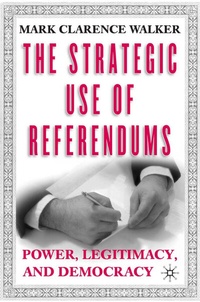
The Strategic Use of Referendums
Description

Reviews / Votes
"Walker's study is a valuable contribution to our thinking about the role of referendums in late-communist and post-communist regimes as well as France and Chile. Walker deftly examines the bargaining and power relations among institutions that generate such referendums, the results of the popular votes, and the implications of these factors for our thinking about leadership, democracy, and popular will. The book is very well written and a pleasure to read." - George W. Breslauer, Professor of Political Science, Dean of Social Sciences, University of California at Berkeley
"This excellent comparative work is very thorough...This analysis is quite credible, and Walker has built a very convincing case with his examples from these four countries... Mark Walker has done an excellent job in thoroughly describing the strategic aspect of referenda in four different contexts; it is to his credit that he raises many other issues in the process of this extensive and provocative analysis."
- Priscilla L. Southwell, Professor of Political Science & Associate Dean of Social Sciences, University of Oregon, in Perspectives on Politics
"The Strategic Use of Referendums...is a brief but informative book that contributes to several literatures, including work on leadership, comparative legislative-executive relations, and the post-Soviet states. In it, Walker places the leader who desires to increase his power (especially vis-a`-vis the legislative branch of government) at center stage and builds a theory about how the referendum can be used for that purpose."
- Andrea K. Grove, Department of Political Science and Peace Studies Program, Westminster College, in International Studies Review
More details
Other editions
Additional editions
Person
Content
- Cover
- Table of Contents
- Preface
- Chapter 1 Legitimacy, Bargaining, and Power in the Use of Referendums
- Chapter 2 Referendums and Executives in France and Chile
- Chapter 3 The USSR Referendum and Republic Counter-Referendums
- Chapter 4 Bargaining and Power in Russian Referendums
- Chapter 5 Patterns in the Use of Referendums
- Chapter 6 Pros and Cons of Referendums and Democratic Theory
- Notes
- Bibliography
- Index
- A
- B
- C
- D
- E
- F
- G
- I
- K
- L
- M
- N
- P
- R
- S
- T
- U
- V
- Y
- Z
