

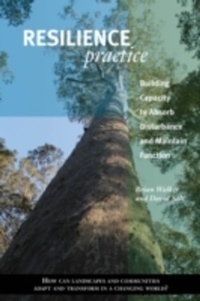
Resilience Practice
Description

In 2006, Resilience Thinking addressed an essential question: As the natural systems that sustain us are subjected to shock after shock, how much can they take and still deliver the services we need from them? This idea caught the attention of both the scientific community and the general public. In Resilience Practice, authors Brian Walker and David Salt take the notion of resilience one step further, applying resilience thinking to real-world situations and exploring how systems can be managed to promote and sustain resilience. The book begins with an overview and introduction to resilience thinking and then takes the reader through the process of describing systems, assessing their resilience, and intervening as appropriate. Following each chapter is a case study of a different type of social-ecological system and how resilience makes a difference to that system in practice. The final chapters explore resilience in other arenas, including on a global scale. Resilience Practice will help people with an interest in the "coping capacity" of systems-from farms and catchments to regions and nations-to better understand how resilience thinking can be put into practice. It offers an easy-to-read but scientifically robust guide through the real-world application of the concept of resilience and is a must read for anyone concerned with the management of systems at any scale.
All prices
More details
Other editions
Additional editions
Persons
Brian Walker is a Research Fellow in Australia's CSIRO Ecosystem Sciences, Visiting Researcher in the Stockholm Resilience Centre, and Chair of the Resilience Alliance. David Salt is a science and environment writer at the Australian National University, and has more than two decades experience writing and producing popular science magazines and books. Both authors live in Canberra, Australia.
Content
Foreword Preface Acknowledgments
1. Preparing for Practice: The Essence of Resilience Thinking Case Study 1: Thresholds on the Range: A Safe Operating Space for Grazing Enterprises
2. Describing the System Case Study 2: From Taos to Bali and Sri Lanka: Traditional Irrigation at the Crossroads
3. Assessing Resilience Case Study 3: Assessing Resilience for "the Plan": The Namoi and Central West Catchment Management Authorities
4. Managing Resilience Case Study 4: People and Pen Shells, Marine Parks and Rules: Why Governance Is Central to the Resilience of Coastal Fisheries
5. Practicing Resilience in Different Ways Case Study 5: Out of the Swamp: Lessons from Big Wetlands
6. A Resilient World
Postscript: A View from the Northwest PassageReferences Glossary About the Authors Index.

