

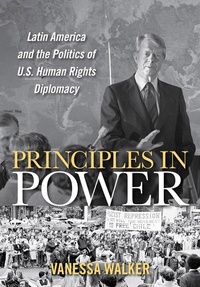
Principles in Power
Description

Vanessa Walker's Principles in Power explores the relationship between policy makers and nongovernment advocates in Latin America and the United States government in order to explain the rise of anti-interventionist human rights policies uniquely critical of U.S. power during the Cold War. Walker shows that the new human rights policies of the 1970s were based on a complex dynamic of domestic and foreign considerations that was rife with tensions between the seats of power in the United States and Latin America, and the growing activist movement that sought to reform them.
By addressing the development of U.S. diplomacy and politics alongside that of activist networks, especially in Chile and Argentina, Walker shows that Latin America was central to the policy assumptions that shaped the Carter administration's foreign policy agenda. The coup that ousted the socialist president of Chile, Salvador Allende, sparked new human rights advocacy as a direct result of U.S. policies that supported authoritarian regimes in the name of Cold War security interests. From 1973 onward, the attention of Washington and capitals around the globe turned to Latin America as the testing ground for the viability of a new paradigm for U.S. power.
This approach, oriented around human rights, required collaboration among activists and state officials in places as diverse as Buenos Aires, Santiago, and Washington, DC. Principles in Power tells the complicated story of the potentials and limits of partnership between government and nongovernment actors. Analyzing how different groups deployed human rights language to reform domestic and international power, Walker explores the multiple and often conflicting purposes of U.S. human rights policy.
More details
Other editions
Additional editions
Person
Vanessa Walker is the Morgan Assistant Professor of Diplomatic History at Amherst College.
Content
Introduction: The Politics of Complicity
1. The Chilean Catalyst: Cold War Allies and Human Rights in the Western Hemisphere
2. Words Are Not Enough: Building a Human Rights Agenda in the Shadow of the Past
3. A Special Responsibility: Human Rights and U.S.-Chilean Relations
4. Weighing the Costs: Human Rights and U.S.-Argentine Relations
5. The Reagan Reinvention: A Cold War Human Rights Vision
Conclusion: The Golden Years of Human Rights?
