

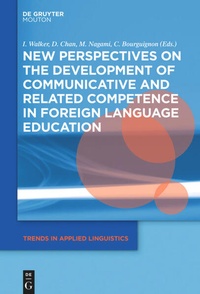
New Perspectives on the Development of Communicative and Related Competence in Foreign Language Education
Description

Nearly half a century has passed since Hymes proposed the concept of communicative competence to describe the knowledge and skills required for the appropriate use of language in a social context. During these decades, a number of scholars have applied and refined this concept. In language education, communicative competence has been identified as a major objective of learning.
This book will inform readers about communicative competence as a highly complex construct encompassing an array of sub-competencies such as linguistic skills and proficiencies, knowledge of socio-cultural and socio-pragmatic codes, and the ability to engage in textual and conversational discourse. Findings from research in related disciplines have pointed to the significance of factors that can contribute to the attainment of communicative competence. Various teaching practices and relevant Information and Communication Technology (ICT) tools will be also introduced and discussed to achieve communicative competence as a complex ability. It is a timely contribution to current research on key areas in the teaching, learning and acquisition of second/foreign languages.
More details
Other editions
Additional editions
Persons
Content
- Intro
- Preface
- Contents
- 1. New perspectives on the development of communicative and related competence in foreign language education: An introduction to the book
- Part I: Theoretical and pedagogical issues in the development of competence
- 2. Taking the critics to task: The case for task-based teaching
- 3. Developing self-regulated learning in the language classroom
- 4. Pragmatic competence in foreign language education: Cultivating learner autonomy and strategic learning of pragmatics
- 5. Teaching english to young learners in Japan: Teacher competence and classroom context
- 6. What competence is necessary to be able to work in Japan-related workplaces? A survey of Singaporean business persons
- Part II: Empirical research on the acquisition of competence
- 7. The effects of the first language on the description of motion events: Focusing on L2 Japanese learners of english and hungarian
- 8. Explicit instruction on English verb structures in L2 classrooms
- 9. Character knowledge and reading stages of Chinese as a foreign language
- 10. Developing communicative competence: The role of handover in scaffolding oral communication
- Part III: Practices in developing competence
- 11. Pragmatic development in the study abroad context: Impact of a cross-cultural pragmatic strategies intervention
- 12. Intercultural communication competence and possible L2 selves in a short-term study abroad program
- 13. Corpora as an L2 writing reference tool: Classroom practice and student response
- 14. Effects of digital storytelling on japanese Efl learners: Focus on anxiety and PBL skills
- 15. Evaluation of two communities of inquiry
- Index
