

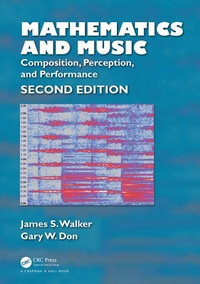
Mathematics and Music
Composition, Perception, and Performance
2nd Edition
Published on 24. September 2019
398 pages
978-0-429-01355-3 (ISBN)
Description

Mathematics and Music: Composition, Perception, and Performance, Second Edition includes many new sections and more consistent expectations of a student's experience. The new edition of this popular text is more accessible for students with limited musical backgrounds and only high school mathematics is required.
The new edition includes more illustrations than the previous one and the added sections deal with the XronoMorph rhythm generator, musical composition, and analyzing personal performance.
The text teaches the basics of reading music, explaining how various patterns in music can be described with mathematics, providing mathematical explanations for musical scales, harmony, and rhythm. The book gives students a deeper appreciation showing how music is informed by both its mathematical and aesthetic structures.
Highlights of the Second Edition:
Now updated for more consistent expectations of students' backgrounds
More accessible for students with limited musical backgrounds
Full-color presentation
Includes more thorough coverage of spectrograms for analyzing recorded music
Provides a basic introduction to reading music
Features new coverage of building and evaluating rhythms
The new edition includes more illustrations than the previous one and the added sections deal with the XronoMorph rhythm generator, musical composition, and analyzing personal performance.
The text teaches the basics of reading music, explaining how various patterns in music can be described with mathematics, providing mathematical explanations for musical scales, harmony, and rhythm. The book gives students a deeper appreciation showing how music is informed by both its mathematical and aesthetic structures.
Highlights of the Second Edition:
Now updated for more consistent expectations of students' backgrounds
More accessible for students with limited musical backgrounds
Full-color presentation
Includes more thorough coverage of spectrograms for analyzing recorded music
Provides a basic introduction to reading music
Features new coverage of building and evaluating rhythms
More details
Edition
2nd edition
Language
English
Place of publication
London
United Kingdom
Publishing group
Taylor & Francis Ltd
Target group
College/higher education
Product notice
Reflowable
Illustrations
13 Tables, black and white; 87 Illustrations, color; 319 Illustrations, black and white
ISBN-13
978-0-429-01355-3 (9780429013553)
Copyright in bibliographic data and cover images is held by Nielsen Book Services Limited or by the publishers or by their respective licensors: all rights reserved.
Schweitzer Classification
Other editions
Additional editions
Book
02/2023
2nd Edition
Chapman & Hall/CRC
€93.20
Shipment within 10-20 days
Book
06/2021
2nd Edition
CRC Press
€85.60
The article will not be published
Book
09/2019
2nd Edition
CRC Press
€178.44
Shipment within 10-20 days
Persons
James S. Walker holds a doctorate from the University of Illinois at Chicago, advised by Louis L. Pennisi. He is a Professor and teaches in the Mathematics Department at the University of Wisconsin-Eau Claire. He has published papers on topics in Fourier analysis, wavelet analysis, logic, image compression, image denoising, and mathematics & music.
Gary W. Don is a professor of music theory at the University of Wisconsin-Eau Claire. He teaches freshman and sophomore theory and aural skills, and upper-division theory courses. Additionally, he holds a doctorate in music theory from the University of Washington, and taught theory and aural skills at Skidmore College in New York before joining the UWEC faculty.
Gary W. Don is a professor of music theory at the University of Wisconsin-Eau Claire. He teaches freshman and sophomore theory and aural skills, and upper-division theory courses. Additionally, he holds a doctorate in music theory from the University of Washington, and taught theory and aural skills at Skidmore College in New York before joining the UWEC faculty.
Content
Pitch, Frequency, and Musical Scales
Pitch and Frequency
Overtones, Pitch Equivalence, and Musical Scales
The 12-Tone Equal Tempered Scale
Musical Scales within the Chromatic Scale
Logarithms
Basic Musical NotationStaff Notation, Clefs, and Note Positions
Time Signatures and Tempo
Key Signatures and the Circle of Fifths
Some Music Theory Interval and Chords
Diatonic Music
Diatonic Transformations - Scale Shifts
Diatonic Transformations - Inversions, Retrograde
Chromatic Transformation
Composing Your Own Music
Web Resources
Spectrograms and Musical TonesMusical Gestures in Spectrograms
Mathematical Model for Musical Tones
Modeling Instrumental Tones
Beating and Dissonance
Estimating Amplitude and Frequency
Windowing the Waveform: Spectrograms
A Deeper Study of Amplitude Estimation
Spectrograms and Music
Singing
Instrumentals
Compositions
Evaluating Personal Performance
Essay
Analyzing Pitch and Rhythm
Geometry of Pitch Organization and Transpositions
Geometry of Chromatic Inversions
Cyclic Rhythms
Rhythmic Inversion
A Case Study in Rhythm: Bruch's Lok Nidrei
Construction of Scales and Cyclic Rhythms
Perfectly Balanced Rhythms, XronoMorph
XronoMoprh, Well-formed Rhythms
Comparing Musical Scales and Cyclic Rhythms
Serialism
Composing Your Own Music II
A Geometry of Harmony
Riemann's Chromatic Inversions
A Network of Triadic Chords
Embedding Pitch Classes with the Tonnetz
Other Chordal Transformations
Tonnetz Patterns in Music
Audio Synthesis in Music
Creating New Music from Spectrograms
Phase Vocoding
How Auto-Tune Works
Time Stretching and Time Shrinking
MIDI Synthesis
Software and Other Resources
Exercise Solutions
Amplitude and Frequency Results
Complex Numbers
Autocorrelation and Periodicity
Music Software
Glossary
Pitch and Frequency
Overtones, Pitch Equivalence, and Musical Scales
The 12-Tone Equal Tempered Scale
Musical Scales within the Chromatic Scale
Logarithms
Basic Musical NotationStaff Notation, Clefs, and Note Positions
Time Signatures and Tempo
Key Signatures and the Circle of Fifths
Some Music Theory Interval and Chords
Diatonic Music
Diatonic Transformations - Scale Shifts
Diatonic Transformations - Inversions, Retrograde
Chromatic Transformation
Composing Your Own Music
Web Resources
Spectrograms and Musical TonesMusical Gestures in Spectrograms
Mathematical Model for Musical Tones
Modeling Instrumental Tones
Beating and Dissonance
Estimating Amplitude and Frequency
Windowing the Waveform: Spectrograms
A Deeper Study of Amplitude Estimation
Spectrograms and Music
Singing
Instrumentals
Compositions
Evaluating Personal Performance
Essay
Analyzing Pitch and Rhythm
Geometry of Pitch Organization and Transpositions
Geometry of Chromatic Inversions
Cyclic Rhythms
Rhythmic Inversion
A Case Study in Rhythm: Bruch's Lok Nidrei
Construction of Scales and Cyclic Rhythms
Perfectly Balanced Rhythms, XronoMorph
XronoMoprh, Well-formed Rhythms
Comparing Musical Scales and Cyclic Rhythms
Serialism
Composing Your Own Music II
A Geometry of Harmony
Riemann's Chromatic Inversions
A Network of Triadic Chords
Embedding Pitch Classes with the Tonnetz
Other Chordal Transformations
Tonnetz Patterns in Music
Audio Synthesis in Music
Creating New Music from Spectrograms
Phase Vocoding
How Auto-Tune Works
Time Stretching and Time Shrinking
MIDI Synthesis
Software and Other Resources
Exercise Solutions
Amplitude and Frequency Results
Complex Numbers
Autocorrelation and Periodicity
Music Software
Glossary
