

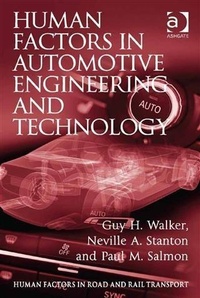
Human Factors in Automotive Engineering and Technology
Published on 28. June 2015
326 pages
978-1-4724-0628-6 (ISBN)
Description

Offering a unique perspective on vehicle design and on new developments in vehicle technology, this book seeks to bridge the gap between engineers, who design and build cars, and human factors, as a body of knowledge with considerable value in this domain. The work that forms the basis of the book represents more than 40 years of experience by the authors. Human Factors in Automotive Engineering and Technology imparts the authors' scientific background in human factors by way of actionable design guidance, combined with a set of case studies highly relevant to current technological challenges in vehicle design. The book presents a novel and accessible insight into a body of knowledge that will enable students, professionals and engineers to add significant value to their work.
More details
Series
Edition
New edition
Language
English
Place of publication
Farnham
United Kingdom
Publishing group
Taylor & Francis Ltd
Target group
Professional and scholarly
Edition type
New edition
Illustrations
Includes 46 b&w illustrations
File size
11,12 MB
ISBN-13
978-1-4724-0628-6 (9781472406286)
Copyright in bibliographic data and cover images is held by Nielsen Book Services Limited or by the publishers or by their respective licensors: all rights reserved.
Schweitzer Classification
Other editions
Additional editions
Guy H. Walker | Neville A. Stanton
Human Factors in Automotive Engineering and Technology
E-Book
03/2017
1st Edition
CRC Press
€88.49
Available for download
Guy H. Walker | Neville A. Stanton
Human Factors in Automotive Engineering and Technology
E-Book
03/2017
CRC Press
€88.49
Available for download
Guy H. Walker | Neville A. Stanton
Human Factors in Automotive Engineering and Technology
Book
05/2015
1st Edition
Ashgate Publishing Limited
€207.00
Shipment within 10-20 days
Persons
Dr Guy Walker is an Associate Professor within the Institute for Infrastructure and Environment at Heriot-Watt University in Edinburgh. He lectures on transportation engineering and human factors and is the author/co-author of ninety peer reviewed journal articles and eleven books. He and his co-authors have been awarded the Institute for Ergonomics and Human Factors (IEHF) President's Medal for the practical application of Ergonomics theory, the Peter Vulcan prize for best research paper, and Heriot-Watt's Graduate's Prize for inspirational teaching. Dr Walker has a BSc Honours degree in Psychology from the University of Southampton, a PhD in Human Factors from Brunel University, is a Fellow of the Higher Education Academy and a member of the Royal Society of Edinburgh's Young Academy of Scotland. His research interests are wide ranging, spanning driver behaviour and the role of feedback in vehicles, using human factors methods to analyse black-box data recordings, the application of sociotechnical systems theory to the design and evaluation of transportation systems, through to self-explaining roads and driver behaviour in road works. His research has featured in the popular media, from national newspapers, TV and radio through to an appearance on the Discovery Channel.
Professor Neville A Stanton, PhD, is both a Chartered Psychologist and a Chartered Engineer and holds the Chair in Human Factors in the Engineering Centre of Excellence at the University of Southampton. He has degrees in Psychology, Applied Psychology and Human Factors and has worked at the Universities of Aston, Brunel, Cornell and MIT. His research interests include modelling, predicting and analysing human performance in transport systems as well as designing the interfaces between humans and technology. Professor Stanton has worked on cockpit design in automobiles and aircraft over the past 25 years, working on a variety of automation projects. He has published 30 books and over 200 journal papers on Ergonomics and Human Factors, and is currently an editor of the peer-reviewed journal Ergonomics. In 1998 he was awarded the Institution of Electrical Engineers Divisional Premium Award for a co-authored paper on Engineering Psychology and System Safety. The Institution of Ergonomics and Human Factors awarded him The Otto Edholm Medal in 2001, The President's Medal in 2008 and The Sir Frederic Bartlett Medal in 2012 for his contribution to basic and applied ergonomics research. The Royal Aeronautical Society awarded him and his colleagues the Hodgson Prize and Bronze Medal in 2006 for research on design-induced flight-deck error published in The Aeronautical Journal. The University of Southampton have awarded him a DSc in 2014 for his sustained contribution over the past twenty years to the development and validation of Human Factors methods.
Professor Paul Salmon holds a chair on Human Factors and is creator and director of the University of the Sunshine Coast Accident Research (USCAR) centre. He currently holds a prestigious Australian Research Council Future Fellowship and has almost 15 years' experience in applied Human Factors research in a number of areas, including defence, transportation safety, sports and outdoor recreation, and disaster management. Paul has co-authored 10 books, over 100 peer reviewed journal articles, and numerous conference articles and book chapters. He has received various accolades for his contribution, including the 2007 Royal Aeronautical Society Hodgson Prize for best research and best paper and the 2008 Ergonomics Society's President's Medal. His current research interests are accident prediction and analysis, applying systems thinking approaches in transportation, human factors in sport, and the design and analysis of sociotechnical systems.
Professor Neville A Stanton, PhD, is both a Chartered Psychologist and a Chartered Engineer and holds the Chair in Human Factors in the Engineering Centre of Excellence at the University of Southampton. He has degrees in Psychology, Applied Psychology and Human Factors and has worked at the Universities of Aston, Brunel, Cornell and MIT. His research interests include modelling, predicting and analysing human performance in transport systems as well as designing the interfaces between humans and technology. Professor Stanton has worked on cockpit design in automobiles and aircraft over the past 25 years, working on a variety of automation projects. He has published 30 books and over 200 journal papers on Ergonomics and Human Factors, and is currently an editor of the peer-reviewed journal Ergonomics. In 1998 he was awarded the Institution of Electrical Engineers Divisional Premium Award for a co-authored paper on Engineering Psychology and System Safety. The Institution of Ergonomics and Human Factors awarded him The Otto Edholm Medal in 2001, The President's Medal in 2008 and The Sir Frederic Bartlett Medal in 2012 for his contribution to basic and applied ergonomics research. The Royal Aeronautical Society awarded him and his colleagues the Hodgson Prize and Bronze Medal in 2006 for research on design-induced flight-deck error published in The Aeronautical Journal. The University of Southampton have awarded him a DSc in 2014 for his sustained contribution over the past twenty years to the development and validation of Human Factors methods.
Professor Paul Salmon holds a chair on Human Factors and is creator and director of the University of the Sunshine Coast Accident Research (USCAR) centre. He currently holds a prestigious Australian Research Council Future Fellowship and has almost 15 years' experience in applied Human Factors research in a number of areas, including defence, transportation safety, sports and outdoor recreation, and disaster management. Paul has co-authored 10 books, over 100 peer reviewed journal articles, and numerous conference articles and book chapters. He has received various accolades for his contribution, including the 2007 Royal Aeronautical Society Hodgson Prize for best research and best paper and the 2008 Ergonomics Society's President's Medal. His current research interests are accident prediction and analysis, applying systems thinking approaches in transportation, human factors in sport, and the design and analysis of sociotechnical systems.
Content
Contents: The car of the future, here today; A technology timeline; Lessons from aviation; Defining driving; Describing driver error; Examining driver error and its causes; A psychological model of driving; Vehicle feedback and driver situational awareness; Vehicle automation and driver workload; Automation displays; Trust in vehicle technology; A systems view of vehicle automation; Conclusions; Appendix; Further reading; References; Bibliography; Index.
