

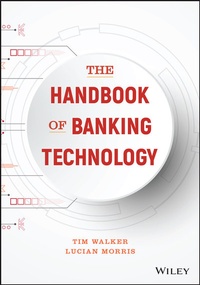
The Handbook of Banking Technology
Description

The Handbook of Banking Technology provides a blueprint for the future of banking, with deep insight into the technologies at the heart of the industry. The rapid evolution of IT brings continual change and demand for investment -- yet keeping pace with these changes has become an essential part of doing business. This book describes how banks can harness the power of current and upcoming technology to add business value and gain a competitive advantage; you'll learn how banks are using technology to drive business today, and which emerging trends are likely to drive the evolution of banking over the next decade.
Regulation is playing an ever increasing role in banking and the impact of regulatory change on technology and the management of it are discussed -- while mandatory changes put pressure on many of our high street banking brands, their ability to adapt and utilise technology will have a fundamental impact on their success in the rapidly changing marketplace.
Technology costs can amount to 15 per cent or more of operational costs and bank leaders need to be able to make informed decisions about technology investments in light of the potential benefits. This book explores the depth and breadth of banking technology to help decision makers stay up to date and drive better business.
* Assess your current technology against the new banking paradigms
* Procure the systems needed to protect the bottom line
* Implement newer technology more efficiently and effectively
* Ensure compliance and drive value with appropriate technology management
Technological change is driven by mass adoption of new channels, innovation from new entrants, and by banks themselves as a means of increasing revenue and reducing costs. The Handbook of Banking Technology offers a comprehensive look at the role of technology in banking, and the impact it will have in the coming years.
More details
Other editions
Additional editions
Persons
TIM WALKER is a former Partner in Deloitte's Financial Services Consulting practice. He has over two decades of experience working for banking and payments institutions implementing new front, middle, and back office technology.
LUCIAN MORRIS is the CIO of the Mortgage Advice Bureau in the UK. Formerly a Director in Deloitte's Financial Services Consulting practice, Lucian has worked with many of the UK high street banking and fintech start-up organisations and was CIO of Metro Bank during its launch.
Content
Preface ix
Chapter 1 Introduction 1
1.1 Banking and the Rise of Technology 1
1.2 The Challenges of Technology in Large Banks 3
1.3 Navigating This Book 4
1.4 References 7
Chapter 2 The History and Current State of Banking 8
2.1 A Brief History of Banking 8
2.2 Cash, Gold and Digital Money 11
2.3 Branch Centrism 14
2.4 Banking Consolidation 16
2.5 The Development of Modern Banking Products and Services 24
2.6 Developments in Banking Technology 33
2.7 The Challenges of Technology in Banking 39
2.8 New Banking Models 41
2.9 The Impact of the 2008 Banking Crisis 46
2.10 The Current State of Banking 50
2.11 Further Reading 55
2.12 References 56
Chapter 3 An Introduction to Banking Technology 67
3.1 Introduction 67
3.2 A Model of a Simple Bank 67
3.3 The Core Banking Platform 68
3.4 Database Architectures 72
3.5 Making Platforms Highly Available 80
3.6 Platform Architectures 85
3.7 Revisiting Our Simple Model of a Bank 91
3.8 Single Customer View 92
3.9 IBM CICS 95
3.10 Internet Banking 104
3.11 Customer Authentication 108
3.12 Remote Procedure Calls 113
3.13 Distributed Objects and CORBA 116
3.14 Services 117
3.15 Web Services 119
3.16 RESTful Web Services 123
3.17 Service-Oriented Architecture 125
3.18 An Updated Model of Our Bank 127
3.19 Application Processing 128
3.20 Microservices 129
3.21 Modern Databases 133
3.22 Data Analysis and Reporting 135
3.23 Further Reading 146
3.24 References 147
Chapter 4 Channels 149
4.1 Introduction 149
4.2 Branches 150
4.3 Branch Technology 152
4.4 Post 157
4.5 Automated Teller Machines 158
4.6 Telephony 168
4.7 Online Chat 169
4.8 Video Calling 169
4.9 Handling Telephone, Chat and Video Contacts 170
4.10 Text Messaging 194
4.11 Internet 195
4.12 Email 195
4.13 Mobile 196
4.14 Social Media 198
4.15 Marketing 198
4.16 Cross-channel Considerations and Implications 200
4.17 References 203
Chapter 5 Banking Operations 207
5.1 Contact Centre 207
5.2 Payment Operations 208
5.3 Cash Management 210
5.4 Credit Operations 210
5.5 Collections and Recoveries 213
5.6 Fraud Services 214
5.7 References 227
Chapter 6 Card Payments 230
6.1 Types of Card 230
6.2 Information on a Payment Card 232
6.3 How a Card Payment Works 233
6.4 Card Payment Networks 238
6.5 Other Types of Card Transactions 243
6.6 Managing Payment Cards 245
6.7 References 257
Chapter 7 Payments 259
7.1 Introduction 259
7.2 Cash 260
7.3 Cheques 262
7.4 Direct Credits 267
7.5 Clearing and Settlement 267
7.6 Interbank Payments 268
7.7 Payment Fraud and Sanctions 284
7.8 Payment Reconciliation 284
7.9 Payment Technology 286
7.10 References 294
Chapter 8 Regulation, Finance and Compliance 297
8.1 Introduction 297
8.2 Regulation 297
8.3 Global Standards 303
8.4 Working with (and within) Regulation 303
8.5 Finance Functions - Introduction 304
8.6 Finance 305
8.7 Treasury 307
8.8 Compliance 313
8.9 Human Resources 315
8.10 Procurement 317
8.11 Other Corporate Functions 317
8.12 References 318
Chapter 9 The Technology Function 321
9.1 Organisation and Governance 321
9.2 Conway's Law 325
9.3 Cost of Technology 326
9.4 Working with the Business - It's about the Service, Not the Technology 327
9.5 Service Management 329
9.6 Mapping Services to Applications 331
9.7 Governing the Application Estate 332
9.8 Insourcing and Outsourcing 334
9.9 Managing the Estate 337
9.10 Following the Rules - Regulation, Law and Technology 343
9.11 References 346
Chapter 10 The Future of Banking 348
10.1 Broad Trends 348
10.2 Changing Products, Features and Functions 352
10.3 The Future of Payments 352
10.4 Technology in Operations 354
10.5 Regulation 355
10.6 Finance 355
10.7 The Technology Function 356
10.8 A Short Digression on Data 356
10.9 Banking Products and Services 357
10.10 Distributed Ledger Technologies and Cryptocurrencies 359
10.11 The Future of the Branch 360
10.12 Headcount, Skills and Career Progression in the Bank of the Future 361
10.13 References 362
About the Authors 365
Index 367
CHAPTER 1
Introduction
1.1 Banking and the Rise of Technology
The banking industry, in many varied forms, has verifiably been in existence for at least four millennia. Beginning as a simple money and commodity management activity that supported early merchants and royalty, banking has gradually evolved into today's model: a complex, highly connected network of businesses that spans the globe. While it can appear that the development of the banking industry has generally taken place at a rather sedate pace, in reality banks have been established, grown and consolidated into ever larger organisations seemingly non-stop for centuries.
The advent of computers and, later, the Internet have had a dramatic impact on how banking has been conducted in recent times and ended the long-standing trend of opening more and more branches across the globe. Banks have changed their products and services, developed credit and debit cards, introduced computers to improve efficiency, built multi-channel digital banking platforms and, in many geographies, significantly reduced their high street footprint. They are moving from being brick-and-mortar businesses to what seems often to be purely digital utilities. However, the emergence of digital-only propositions may allow new businesses to develop with a much lower cost to serve, better products and services and more convenient customer access. A digital-first world of banking, it is argued, would not only replace the legacy brick-and-mortar world, but has the potential to deliver business models that will out-compete the incumbents, businesses that have grown huge, cumbersome and complacent. Visionaries and digital advocates in the financial services market argue that incumbent banks are, like the dinosaurs, plodding slowly but surely towards their inexorable extinction. On the other hand, large incumbents have the advantage of huge economies of scale and existing customer bases, meaning they pay less for deposits and make more money from each of their existing customers. Although there is evidence to show that the costs of complex, legacy technology are higher than modern technology, the massive scale of incumbent banks may mean that this cost can be borne for long enough for these banks to modernise their technology estates. Thus, the stage is set for a struggle between the old and the new.
The outcome of this struggle is far from a foregone conclusion and, in fact, the history of banks and banking institutions implies that the bigger ones eventually acquire the smaller ones - for more than a century the total number of banks in developed markets has been declining and this trend continues even up to the present.
Some observers have predicted that the shift to digital will sideline incumbent organisations in a different way, akin to what happened in the mobile telecommunications industry, where huge and highly profitable new businesses offering a new paradigm - the smartphone - were built. The mobile network providers no longer have access to the bulk of the revenue in this industry and are purely utilities with varying levels of profitability and return on capital in different markets around the world. Could incumbent banks just become utilities providing vanilla banking products with the customer relationships intermediated by new organisations with better technology? In practice, many digital new entrants are offering just the same banking products as incumbents, with a better mobile app, and this doesn't feel like a paradigm shift like the smartphone was. Also, it appears likely that only some incumbents will manufacture products for others and the rest will resist being intermediated unless forced by regulators, such as in the EU, where the Payment Services Directive 2 (PSD2) has resulted in banks having to offer an open banking interface for use by third-party service providers.
There is a third point of view: that to even present the current situation as incumbents versus new entrants and fintech start-ups, or old versus new, may not even be an appropriate or accurate representation of the true picture.
Where many analysts and commentators originally expected conflict (as early as 1994 Bill Gates famously made his big bank dinosaur speech),1 it is now becoming clear that the relationship between new and old will be much more nuanced, with start-ups as likely to cooperate with incumbents as they are to compete.
So, we believe that the predictions of apocalypse for the incumbents within the banking industry are far from certain. While the digital agenda is creating opportunities for new entrants and does pose a risk to incumbent organisations, the rise of innovative fintech solutions and business models also provides many opportunities for established entities. There is no doubt that a significant amount of work, both forward-looking and in remediation, must be carried out in order for the incumbents to remain competitive and position them to seize these new opportunities, but their size and scale offers stability, established market access, lower unit costs and the income to fund the required changes - all key attributes that the new entrants and fintech start-ups typically lack. Over the last seven decades the established banks have proven themselves more than capable of adjusting to, and adopting, new technologies (computers, ATMs and Internet banking, to name a few) and any suggestion that a new wave of technologies means certain destruction for them may therefore be premature or even wrong. Not only do they have a proven history of adaptation, but many also have the balance sheets to buy themselves out of trouble should they need to, either through investing in joint ventures with up-and-coming start-ups or through outright acquisition of potential competitors.
Incumbent organisations may well struggle to adapt and there will inevitably be some organisations that will fall by the roadside (which usually means being acquired), but any significant change in market conditions typically results in casualties among the established order in that market. To survive and prosper, the leadership of a bank needs to recognise that it is a fundamentally digital business and that having a sufficient understanding of technology, its uses and sources of competitive advantage is essential.
1.2 The Challenges of Technology in Large Banks
There are several typical challenges that a bank's leadership faces relating to technology. For example, the leadership will have to decide whether its bank can persist in using legacy banking platforms. In order to meet the demands of the new digital economy our incumbent banking organisations require substantial changes within their organisations, and not just in the technology itself. Bank leadership teams need to acknowledge that the banking business is essentially becoming one of technology. Banks are now, at their core, digital businesses, and the leadership team must accept that and ensure that it has the skills at the top of the bank to manage a technology organisation. One of the reasons we wrote this book is to help to raise the level of understanding of technology among bank management.
Many of the platforms and systems that sit at the core of banking businesses are legacy environments, containing dated software and hardware, that have been built up over many years. Stories continue to circulate about the age of some of these systems. For example, the UK newspaper The Telegraph, as recently as December 2016, published an article claiming that some banking platforms in the UK still run on pounds, shillings and pence,2 the UK's currency before decimalisation in 1971. We do not know whether this story is really true or not, but it was certainly an urban myth that occasionally surfaced in our conversations across the industry during our careers. While the latest developments may have been carried out in modern software development languages, the core of these platforms is still legacy and is often complex and poorly understood and therefore prone to going wrong when changes are made. Not only are these platforms getting on in age, but so are many of the developers who understand them. Such systems are often blamed for the seemingly high cost base of technology, the shortcomings of various products offered by the bank, and the lack of flexibility to introduce new products and services. On the other hand, re-platforming is expensive and full of risk - we are aware of several banks around the world that spent huge sums replacing their core banking platforms, and some, such as TSB in the UK,3 that ran into highly public difficulties.
In parallel with maintaining legacy banking platforms, it would appear that many banks have struggled to maintain appropriate controls over the ongoing development of their technology estates. Of course, there are many reasons for the huge diversity in technology estates, which include business-led decision-making with technology standardisation low on the list of priorities, ongoing developments in technology with consequent dead ends and obsolescence, and accumulation of technology variety through mergers and acquisitions. Consequently, modern banking technology estates are complex and often poorly understood, even by the technology functions that run them. Some estates are so large that even tracking the hardware and software within them can be a significant task and many large modern banks struggle to do even this effectively, let alone calculate the input costs for each service that they supply and for which they charge the business units that consume them. Of course, there are usually no easy solutions to the problems posed...
