

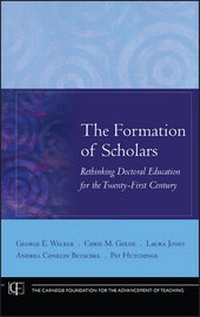
The Formation of Scholars
Description

Reviews / Votes
The book shows how doctoral education has evolved, how graduate programs take a hard look at themselves, and the specific change practices attempted by participating departments... Together, the chapters offer guidelines for surviving and thriving as a college teacher. (The Journal of Continuing Higher Ed, 06/08)More details
Other editions
Additional editions
Persons
Content
FOREWORD
Academics are very careful with words. The title of this book, The Formation of Scholars, embodies two key terms that call for explanation and interpretation. Why formation? Why scholars? The answer is that the juxtaposition of these two ideas captures the essential character of the work reported in this volume. Doctoral education prepares scholars who both understand what is known and discover what is yet unknown. They conserve the most valued knowledge of the past even as they examine it critically. They invent new forms of understanding as they move their fields ahead. Yet the more they understand, the heavier their moral obligation to use their knowledge and skill with integrity, responsibility, and generosity. They are thinkers and actors, intellectual adventurers and moral agents. The idea of formation, borrowed from religious educators, refers to the kind of education that leads to an integration of mind and moral virtue that we often call character or integrity.
When I first began working in teacher education, I was admonished by insiders never to use the phrase “teacher training.” Training implied mindless, routine practice more appropriate to an assembly line than to a classroom. It also reinforced the rampant behaviorism that dominated the fields of teacher preparation and teacher evaluation. The correct term was “teacher education,” which more aptly captured the fundamentally intellectual, strategic, and thoughtful functions associated with teaching. I took this instruction to heart. Indeed, when I delivered my presidential address to the American Educational Research Association in 1984, I concluded my remarks with a revision of Shaw’s “Those who can, do; those who cannot, teach,” changing it to “Those who can, do. Those who understand, teach.” Teaching must be understood as an intentional act of mind for which a rich educational experience is necessary. Yet this move may not be enough.
In recent years, my colleagues and I at The Carnegie Foundation for the Advancement of Teaching undertook our comparative studies of education across the “learned professions” of law, engineering, the clergy, teaching, medicine, and nursing. In parallel, we initiated the study of doctoral education that is described and analyzed in this book. We recognized early on that doctoral education could be examined as a form of professional preparation. Those with PhDs are prepared both to know and to do. Holders of the PhD are prepared to profess their disciplines and their fields of study, not only to understand them deeply but also to take upon themselves the moral responsibility to protect the integrity of their field and its proper use in the service of humanity. We found the term formation—used extensively in the field of religious education and the preparation of clergy—to be particularly appropriate for describing this integration of the intellectual and the moral in preparing for the many roles of the scholar—discovery and synthesis, teaching and service. Thus we had evolved from training to education and from education to formation.
The PhD is the monarch of the academic community. It is the very highest accomplishment that can be sought by students. It signals that its recipient is now ready, eligible, indeed obligated, to make the most dramatic shift in roles: from student to teacher, from apprentice to master, from novice or intern to independent scholar and leader. The PhD marks its holder as one charged to serve as a steward of the discipline and profession. If this language sounds mildly ecclesiastical, it is no accident. We do not choose the language of “formation” or “stewardship” capriciously. The doctorate carries with it both a sense of intellectual mastery and of moral responsibility. That the entire process concludes with all members of the community dressed in religious robes and engaged in an act of ordination of the novice by the master with a priestly hood is no accident.
So is the PhD to be understood as just one more learned profession, the academic parallel to engineering, law, or medicine? Not really. I remember my surprise at the scheduling of commencements at my alma mater. When completing graduate study at the University of Chicago, I saw that the undergraduate commencement was to be held on Friday, when all of the baccalaureate degrees would be awarded—including the degrees of MD and JD. The graduate commencement for recipients of master’s degrees and PhDs was scheduled for the following day. When I expressed my confusion over this placement of the medical and law degrees, I was informed that both of these degrees were inherently “undergraduate.” Indeed, we regularly refer to the four years of medical school as “undergraduate medical education.” Outside the United States, the first medical degree has traditionally been the Bachelor of Medicine; only recently has the first law degree changed from an LLB to a JD, without any alteration in curriculum requirements or standards. These degrees did not prepare their recipients for lives of scholarship and teaching. True graduate degrees are special.
What accounts for the mystique of the PhD? It is the academy’s own means of reproduction. In a Darwinian sense, the academy invests most heavily in its own means of reproduction and sustainability. The denouement of the doctorate, the dissertation, is not only a piece of original research intended to set its writer apart from all who preceded her. It is also a celebration of the scores of scholars on whose shoulders any piece of individual scholarship rests. Even as the candidate writes the dissertation—the contribution to knowledge, the evidence of scholarly innovation and invention—the text is peppered with footnotes and references, citations and bibliographies, acknowledgments and attributions. Each of these bears witness to every scholar’s debt to her predecessors in scholarship. References and footnotes also acknowledge the work of contemporaries who live in the same professional and disciplinary community as the candidate, or in a closely neighboring field of study. Scholarship is a social and communal activity. Thus candidates give recognition to the continuing presence of their extended intellectual community as the scaffold that supports and sustains their research work, whether present in the teachers and colleagues of one’s own program, or ever helpful in the whispers, hints, proof texts, and challenges of scholars long dead but still audible through their published work. It is also why, we argue in this volume, nothing is more critical to the quality of a doctoral program than the character of the intellectual community created by its teachers and students.
We at the Carnegie Foundation elected to devote five years to the study of the PhD and its possible futures because we felt strongly that the academic profession bridges past and future in the context of each individual doctoral program. The doctorate as an institution provides the stability and tradition that renders scholarship a human activity that transcends generations, cultures, and contexts. It is both a paragon of innovation and a defender of the faith. The doctorate is both transformation and impediment; it preserves what is enduring, but can also paralyze—hardening categories and freezing traditions into empty rituals. The best doctoral programs attempt to discover the “sweet spot” between conservation and change by teaching skepticism and respect for earlier traditions and sources while encouraging strikingly new ideas and courageous leaps forward. As readers of the late Thomas Kuhn can aver, scholars are evaluated and rewarded by how faithfully they labor within the existing paradigms, but they are celebrated and venerated for scientific revolutions that shatter old paradigms and create new ones.
Also decided, unlike most previous studies of the doctorate, to treat doctoral education as domain- and field-specific, not as a generic activity at the all-university level. Both scholarship and teaching in any field reflect the character of inquiry, the nature of community, and the ways in which research and teaching are conducted in that particular discipline or disciplinary intersection. We therefore elected to distribute our efforts across a set of fields selected to represent the full extent of the academic enterprise.
This kind of work is complex and labor intensive. Working across six fields—chemistry, education, English, history, mathematics, and neuroscience—demanded the efforts of a remarkably diverse and multitalented team. Since I write both to introduce the volume and, as president of the Foundation, to express my gratitude to my colleagues, the scholars who made this work possible, I conclude by turning to them and acknowledging their creative leadership.
Leading the team was George Walker, a theoretical physicist by training and scholarship, who served for many years as graduate dean and vice president for research at Indiana University. A national leader in graduate education, George has been an energetic and charismatic leader of this work. Coaxing him to leave Bloomington to come west and lead this project was no small challenge. Fortunately, he is a lifelong San Francisco Giants baseball fan, which made the “pitch” far easier than it might have been.
Chris Golde began her academic career at Stanford University with a pioneering dissertation study of the complexities of doctoral education and continued this work as a faculty member at the University of Wisconsin. As director of research for the Carnegie...
